

Jawline Filler vs Endolift
Structural Support vs Subdermal Laser Contouring
Jawline Filler vs Endolift: Which Is More Effective?
Jawline filler and Endolift are two different medical aesthetic approaches that may be considered to create a clearer and more balanced lower-face contour. Jawline filler adds volume and structural support around the mandibular angle, jawline, chin or pre-jowl region. Endolift delivers 1470 nm laser energy beneath the skin through a thin optical fibre to support tissue contraction, collagen remodelling and contouring of suitable small fat deposits.
Jawline filler may be more direct when the jawline lacks bony support, the mandibular angle is underdefined, the chin is retruded or the pre-jowl area is hollow. Endolift may be considered when the jawline is softened by subdermal laxity, early jowls or mild submental fullness. In some patients, the most balanced result may come from addressing these different layers separately.
Send Your Photos on WhatsApp Explore Jawline Filler Explore Endolift Request a Medical AssessmentFor an initial review, you may send clear front, profile and 45-degree photographs. Final suitability and treatment planning require an in-person medical consultation.
Adds volume, projection and structural support to improve lower-face contour.
Uses laser energy beneath the skin to support contraction, collagen remodelling and contouring.
Filler adds missing support; Endolift aims to tighten lax or heavy soft tissue.
Both may support a clearer and more balanced lower-face contour in suitable patients.
The Essential Answer: Jawline Filler or Endolift?
Jawline filler may be more suitable when definition is limited by weak bony support, a retruded chin, an underdefined mandibular angle or pre-jowl hollowing. Endolift may be considered when the jawline is blurred by lax subdermal tissue, early jowls or mild submental fullness.
Jawline filler is a volume-adding procedure. Endolift does not add volume; it aims to create controlled contraction and remodelling within existing tissue.
Some patients may need only filler, while others may need only Endolift. When structural deficiency and tissue laxity occur together, a layered combination plan may be considered.
What Is Jawline Filler?
Jawline filler is a medical aesthetic procedure that uses dermal filler material at selected anatomical points to support the mandibular contour and improve lower-face proportions.
Treatment may involve the mandibular angle, mandibular body, pre-jowl sulcus, chin and other points across the lower-face transition. Applying the same quantity of filler along the entire jawline is not appropriate for every patient.
Jawline treatment commonly uses hyaluronic-acid fillers with structural support and projection capacity. Product selection depends on injection plane, skin thickness, bone structure, tissue weight and the desired degree of definition.
Filler does not remove fat or tighten existing lax tissue. It adds projection where support is limited and may make an interrupted jawline appear smoother.
For further information, see the jawline filler treatment page and the natural jawline filler guide.
What Is Endolift?
Endolift is a minimally invasive laser procedure in which a very thin optical fibre is guided through selected tissue planes beneath the skin.
The 1470 nm laser energy aims to create controlled thermal effects within connective tissue, supporting early contraction and gradual collagen remodelling over the following months.
In suitable patients, Endolift may target mild laxity around the jawline, early jowls, submental fullness and small fat deposits across the chin-to-neck transition.
Endolift does not add bony support, project the chin forward or create an underdefined mandibular angle through added volume.
For more detail, see the Endolift treatment page, Endolift for the jawline and how Endolift works.
Main Differences Between Jawline Filler and Endolift
| Comparison | Jawline Filler | Endolift |
|---|---|---|
| Core method | Adds dermal filler for volume and structural support | Delivers laser energy through a subdermal optical fibre |
| Primary objective | Supports projection, mandibular definition and lower-face proportions | Supports tissue contraction, collagen remodelling and contouring |
| Volume effect | Adds volume | Does not add volume; may reduce suitable small fat deposits |
| Onset of result | Visible early after treatment, becoming clearer as swelling settles | Early contraction may occur, with gradual development over weeks and months |
| Double-chin fat | Does not reduce fat | Limited contouring may be considered in suitable small fat deposits |
| Chin projection | Can be supported with chin filler | Does not project the chin forward |
| Invasiveness | Minimally invasive injection procedure | Minimally invasive optical-fibre laser procedure |
| Recovery | Swelling, tenderness and bruising may occur | Swelling, bruising, tenderness, firmness and numbness may occur |
| Reversibility | Hyaluronic-acid filler may be dissolved with hyaluronidase when medically appropriate | The biological laser effect cannot be dissolved or immediately reversed |
| Typical suitability | Structural deficiency and limited projection | Subdermal laxity and suitable soft-tissue fullness |
Who May Be More Suitable for Jawline Filler?
- People with an underdefined mandibular angle
- Patients with a retruded or short chin
- People with limited bony support along the jawline
- Patients with an interrupted jawline caused by pre-jowl hollowing
- People seeking more balanced lower-face proportions
- Thin-faced patients in whom facial volume should be preserved
- People seeking an earlier visible structural change
- Patients considered medically and anatomically suitable for dermal filler
Jawline filler is particularly relevant when missing structural support needs to be restored. If tissue laxity is pronounced, adding substantial filler alone may make the lower face appear heavier.
Who May Be More Suitable for Endolift?
- People with mild or moderate subdermal laxity around the jawline
- Patients concerned about early jowls
- People with soft-tissue heaviness over the mandibular border
- Patients with mild double-chin fullness and laxity
- People seeking clearer contour without added volume
- Patients seeking support across the lower-face and chin-to-neck transition
- People prioritising gradual collagen remodelling
- Patients considered anatomically suitable for optical-fibre laser treatment
Endolift does not change the underlying bone structure. If weak chin projection is the main cause of limited jawline definition, Endolift alone may not provide the desired structural result.
Which Is More Effective for a Structurally Weak Jawline?
A weak-looking jawline does not always indicate laxity. Limited mandibular projection, a retruded chin and an underdefined mandibular angle may all reduce lower-face definition.
In these cases, jawline filler and, when appropriate, chin filler may provide more direct structural support.
Endolift may tighten existing soft tissue but cannot create bony projection where it is absent.
Attempting to create definition by reducing fat in a structurally under-supported face may make the lower face appear thinner rather than better balanced.
Jawline Filler or Endolift for Jowls?
Jowls may become more visible because of lower-face tissue descent, pre-jowl hollowing, connective-tissue laxity and reduced mandibular support.
If pre-jowl hollowing makes the jowl appear more prominent, conservative filler support may create a smoother mandibular line.
If the jowl represents true tissue laxity and soft-tissue heaviness, Endolift may be more targeted.
Adding excessive filler directly around a prominent jowl can make the lower face heavier. The consultation should therefore distinguish hollowing from laxity and determine whether both are present.
Which Is More Suitable When a Double Chin Is Present?
Jawline filler does not reduce double-chin fat. Supporting the chin and mandibular border may nevertheless make the chin-to-neck transition appear more proportionate.
When mild submental fat and tissue laxity occur together, Endolift may be considered for contour and contraction support.
When submental fat is thick or pronounced, Endolift may also be insufficient. Liposuction or another body-contouring approach may need to be considered.
For further information, see Endolift vs double-chin liposuction and Endolift for a double chin.
Which Is More Suitable for a Thin Face?
In thin faces, limited jawline definition is often related to skeletal support or volume loss rather than excess fat.
Conservative jawline or chin filler may support lower-face proportions in these patients.
Endolift should be planned conservatively in thin faces and only where genuine laxity is present. Unnecessary fat targeting may increase hollowing.
Creating a sharper jawline in a thin face does not always require reducing more tissue.
Which Is More Suitable for a Full or Heavy Lower Face?
When the lower face is thick or heavy, adding a large volume of filler may make the jawline appear wider rather than clearer.
In suitable patients, Endolift may be considered for subdermal laxity and small localised fat deposits.
If the mandibular angle remains structurally underdefined, limited and strategic filler support may still be useful.
Treatment should be based on regional anatomy rather than general labels such as a “thin face” or “full face.”
Which Produces Faster Results?
The structural change from jawline filler is visible early after treatment. The contour becomes more accurate as initial swelling settles.
Endolift may produce early tissue contraction, although its main tightening effect develops gradually through collagen remodelling.
Jawline filler generally creates a faster visible change in anatomically suitable patients seeking added projection.
Endolift has a more gradual result character, developing across the following weeks and months.
Which Looks More Natural?
Both procedures may look natural when patient selection and treatment planning are conservative.
Excessive jawline filler may make the lower face appear unnecessarily wide, angular or heavy. Mandibular angle and chin-width targets should be adapted to each individual rather than based on a single male or female template.
Excessive Endolift energy or unnecessary fat targeting may create hollowing, asymmetry or an overly firm appearance.
A natural result is not the sharpest possible jawline. It is a jawline that remains proportionate to the upper, middle and lower thirds of the face.
Which Is More Painful?
During jawline filler treatment, patients may feel entry points, pressure and the product being placed within tissue.
During Endolift, patients may feel warmth, pressure, pulling and movement of the optical fibre beneath the skin despite the planned comfort measures.
After filler, tenderness is generally concentrated around injection points and treated anatomical areas. After Endolift, tenderness, swelling and firmness may involve a broader region.
Comfort varies according to personal sensitivity, treatment area, technique and procedure extent.
How Do Recovery Times Compare?
After Jawline Filler
- Redness around treatment points
- Swelling and tenderness
- Bruising
- Temporary asymmetry
- Temporary firmness around the filler
- Usually a relatively short social recovery
- More accurate contour as swelling settles
After Endolift
- Swelling and oedema
- Bruising
- Tenderness to touch
- Temporary tightness or firmness
- Temporary numbness
- Temporary asymmetry related to swelling
- Social recovery depending on the treatment area
For Endolift recovery information, see the Endolift recovery guide and Endolift aftercare guide.
When Do Results Appear?
| Period | Jawline Filler | Endolift |
|---|---|---|
| First days | Contour change is visible, although swelling may affect appearance | Early contraction may occur, while swelling can mask the contour |
| First weeks | Appearance becomes more balanced as filler settles within tissue | The jawline becomes easier to assess as swelling decreases |
| First months | The result is generally stable | Collagen remodelling and tissue tightening continue to develop |
For Endolift, see when Endolift results appear.
Which Result Lasts Longer?
The duration of jawline filler depends on the product, injection plane, metabolism, facial movement and amount used. Filler is gradually broken down by the body.
Endolift results depend on tissue contraction and collagen remodelling. Natural ageing continues, so the result is not permanent or unchanging.
It is not accurate to state that one treatment is universally longer-lasting. Filler provides support while the product remains effective, while Endolift depends more strongly on individual biological tissue response.
For Endolift, see how long Endolift results last.
Side Effects and Risks
Possible Jawline-Filler Risks
- Swelling, bruising and tenderness
- Asymmetry or contour irregularity
- Palpable or displaced filler
- Infection
- Delayed nodules or inflammatory reactions
- An overly heavy or wide lower face
- Vascular occlusion and tissue injury
- Rare but serious vascular complications
Possible Endolift Risks
- Swelling, bruising and tenderness
- Temporary or prolonged numbness
- Burns or pigmentation changes
- Infection
- Asymmetry or contour irregularity
- Unwanted fat loss or hollowing
- Firmness or nodules
- An unsatisfactory result
One of the most serious filler-related risks is unintended injection into a blood vessel. Treatment should therefore be performed by a physician with detailed knowledge of facial anatomy using an appropriate product and technique.
With Endolift, correct fibre depth, energy selection and treatment-area planning are important for reducing the risk of nerve injury, vascular injury and unwanted volume loss.
For Endolift, see Endolift side effects and is Endolift safe?
Can Jawline Filler Be Dissolved?
Hyaluronic-acid jawline filler may be partially or fully dissolved with hyaluronidase when medically appropriate.
Dissolving filler also requires medical assessment. The product type, injection plane, clinical concern and degree of correction required should be considered.
Calcium-hydroxylapatite and other biostimulatory materials cannot be dissolved with hyaluronidase in the same way as hyaluronic-acid filler.
The thermal and biological effects created by Endolift cannot be dissolved or immediately reversed. Conservative energy planning is therefore essential.
Can Jawline Filler Make the Face Look Wider?
An unsuitable product, excessive volume or unnecessary filler along the entire jawline may make the lower face appear wide or heavy.
In some faces, supporting only the chin and pre-jowl area may be sufficient. Excessive enlargement of the mandibular angle may disturb facial balance.
Women may prefer a narrower, softer mandibular contour and men may prefer a broader angle, but treatment should not rely on a single gender-based template.
In natural jawline filler treatment, the anatomical placement of the product is as important as the quantity used.
Can Endolift Make the Face Look Hollow?
The purpose of Endolift is not to create hollowing, but to support contraction and contour within appropriate tissue.
Unwanted volume loss may occur when fat is unnecessarily targeted in thin faces or areas that already have volume deficiency.
Fat reduction should not be performed in every jawline patient. Some patients require connective-tissue contraction without deliberate fat targeting.
Preserving natural facial fat compartments is important for long-term facial balance.
Who May Not Be Suitable?
- People with active infection or an open wound
- Patients with uncontrolled systemic disease
- People taking medication that affects bleeding or healing
- Pregnant or breastfeeding patients
- People with a known serious reaction to filler material
- Patients with advanced excess skin or heavy jowls
- People expecting the result of a surgical facelift
- Patients with pronounced volume loss who may be vulnerable to excessive fat reduction
- People with large amounts of previous lower-face filler
- Patients seeking an unrealistically sharp or extreme jawline
Previous filler, thread lift, HIFU, radiofrequency, Endolift or surgical procedures should be disclosed during consultation.
Can Jawline Filler and Endolift Be Combined?
In selected patients, the two treatments may be planned to address different anatomical layers.
Endolift may be considered for subdermal laxity and suitable small fat deposits. Jawline filler may be used for mandibular support, pre-jowl hollowing and chin projection.
Performing both treatments on the same day is not always necessary. It may be more appropriate to allow swelling to settle and assess the Endolift result before deciding whether filler is still required.
In some patients, the soft-tissue contour is first refined with Endolift and the remaining structural deficiency is later addressed with a conservative amount of filler.
For more information, see can Endolift be combined with filler?
Jawline Filler, Endolift, Ultherapy and Facelift Compared
| Treatment | Core Method | Primary Objective | Volume Effect |
|---|---|---|---|
| Jawline Filler | Dermal filler injection | Structural support, projection and contour | Adds volume |
| Endolift | Subdermal optical-fibre laser | Contraction, collagen support and contouring of suitable small fat deposits | Does not add volume |
| Ultherapy / HIFU | Surface-applied focused ultrasound | Non-invasive tightening at selected depths | Does not add volume |
| Facelift | Surgical tissue release and repositioning | Correction of advanced laxity and excess skin | May be combined with fat transfer when appropriate |
Related comparisons include Endolift vs HIFU, Endolift vs facelift and Ultherapy for the jawline.
The Efem Method: Add Missing Support or Reduce Excess Tissue?
Within the Efem Method, the first step is to identify the cause of jawline loss.
Filler may be considered when bony support or projection is limited. Endolift may be considered when connective-tissue laxity, early jowls or suitable small fat deposits are present.
Adding substantial filler to a heavy, lax lower face may be as inappropriate as reducing fat unnecessarily in a thin face with volume loss.
The objective is not to make the jawline as sharp as possible, but to create lower-face proportions that remain harmonious with the whole face.
How Should Costs Be Compared?
Jawline-filler and Endolift costs depend on the material used and the extent of treatment. Comparing only a single-session price may be misleading.
Factors Affecting Jawline-Filler Cost
- Type of filler product
- Amount of filler required
- Whether the jawline, chin and pre-jowl areas are treated
- Degree of structural deficiency
- Previous filler treatments
- Follow-up or refinement planning
Factors Affecting Endolift Cost
- Number of treatment areas
- Length and extent of fibre pathways
- Degree of laxity and fat
- Procedure duration
- Technical difficulty
- Follow-up plan
For Endolift, see the Endolift cost guide and factors affecting Endolift cost.
Planning Treatment from Abroad
International patients travelling to Istanbul may request an initial review by sending front, profile and 45-degree photographs.
Jawline filler generally involves a relatively short social recovery, although swelling and bruising should be considered when planning travel.
Swelling and bruising may be more noticeable after Endolift, so flights, work commitments and social plans should be arranged accordingly.
A photographic review does not replace an in-person consultation. Bone structure, tissue thickness, pre-jowl hollowing, filler requirements and fat distribution are assessed more accurately in person.

Personalised Jawline Planning with Dr. Abdurrahman Efem
Dr. Abdurrahman Efem is a medical aesthetic physician and a Ministry-appointed trainer in medical aesthetics. He provides personalised planning for Endolift, advanced filler treatments, Ultherapy, Morpheus8 and facial contouring.
The consultation assesses not only jawline definition but also chin projection, mandibular angle, the pre-jowl area, tissue weight, double-chin fullness, skin thickness, volume loss and previous treatments.
Patients who do not require filler are not given unnecessary volume. Patients whose structural deficiency cannot be corrected with Endolift are not given unrealistic tightening expectations.
Meet Dr. Efem Our Treatment Philosophy Efem in MediaA Privacy-Focused Villa Clinic in Levent
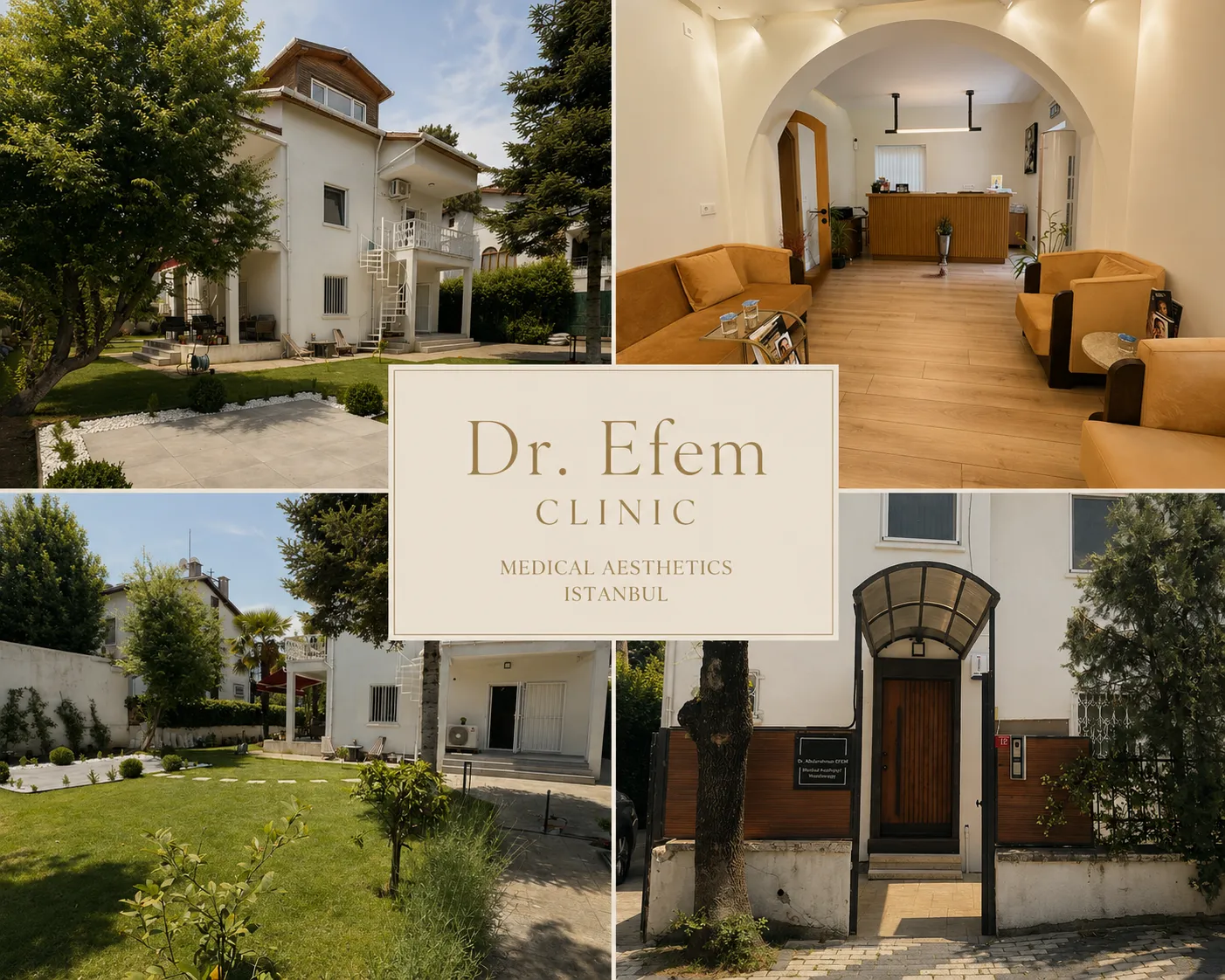
Efem Clinic welcomes patients in a premium villa clinic with a garden and parking in Levent, Istanbul. Consultations are conducted with privacy, personal communication and an unhurried medical assessment.
The capabilities, treatment process, recovery, risks and realistic outcomes of jawline filler and Endolift are explained before treatment.
The aim is not to create the same jawline in every patient, but to develop a natural lower-face plan suited to individual facial proportions.
What Is a Realistic Result?
In a suitable patient, jawline filler may reduce interruptions along the mandibular border, support the mandibular angle and create more balanced lower-face proportions.
In a suitable patient, Endolift may support reduced laxity around the jawline, improvement in early jowls and a more balanced chin-to-neck transition.
No treatment creates a dramatically sharp jawline in every patient. Bone structure, skin thickness, fat distribution and the degree of ageing remain important.
Before-and-after photographs should be compared using the same lighting, angle, camera distance and facial position.
Explore the Before-and-After GalleryEfem Note
Statements such as “jawline filler defines every jawline” or “Endolift always looks more natural than filler” are inaccurate.
Filler adds missing support. Endolift aims to contract lax tissue. They do not address the same problem in the same way.
The correct jawline treatment is not the one that uses more filler or more energy, but the one that addresses the source of the concern with the least necessary intervention.
Related Treatments and Guides
Frequently Asked Questions
Which is more effective, jawline filler or Endolift?
Jawline filler may be more appropriate for structural deficiency and limited projection. Endolift may be more suitable for subdermal laxity, early jowls and mild submental fullness.
Are jawline filler and Endolift the same?
No. Jawline filler adds volume and structural support. Endolift uses optical-fibre laser energy to support tissue contraction and collagen remodelling.
Which gives faster results?
Jawline filler produces an earlier visible contour change. Endolift results generally develop over weeks and months.
Which is better for a double chin?
Filler does not reduce double-chin fat but may improve chin projection. Endolift may be considered when mild fat and laxity occur together.
Which is better for jowls?
Conservative filler may help when pre-jowl hollowing exaggerates the jowl. Endolift may be more appropriate when true laxity and soft-tissue heaviness are present.
Can jawline filler make the face wider?
Excessive filler or placement at unsuitable points may make the lower face look wider or heavier. Conservative planning is important.
Can Endolift make the face hollow?
The aim is not to create hollowing. Unnecessary fat targeting in a thin face may cause unwanted volume loss.
Can jawline filler be dissolved?
Hyaluronic-acid filler may be dissolved with hyaluronidase when medically appropriate. Other filler materials cannot necessarily be dissolved in the same way.
Can Endolift be reversed?
The biological tissue effect created by Endolift cannot be dissolved or immediately reversed. Conservative energy planning is therefore important.
Which is more suitable for a thin face?
Conservative filler may be more suitable when structural support is limited. Endolift should be used cautiously and only where genuine laxity is present.
Which is more suitable for a full lower face?
Endolift may be considered when soft-tissue heaviness and laxity are present. Limited filler may still be useful if structural support is also deficient.
Which has a shorter recovery?
Jawline filler generally has a shorter social recovery. Swelling, bruising and firmness may last longer after Endolift.
Which is more painful?
Filler may involve pressure and treatment-point discomfort. Endolift may involve warmth and movement of the optical fibre. Comfort varies between patients.
How many millilitres of jawline filler are needed?
There is no fixed amount. Product quantity depends on bone structure, chin projection, mandibular angle and the pre-jowl area.
How many Endolift sessions are needed?
Endolift is usually planned as one main session. Future treatment depends on tissue response and ongoing ageing.
Does jawline filler reduce fat?
No. Jawline filler adds structural support and volume; it does not reduce fat.
Does Endolift reduce fat?
Limited contouring may be considered in suitable small localised areas. Endolift does not replace liposuction.
Can jawline filler and Endolift be combined?
They may be planned to address different tissue layers in selected patients. Treatment sequence and timing should be determined by the physician.
Which lasts longer?
Neither is universally longer-lasting. Filler duration depends on product and metabolism, while Endolift depends on biological tissue response.
Is jawline filler safe?
Jawline filler has common and rare serious risks. Safety depends on product choice, anatomical knowledge, treatment technique and physician experience.
Is Endolift safe?
Appropriate patient selection, correct fibre depth and controlled energy planning are important. Possible risks include swelling, burns, asymmetry and unwanted fat loss.
Which costs more?
Jawline-filler cost depends on the product and amount used. Endolift cost depends on treatment area, fibre planning and procedure extent.
Deciding Between Jawline Filler and Endolift?
The first step is to determine whether limited jawline definition is caused by weak bony support, reduced chin projection, pre-jowl hollowing, subdermal laxity or double-chin fullness. You may send photographs for an initial review or arrange an in-person consultation with Dr. Abdurrahman Efem at Efem Clinic in Levent, Istanbul.
Request a Free Initial Assessment Contact Efem Clinic Learn About Dr. EfemThis content is provided for general educational purposes and does not replace an individual medical consultation. Suitability, filler material, product quantity, fibre planning, recovery, risks and results vary between patients.
About Dr. Abdurrahman Efem

Dr. Abdurrahman Efem
Dr. Abdurrahman Efem is a medical aesthetic physician specializing in facial rejuvenation, non-surgical aesthetic treatments, and regenerative medicine. His approach focuses on enhancing natural beauty through personalized treatment plans designed around each patient's unique features and goals. Dr. Efem works with both local and international patients, emphasizing balanced, natural-looking results and long-term aesthetic wellbeing. This content has been prepared or medically reviewed by Dr. Abdurrahman Efem to ensure accuracy and relevance.