


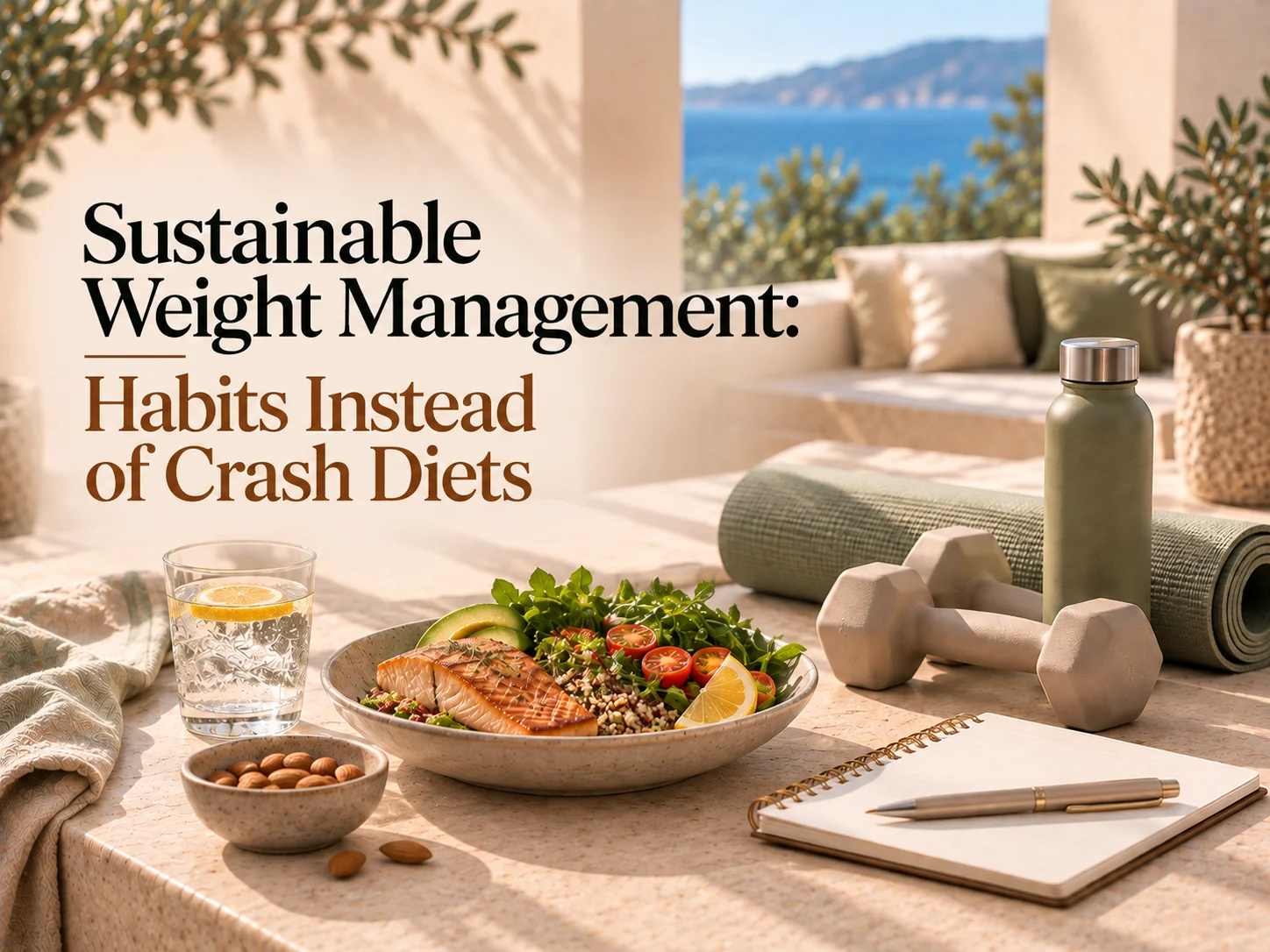
Sustainable Weight Management: Habits Instead of Crash Diets
NUTRITION • HABITS • LIFESTYLE
Sustainable Weight Management: Building Habits That Can Last
Sustainable weight management is not about following the strictest possible diet for a few weeks. It is about developing an approach to nutrition and daily life that is realistic enough to continue beyond the initial period of motivation.
For some people, the goal may include losing weight. For others, maintaining weight, improving eating consistency or working toward a different body-composition goal may be more relevant. The starting point is understanding the individual rather than imposing the same target on everyone.
QUICK ANSWER
What Does Sustainable Weight Management Mean?
Sustainable weight management means approaching nutrition, eating habits and lifestyle in a way that can realistically be maintained over time. It does not require perfect eating, extreme restriction or a continuously falling number on the scale.
The appropriate goal differs between individuals. Depending on the starting point and priorities, it may involve weight loss, weight maintenance, changes in body composition or establishing a more consistent eating pattern.
A useful plan should therefore be structured enough to provide direction but flexible enough to function within work, travel, family life, social occasions and ordinary day-to-day changes.
Why Quick-Fix Diets Can Be Difficult to Sustain
Highly restrictive or “crash” diets can create a simple set of rules: eat this, avoid that, follow the plan for a defined period. The difficulty is that short-term compliance does not necessarily translate into a practical long-term eating pattern.
A plan may become difficult to maintain when it leaves little room for work schedules, eating out, travel, cultural preferences, social events or ordinary fluctuations in appetite and routine. Once the strict phase ends, the person may be left without a workable structure for everyday life.
Sustainability therefore asks a different question. Instead of only asking whether someone can follow a plan today, it asks whether the core habits can still make sense months later.
More Restriction Does Not Automatically Mean a Better Plan
A nutrition plan should not be judged simply by how many foods it removes or how difficult it is to follow. Restriction is not a measure of quality.
For some people, a clear structure can be useful. But structure and extreme restriction are not the same thing. A practical approach can establish boundaries, meal patterns and priorities without turning ordinary eating into a constant test of willpower.
The aim is not to create the hardest possible diet. It is to develop an approach that supports the individual's goal while remaining workable in real life.
What Can Support Sustainable Weight Management?
A Realistic Eating Pattern
The plan should reflect how the person actually eats and lives rather than depending on an ideal routine that rarely exists outside the consultation room.
Practical Meal Planning
Thinking ahead about meals, busy workdays, eating out and travel can make nutrition decisions easier to repeat consistently.
Appropriate Nutrition Priorities
Protein, fibre, hydration and overall meal structure can be considered within the person's wider eating pattern rather than promoted as isolated solutions.
Lifestyle Context
Sleep, stress, appetite, working patterns and social routines can influence how realistic a nutrition strategy feels from one day to the next.
You Do Not Need a “Perfect” Diet to Make Progress
An all-or-nothing approach can make one unplanned meal, weekend or social event feel as though the entire process has failed. Sustainable weight management takes a broader view.
What happens repeatedly over time generally provides more useful information than one isolated meal. A plan that allows a person to return to their usual structure after normal variations in routine may be more practical than one that depends on uninterrupted perfection.
Consistency does not mean doing exactly the same thing every day. It means having a framework that remains recognisable and useful even when circumstances change.
The Scale Is Useful, but It Is Not the Whole Story
Body weight can be a useful way to follow a general trend, but the scale does not explain what that weight consists of. It cannot independently distinguish changes in fat and muscle or describe the person's overall body composition.
For this reason, a weight-management plan does not need to treat every short-term movement on the scale as a verdict on progress. The broader picture may include body composition, eating consistency, lifestyle and whether the approach remains practical.
The question of weight versus body composition is therefore not about choosing one number and ignoring the other. It is about understanding what each measurement can—and cannot—tell you.
Why Weight-Management Plans Should Be Individualised
People do not begin with the same eating habits, schedules, preferences, goals or challenges. A strategy that feels manageable for one person may be unnecessarily restrictive or impractical for another.
Individualisation means considering the person's current routine before deciding what should change. It also means avoiding predetermined promises about exactly how much weight someone will lose or how quickly that change will occur.
The purpose is to build a plan around a realistic objective rather than forcing the individual to fit a standardised diet template.
What If Progress Is Not Linear?
Weight management does not always follow a smooth downward line. Daily and short-term changes can occur, and a period with little movement on the scale does not automatically explain what is happening with eating habits, body composition or the wider process.
Instead of reacting to every fluctuation by making the plan increasingly restrictive, it may be more useful to review the overall pattern: Is the strategy still being followed? Is it practical? Have routines changed? Is the original goal still appropriate?
A sustainable approach leaves room to review and adapt the plan rather than treating every deviation from expectation as failure.
THE EFEM METHOD™
Define the Goal Before Choosing the Strategy
The Efem Method™ places emphasis on identifying the actual concern before choosing an intervention. The same principle helps separate nutrition and weight-management goals from local aesthetic body concerns.
Overall body weight, body composition, localised fat, skin laxity, muscle or abdominal-wall factors and true excess skin are not interchangeable issues. Trying to solve all of them through a single approach can create unrealistic expectations.
Nutrition and lifestyle planning may be central when the goal involves overall weight or eating habits. A specific local tissue concern may require a different type of assessment.
Weight Management Is Not Body Contouring
It is possible to work on nutrition and weight management while also having a separate aesthetic concern involving localised fat, skin laxity or body contour. These goals should not be confused.
Non-surgical body treatments are not substitutes for sustainable nutrition and are not weight-loss methods. Where appropriate, they are considered for selected local aesthetic concerns rather than overall weight reduction.
If your main concern is a local body issue rather than general weight management, Efem Clinic's Body Treatments section explains the aesthetic treatment category separately.
When Can Dietitian Support Be Useful?
Dietitian support may be useful when someone wants help translating broad nutrition principles into a plan that fits their actual routine, preferences and goals. It can also provide structure when repeated attempts at highly restrictive eating have proved difficult to maintain.
The purpose is not to promise a fixed amount of weight loss within a fixed period. Instead, the focus can be placed on understanding the starting point, defining realistic priorities and building an approach that can be reviewed over time.
Where weight changes or nutrition concerns are associated with a medical condition, symptoms, medication or disease-specific dietary needs, appropriate medical assessment may also be necessary.
Nutrition and Weight-Management Support in Istanbul
People in Istanbul and international patients already planning contact with Efem Clinic can ask the clinic about the current scope and availability of Nutrition & Lifestyle support.
If you are contacting the clinic from abroad, it can be helpful to explain your main goal clearly—whether it relates to weight management, eating habits, body composition or a separate aesthetic body concern—so that the appropriate type of assessment can be clarified.
Ask the International Team
Nutrition & Lifestyle at Efem Clinic
Efem Clinic is located in Levent, Istanbul. Its Nutrition & Lifestyle content framework separates sustainable weight management from local aesthetic body concerns while recognising that both topics may sometimes form part of a person's broader goals.
For more information about the clinic, visit About Efem Clinic. To ask about the current scope of Nutrition & Lifestyle support, contact Efem Clinic.
Related Efem Clinic Resources
FREQUENTLY ASKED QUESTIONS
Sustainable Weight Management FAQ
What is sustainable weight management?
It is an approach to nutrition, habits and lifestyle that aims to remain practical over time rather than depending on a short period of extreme restriction or perfect adherence.
Does sustainable weight management always mean losing weight?
No. Depending on the individual, the goal may involve weight loss, weight maintenance, body-composition goals or establishing a more consistent eating pattern.
Why can crash diets be difficult to maintain?
Very restrictive plans may be difficult to integrate with work, social life, travel, preferences and changing routines. Short-term adherence does not necessarily create a practical long-term eating pattern.
Do I need to eat perfectly to manage my weight?
No. Sustainable planning does not require uninterrupted perfection. A useful approach should allow normal variations in routine while providing a structure that can be returned to consistently.
Is the number on the scale the only way to measure progress?
No. Weight can provide useful information, but body composition, eating consistency, lifestyle and whether the plan remains practical may also be relevant depending on the individual's goal.
Are non-surgical body treatments a weight-loss method?
No. Non-surgical body treatments may be considered for selected local aesthetic concerns, but they are not substitutes for nutrition-based weight management.
Can a dietitian guarantee how much weight I will lose?
A responsible weight-management approach should not guarantee a fixed amount of weight loss within a fixed period. Goals, starting points, routines and individual responses differ.
Looking for a Weight-Management Approach You Can Actually Maintain?
Sustainable weight management begins with understanding your current eating pattern, lifestyle and actual goal rather than simply choosing a more restrictive diet. Contact Efem Clinic for current information about Nutrition & Lifestyle support.
Weight-management needs and responses vary between individuals. General online information does not replace individual dietetic or medical assessment where appropriate.
About Dr. Abdurrahman Efem

Dr. Abdurrahman Efem
Dr. Abdurrahman Efem is a medical aesthetic physician specializing in facial rejuvenation, non-surgical aesthetic treatments, and regenerative medicine. His approach focuses on enhancing natural beauty through personalized treatment plans designed around each patient's unique features and goals. Dr. Efem works with both local and international patients, emphasizing balanced, natural-looking results and long-term aesthetic wellbeing. This content has been prepared or medically reviewed by Dr. Abdurrahman Efem to ensure accuracy and relevance.