
Endolift vs Liposuction
Minimally Invasive Laser vs Surgical Fat Removal
Endolift vs Liposuction: Differences, Benefits and Which May Be More Suitable
Endolift and liposuction may both be considered for localised fat and body contour concerns, but they differ substantially in treatment method, fat-removal capacity, skin-tightening potential, anaesthesia requirements and recovery.
Endolift may be considered for small, selected areas where limited fat contouring and tissue tightening are required together. Liposuction generally offers more powerful and predictable fat removal when the volume of localised fat is greater.
Send Your Photos on WhatsApp Explore Endolift Request a Medical AssessmentFor an initial review, you may send clear front, profile and angled photographs of the area you wish to treat. Final suitability is determined during an in-person medical consultation.
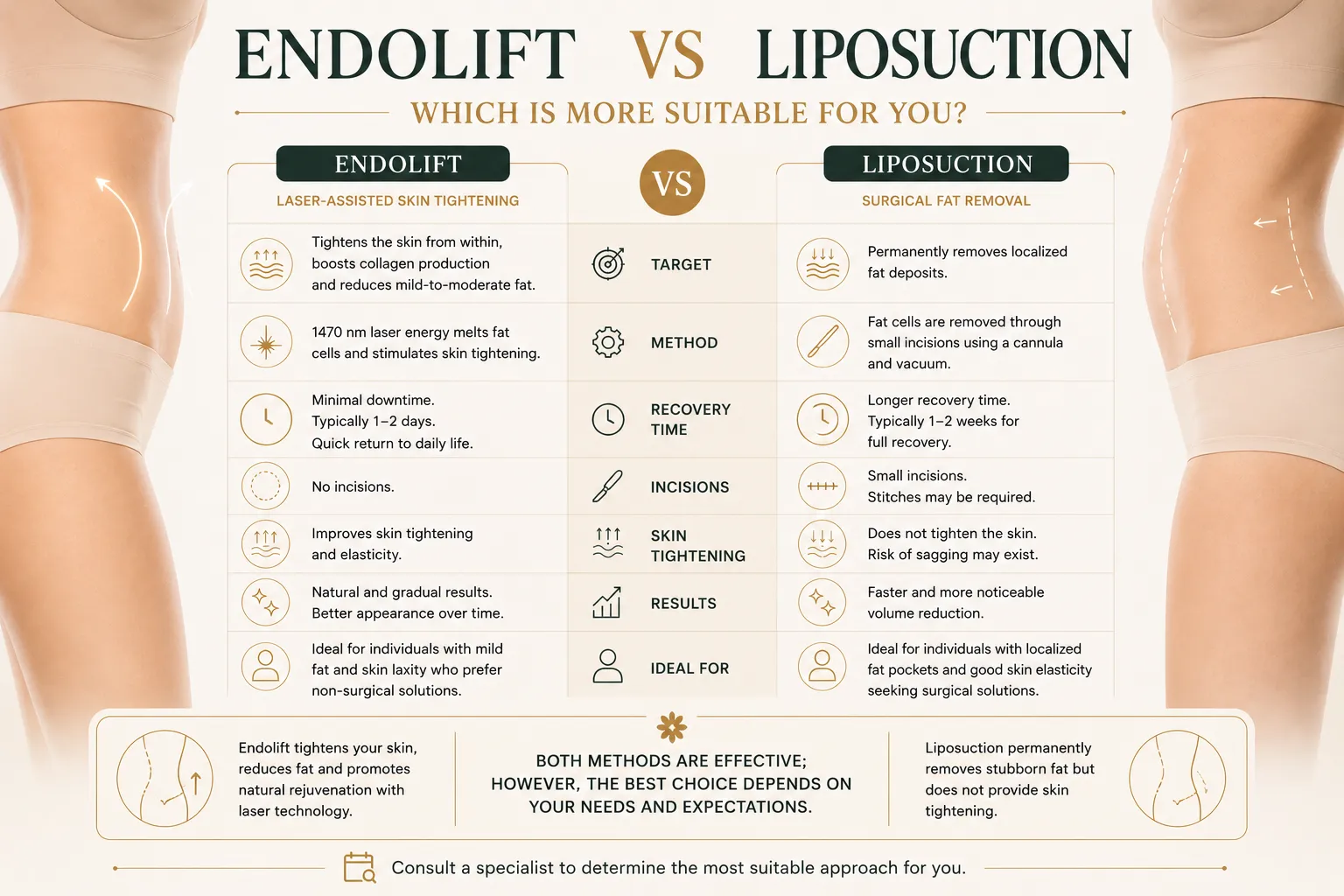
A minimally invasive laser treatment performed beneath the skin with a thin optical fibre.
A surgical procedure that physically removes fat through a cannula and suction.
Endolift prioritises tightening and limited contouring; liposuction prioritises stronger fat reduction.
The correct option depends on fat volume, skin quality, treatment area and expected change.
The Essential Answer: Endolift or Liposuction?
Endolift may be considered when a small, localised fat deposit is accompanied by mild-to-moderate skin laxity. Liposuction is generally more appropriate when a larger amount of fat needs to be physically removed.
Endolift delivers 1470 nm laser energy beneath the skin through a thin optical fibre. The aim is to create controlled thermal effects, support collagen remodelling, improve tissue firmness and provide limited contour refinement in suitable areas.
Liposuction removes subcutaneous fat through small incisions using a cannula and suction. Its fat-removal capacity is considerably greater than that of Endolift.
Endolift is not a non-surgical equivalent of liposuction. Liposuction also does not automatically tighten loose skin sufficiently. Some patients primarily need fat reduction, some need tightening and others require a carefully balanced combination of both.
What Is Endolift?
Endolift is a minimally invasive laser procedure in which a very thin optical fibre is guided through pre-planned subdermal tissue layers.
The 1470 nm laser wavelength is intended to create a controlled thermal response in water- and fat-containing tissues. This may support connective-tissue contraction, progressive collagen remodelling and limited fat contouring in selected patients.
It may be considered for areas such as the face, jawline, jowls, double chin, neck, arms, abdomen, back and inner thighs. As the treatment area and fat thickness increase, the capacity of Endolift alone becomes more limited.
For more information, see the Endolift treatment page, how Endolift works and who may be a good candidate for Endolift.
What Is Liposuction?
Liposuction is a surgical body-contouring procedure in which subcutaneous fat is physically removed through small incisions using thin cannulas and negative pressure.
It may be performed on the abdomen, waist, flanks, hips, back, arms, thighs, knees, neck and double chin. The surgical technique varies according to the treatment area, fat volume, skin quality and the surgeon’s plan.
Liposuction is not a weight-loss treatment. Its purpose is to improve body proportions by reducing localised fat deposits that remain despite weight management, diet and exercise.
Because it is surgery, liposuction requires plastic-surgery assessment, an appropriate anaesthetic plan, an operating environment, compression garments and a more structured recovery period.
Main Differences Between Endolift and Liposuction
| Comparison | Endolift | Liposuction |
|---|---|---|
| Procedure type | Minimally invasive laser treatment | Surgical fat-removal procedure |
| Technology | 1470 nm laser and thin optical fibre | Cannula, suction and surgical contouring |
| Primary aim | Tissue tightening, collagen support and limited fat contouring | Removal of a more substantial volume of localised fat |
| Fat-removal capacity | Limited to small, selected fat areas | Higher capacity in broader or thicker fat deposits |
| Skin-tightening aim | One of the central treatment goals | Variable and dependent on skin quality and surgical technique |
| Anaesthesia | Local comfort or anaesthetic planning according to the area | Local anaesthesia, sedation or general anaesthesia may be required |
| Entry points | Very small fibre-entry points | Small surgical incisions for cannula access |
| Recovery | Generally shorter; swelling, bruising and tenderness may occur | More structured; compression, swelling, bruising and activity restrictions may be required |
| Result development | Gradual as swelling settles and collagen remodelling develops | Fat is removed immediately, but final contour appears as swelling decreases |
| Practitioner | A physician trained and experienced in Endolift | A qualified plastic, reconstructive and aesthetic surgeon |
Who May Be More Suitable for Endolift?
Small Localised Fat Deposit
It may be considered when the fat volume is limited and surgical high-volume removal is unnecessary.
Fat with Mild Laxity
Contour refinement and tightening may be planned together when mild fat is accompanied by skin laxity.
Smaller Treatment Area
Areas such as the double chin, jawline, inner arms or a limited abdominal zone may be considered.
Shorter Recovery Priority
It may suit patients who want to avoid surgical recovery but accept a minimally invasive procedure.
Subtle and Gradual Change
It may be appropriate for patients seeking measured contour improvement rather than dramatic fat reduction.
Anatomy That Does Not Require Liposuction
It may be considered when the fat volume does not justify surgical removal.
For body-specific information, see Endolift for the abdomen, Endolift for the inner thighs, Endolift for the arms and Endolift for the back.
Who May Be More Suitable for Liposuction?
- People with clear localised fat deposits that remain despite diet and exercise
- Patients with broad areas that exceed the limited contouring capacity of Endolift
- Those seeking stronger volume reduction in the abdomen, waist, flanks, back or thighs
- Patients whose weight is relatively stable
- People who accept surgery, anaesthesia and a structured recovery period
- Patients able to wear compression garments and follow activity restrictions
- People with realistic expectations
- Patients considered suitable after plastic-surgery assessment
Liposuction is not a treatment for obesity or general weight loss. When skin elasticity is poor, loose skin may become more visible after fat removal and additional skin-removal or tightening procedures may need to be considered.
When May Endolift Make More Sense?
- Mild double-chin fullness with skin laxity
- Small jowls and lower-face heaviness
- Limited arm fat with mild skin looseness
- A small contour irregularity on the abdomen or inner thighs
- Mild tissue laxity after weight loss or pregnancy
- A need for collagen support together with measured fat contouring
- Small treatment areas that do not require surgical liposuction
The principal advantage of Endolift is not high-volume fat removal. It is the ability to target tissue firmness and limited contouring within the same minimally invasive plan.
When May Liposuction Make More Sense?
- Clear abdominal and waist fat deposits
- Higher-volume fat around the flanks, hips or thighs
- Broader fat deposits across the back and bra line
- Arm fat that exceeds the realistic capacity of Endolift
- A desire for more visible fat reduction
- Surgical contouring of several larger regions
- Situations in which fat must be physically removed
A greater fat-removal capacity does not automatically mean a better aesthetic outcome. Skin quality, contour transitions, muscle structure and overall body proportions must be planned together.
How Do Endolift and Liposuction Work?
Endolift Mechanism
- The thin optical fibre is guided through a selected subdermal plane
- Controlled 1470 nm laser energy is delivered
- Thermal contraction of connective tissue is targeted
- Collagen remodelling continues over time
- Limited contouring may be performed in suitable small fat areas
Liposuction Mechanism
- Small surgical access points are created
- A thin cannula is guided through the subcutaneous fat layer
- Fat is removed through controlled suction
- The region is sculpted according to body proportions
- The tissues gradually adapt to the new contour during recovery
How Does the Treatment Process Work?
Body and Tissue Assessment
Fat thickness, skin elasticity, laxity, stretch marks, muscle structure, asymmetry and overall body proportions are assessed.
Identification of the Main Concern
The doctor determines whether the primary need is fat reduction, skin tightening, treatment of muscle separation, removal of excess skin or combined contouring.
Selection of the Method
Endolift may be considered when limited laser contouring is sufficient. Plastic-surgery assessment is more appropriate when higher-volume fat removal is required.
Personalised Mapping
For Endolift, fibre pathways and areas to protect are marked. For liposuction, fat-removal zones, contour transitions and surgical entry points are planned.
Treatment
The selected procedure is performed with attention to anatomy, symmetry, safety and natural body proportions.
Recovery and Review
Swelling, bruising, tissue adaptation, contour transitions and result development are reviewed at appropriate intervals.
Which Treatment Is More Painful?
During Endolift, patients may feel warmth, pressure, pulling or movement of the fibre beneath the skin. The comfort or anaesthetic approach is selected according to the treatment area and extent.
Liposuction is performed under an appropriate form of anaesthesia. After surgery, pain, tenderness, burning, tightness and muscle-like soreness may occur.
Postoperative discomfort is generally more noticeable after liposuction because of the larger treatment area, surgical tissue trauma and compression garments.
Pain varies according to personal sensitivity, the treatment area, the amount of fat removed, the technique used and the individual healing response. For Endolift, see is Endolift painful?
Recovery Time and Return to Daily Life
After Endolift
- Swelling and oedema
- Bruising
- Tenderness to touch
- A feeling of tightness or firmness
- Temporary numbness
- Several quieter days depending on the area
- Gradual collagen development
After Liposuction
- More noticeable swelling and bruising
- Pain and movement sensitivity
- Compression-garment use
- Temporary numbness and firmness
- Incision care
- Exercise and heavy-activity restrictions
- Final contour development over several months
Liposuction recovery varies according to the size and number of areas treated. Smaller procedures may allow an earlier return to daily activities, while broader treatment requires more recovery time. For Endolift, see Endolift recovery time and the Endolift aftercare guide.
When Do Results Appear?
| Period | Endolift | Liposuction |
|---|---|---|
| First days | Early contraction may be visible, although swelling can affect the appearance | Fat has been removed, but swelling may hide the final contour |
| First weeks | Contour can be assessed more accurately as swelling settles | Volume reduction becomes clearer as swelling and bruising improve |
| First months | Collagen remodelling and tightening continue to develop | The final contour becomes clearer as tissues adapt |
For the Endolift timeline, see when Endolift results become visible.
Which Treatment Removes More Fat?
Liposuction has a substantially greater fat-removal capacity. Fat is physically aspirated and removed from the treatment area.
The fat-contouring effect of Endolift is more limited, targeted and localised. It should not be planned as an alternative to liposuction for thick fat layers or broad abdominal, waist and hip areas.
Endolift is more relevant when skin quality and tightening are important and the amount of fat is small.
Which Treatment Tightens Skin More?
One of the primary aims of Endolift is to create controlled thermal contraction and collagen remodelling within the connective tissue beneath the skin.
The main purpose of standard liposuction is fat removal. Younger and more elastic skin may adapt well after fat reduction, but liposuction alone may not provide sufficient tightening when elasticity is poor, stretch marks are extensive or loose skin is advanced.
Endolift may also be insufficient when the amount of excess skin is significant. Surgical procedures such as abdominoplasty, arm lift, thigh lift or neck lift may need to be considered.
The answer therefore depends not only on the procedure but also on skin elasticity and the amount of excess skin.
Endolift or Liposuction for the Abdomen?
Endolift may be considered when a small, limited abdominal fat deposit is accompanied by mild laxity.
Liposuction may provide a stronger contour change when the abdominal and waist fat layer is broader or thicker.
Neither method may be sufficient when there is post-pregnancy muscle separation, substantial loose skin or a significant lower-abdominal fold. Plastic-surgery assessment for abdominoplasty may be more appropriate.
For additional information, see Endolift for the abdomen and Endolift after pregnancy.
Endolift or Liposuction for a Double Chin?
Endolift may be considered when mild double-chin fat and skin laxity are present together, because tightening and contouring can be addressed within the same plan.
Liposuction may provide more powerful fat reduction when the submental fat layer is thicker or more pronounced. However, poor skin elasticity can make neck laxity more visible after fat removal.
A retruded chin, neck-muscle bands or advanced excess skin must also be considered.
For a more specific comparison, see Endolift vs liposuction for a double chin.
Which Is More Suitable for the Arms, Inner Thighs and Back?
Endolift may be considered when a small amount of fat is accompanied by mild laxity in the arms or inner thighs. Liposuction may offer stronger fat reduction when the treatment area is broad or the fat layer is thicker.
Endolift may provide measured contour support for smaller back or bra-line folds. Surgical liposuction may be more effective when several larger back areas are involved.
Neither Endolift nor liposuction physically removes substantial excess skin. Surgical lifting procedures may be required when loose skin is advanced.
Related guides include Endolift for the arms, Endolift for the inner thighs and Endolift for the back.
Are the Results Permanent?
Fat cells removed during liposuction are physically removed from the treatment area. However, the remaining fat cells can enlarge with future weight gain and the body contour can change again.
Endolift does not stop natural ageing or future weight changes. Collagen support and contour improvement can be affected by ageing, sun exposure and weight fluctuation.
Stable weight, balanced nutrition, regular physical activity, smoking avoidance and sun protection help preserve the results of both procedures.
For more information, see how long Endolift results last.
Side Effects and Risks
Possible Endolift Risks
- Swelling, bruising and tenderness
- Temporary numbness or altered sensation
- Burns or pigmentation changes
- Infection
- Asymmetry or contour irregularity
- Unwanted fat loss or hollowing
- Firmness or nodules
- An unsatisfactory result
Possible Liposuction Risks
- Anaesthetic complications
- Bleeding, haematoma or infection
- Seroma and fluid accumulation
- Contour irregularity and asymmetry
- Numbness or altered sensation
- Skin injury or delayed healing
- Blood clots and embolic complications
- A need for revision surgery
Because liposuction has a surgical risk profile, qualified plastic-surgeon assessment and an appropriate healthcare setting are essential. For Endolift, see Endolift side effects and is Endolift safe?
Who May Not Be Suitable?
- People with active infection or open wounds
- Patients with uncontrolled systemic disease
- People taking medication that affects bleeding or healing
- Pregnant or breastfeeding patients
- People with rapidly changing weight or general weight-loss expectations
- Patients with advanced excess skin or severe tissue sagging
- People with unrealistic expectations
- Patients not considered medically suitable for surgery or anaesthesia
Smoking can negatively affect circulation and healing. All medication, supplements, previous operations and earlier energy-based procedures should be disclosed to the treating doctor.
Can Endolift and Liposuction Be Combined?
In selected patients, liposuction may be used for fat reduction while laser or another energy-based treatment is considered for tissue tightening, either during the same treatment period or at a different time.
Whether Endolift and liposuction should be used in the same area depends on fat thickness, skin quality, treatment safety and coordinated planning between the relevant specialists.
Combining surgical trauma with additional energy does not automatically improve the result. The priority should be the minimum intervention capable of producing a sufficient and safe outcome.
When broad fat excess is accompanied by advanced loose skin, another surgical tightening procedure may be more appropriate than combining liposuction with Endolift.
Comparison with Other Body-Contouring Treatments
| Treatment | Primary Aim | Fat Reduction | Invasiveness |
|---|---|---|---|
| Endolift | Tightening and limited contour refinement | Small, localised areas | Minimally invasive |
| Liposuction | Surgical fat removal and sculpting | Higher capacity | Surgical |
| XERF RF | Non-invasive tissue heating and tightening | Not the primary aim | Non-invasive |
| Forma Body RF | Skin appearance and firmness support | Limited | Non-invasive |
| Surgical Lift | Removal of excess skin and tissue repositioning | May be combined with liposuction | Surgical |
For non-surgical body options, see body treatments, XERF vs Endolift for the body and Forma Body RF.
The Efem Method: Define the Need Before Choosing the Procedure
Within the Efem Method, the first question is not whether the patient wants Endolift or liposuction. The first question is what anatomical change is genuinely required.
A small area may require only measured laser contouring and tightening. Another patient may need surgical fat removal. In some cases, the real concern is not fat but excess skin, muscle separation or underlying structure.
The aim is to avoid both undertreatment with an inadequate result and overtreatment with unnecessary risk.
How Should Endolift and Liposuction Costs Be Compared?
The prices of the two procedures should not be compared directly because one is a minimally invasive laser treatment and the other is surgery.
Factors that may influence Endolift cost include:
- The number and size of treatment areas
- The extent of fibre pathways
- The degree of fat and laxity
- Procedure duration
- Medical planning and follow-up
Factors that may influence liposuction cost include:
- The number of surgical areas
- The extent and technique of surgery
- The type of anaesthesia
- Hospital and operating-theatre requirements
- Compression garments and follow-up
- Additional surgical procedures
An accurate cost comparison usually requires physical examination and a personalised treatment plan. For Endolift, see the Endolift cost guide and factors that affect Endolift cost.
Planning Treatment from Abroad
For international patients travelling to Istanbul, clear photographs may support an initial assessment. However, skin elasticity, fat thickness and muscle structure are assessed more accurately in person.
Travel planning after Endolift may be shorter for many patients, although swelling, bruising and the need for follow-up should still be considered.
Because liposuction is surgery, preoperative tests, an accompanying person, compression garments, wound review, thrombosis risk and flight timing require additional planning. Return travel should not be finalised without the surgeon’s approval.
The Efem Clinic team can provide general planning support for Endolift assessment and appropriate plastic-surgery referral when required.

Personalised Body-Contouring Assessment with Dr. Abdurrahman Efem
Dr. Abdurrahman Efem is a medical aesthetic physician and a Ministry-appointed trainer in medical aesthetics. He has experience in Endolift, Ultherapy, Morpheus8 and personalised face and body tightening plans.
When the fat volume or degree of loose skin exceeds the realistic capacity of Endolift, patients are not given an unrealistic expectation by being offered a limited laser procedure instead of surgical assessment.
Patients who may need surgery are referred for appropriate plastic-surgery evaluation. In smaller areas where Endolift may be sufficient, unnecessary surgery may be avoided.
Meet Dr. Efem Our Treatment Philosophy Efem in MediaA Privacy-Focused Villa Clinic in Levent
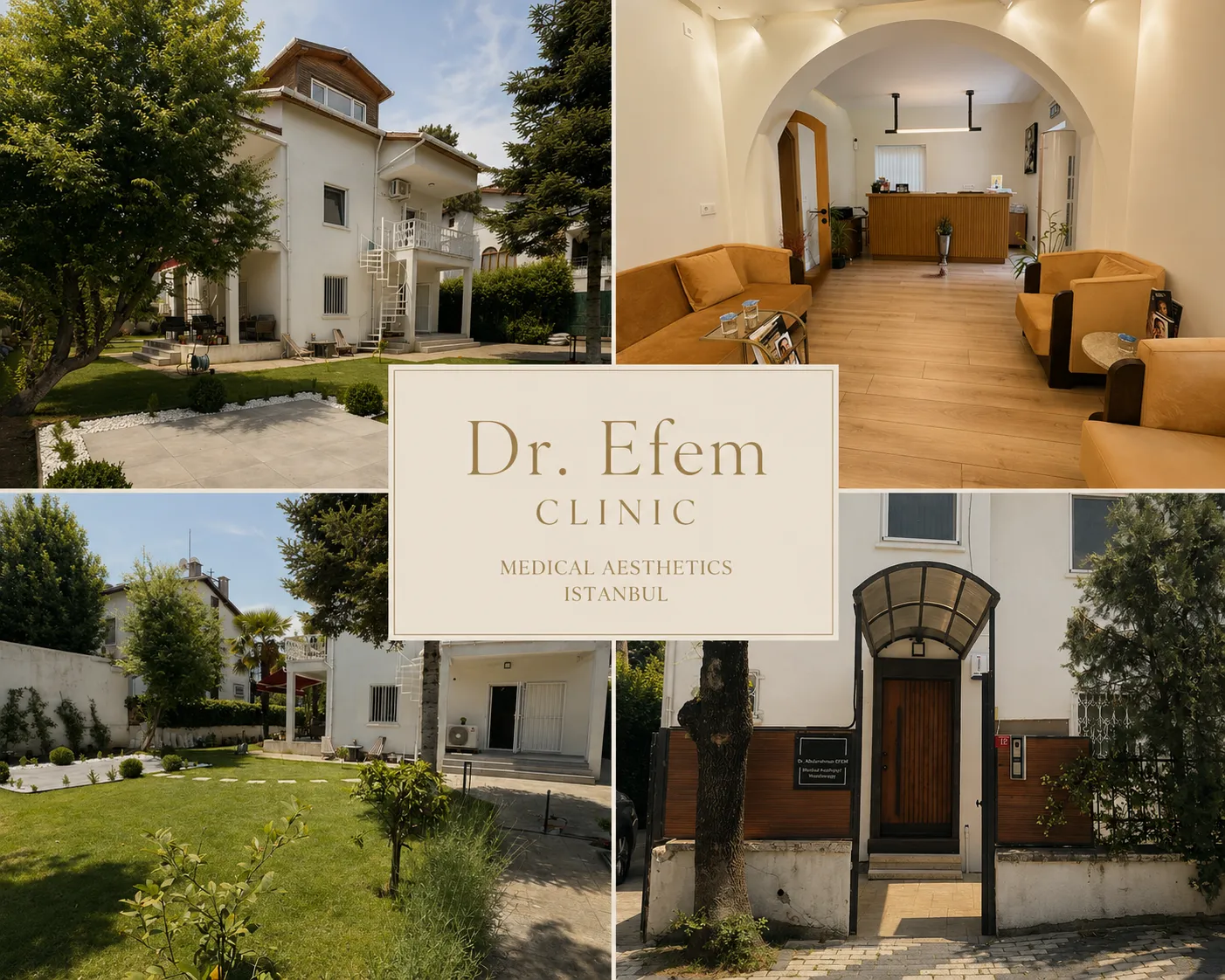
Efem Clinic welcomes patients in a premium villa clinic with a garden and parking in Levent, Istanbul. Assessments are centred on privacy, personal communication and unhurried medical discussion.
Before treatment, fat volume, skin quality, recovery, possible risks and realistic result strength are discussed in detail.
When Endolift is unsuitable or surgical treatment is required, these limitations are explained openly.
What Is a Realistic Result?
Endolift is intended to produce natural and measured improvement in small fat areas and mild laxity. A liposuction-level volume reduction should not be expected.
Liposuction can produce a stronger volume change, but it does not automatically correct excess skin, stretch marks, cellulite or muscle separation.
The degree of improvement depends on age, weight stability, skin elasticity, fat distribution, treatment extent and individual healing.
Before-and-after photographs should be compared under consistent lighting, angle, distance, posture and clothing conditions.
Explore the Before-and-After GalleryEfem Note
Describing Endolift as “non-surgical liposuction” is inaccurate. Its advantage is not high-volume fat removal, but the ability to combine measured contour refinement with tissue tightening in small and selected areas.
Liposuction is also not automatically the correct option simply because it is more powerful. Surgery may be unnecessary when fat volume is small and laxity is the main concern.
The correct procedure should be selected according to fat volume, skin quality and genuine anatomical need—not according to the treatment name preferred by the patient.
Related Treatments and Guides
Frequently Asked Questions
Which is more effective, Endolift or liposuction?
Liposuction is more powerful for fat reduction. Endolift may be more appropriate when a small fat deposit is accompanied by skin laxity.
Can Endolift replace liposuction?
It cannot replace liposuction for large or pronounced fat deposits. Endolift is considered for limited contouring and tightening in selected small areas.
Is Endolift non-surgical liposuction?
No. Liposuction physically removes fat through a cannula. Endolift uses an optical-fibre laser to target limited contouring and tissue tightening.
Which treatment removes more fat?
Liposuction can remove a larger amount of fat from broader areas. The fat-contouring effect of Endolift is more limited.
Which treatment tightens the skin more?
Endolift directly targets tightening and collagen remodelling. However, advanced excess skin may still require surgical removal.
Endolift or liposuction for the abdomen?
Endolift may suit a small fat deposit with mild laxity. Liposuction may be more suitable for a thicker or broader fat layer.
Endolift or liposuction for a double chin?
Endolift may be considered for mild fat with laxity. Liposuction may be more suitable when the fat layer is thicker or more pronounced.
Which procedure has a shorter recovery?
Endolift generally has a shorter recovery. Liposuction may require compression garments, more visible swelling and longer activity restrictions.
Which procedure is more painful?
Postoperative discomfort is generally more noticeable after liposuction. Pain varies according to the treatment area and individual sensitivity.
Does Endolift require general anaesthesia?
Most Endolift plans do not require general anaesthesia. Local comfort and anaesthetic planning depend on the treatment area.
Does liposuction require general anaesthesia?
Small areas may be treated under local anaesthesia or sedation. General anaesthesia may be required for broader procedures.
Does Endolift cause weight loss?
No. Endolift is not a weight-loss treatment. It is planned for limited local contouring and tightening.
Does liposuction cause weight loss?
Liposuction is not an obesity or general weight-loss treatment. Its purpose is to reshape selected areas by reducing localised fat.
Are the results permanent?
Both procedures are affected by weight change and ageing. Fat cells removed during liposuction do not return, but remaining cells can enlarge with weight gain.
Can Endolift and liposuction be combined?
They may be considered in selected patients, but the surgical and energy burden in the same area must be planned carefully.
Can the skin sag after liposuction?
If skin elasticity is poor, laxity may become more visible after fat removal. Skin quality and excess skin should be assessed before surgery.
Which procedure is safer?
Endolift and liposuction have different risk profiles. Safety depends on patient selection, practitioner expertise, treatment setting and procedure extent.
Which procedure costs more?
Cost varies according to treatment area, procedure extent, anaesthesia, operating-theatre requirements and additional procedures.
Deciding Between Endolift and Liposuction?
The first step is to assess fat volume, skin elasticity, laxity and the strength of change you expect. You may send photographs for an initial review or arrange an in-person consultation with Dr. Abdurrahman Efem at Efem Clinic in Levent, Istanbul.
Request a Free Initial Assessment Contact Efem Clinic Learn About Dr. EfemThis content is provided for general educational purposes and does not replace an individual medical consultation. Liposuction is a surgical procedure and should be assessed by a qualified plastic surgeon. Suitability, risk, recovery and outcome vary between patients.
About Dr. Abdurrahman Efem

Dr. Abdurrahman Efem
Dr. Abdurrahman Efem is a medical aesthetic physician specializing in facial rejuvenation, non-surgical aesthetic treatments, and regenerative medicine. His approach focuses on enhancing natural beauty through personalized treatment plans designed around each patient's unique features and goals. Dr. Efem works with both local and international patients, emphasizing balanced, natural-looking results and long-term aesthetic wellbeing. This content has been prepared or medically reviewed by Dr. Abdurrahman Efem to ensure accuracy and relevance.