


Ultherapy For Neck
Neck Laxity, Submental Area and Non-Surgical Lifting Guide
Ultherapy for the Neck: Is Non-Surgical Neck Tightening Possible?
Ultherapy is a non-invasive microfocused ultrasound treatment that may be used in suitable patients to support lax tissue beneath the chin and in the neck. The ULTHERA System has FDA clearance for lifting lax tissue on the neck and under the chin.
The most important part of neck Ultherapy planning is determining whether the visible concern is genuinely skin and soft-tissue laxity, or whether submental fat, platysmal bands, advanced skin excess or limited chin and jawline support are contributing more significantly.
Request a Photo Assessment Explore Ultherapy Neck Tightening GuideNeck treatment should not be planned from the front view alone. Profile, chin-neck angle, jawline, submental tissue and dynamic neck anatomy should be assessed together.
Cleared for lifting lax tissue on the neck and under the chin.
No surgical incision or surgical repositioning of neck tissues.
The appearance develops over time through collagen remodelling.
Advanced skin excess or pronounced platysmal bands may require a different approach.
Quick Answer: Can Ultherapy Tighten the Neck?
In suitable patients, Ultherapy may help improve the appearance of mild-to-moderate neck laxity and support a firmer-looking neck contour.
Ultherapy delivers microfocused ultrasound energy to selected tissue levels and uses real-time ultrasound imaging. Its effects develop gradually as collagen remodelling continues after treatment.
Ultherapy does not cut away excess neck skin, physically remove significant submental fat like liposuction or provide the same degree of tissue repositioning as surgical neck lifting.
For this reason, choosing the right candidate is just as important as choosing the device.
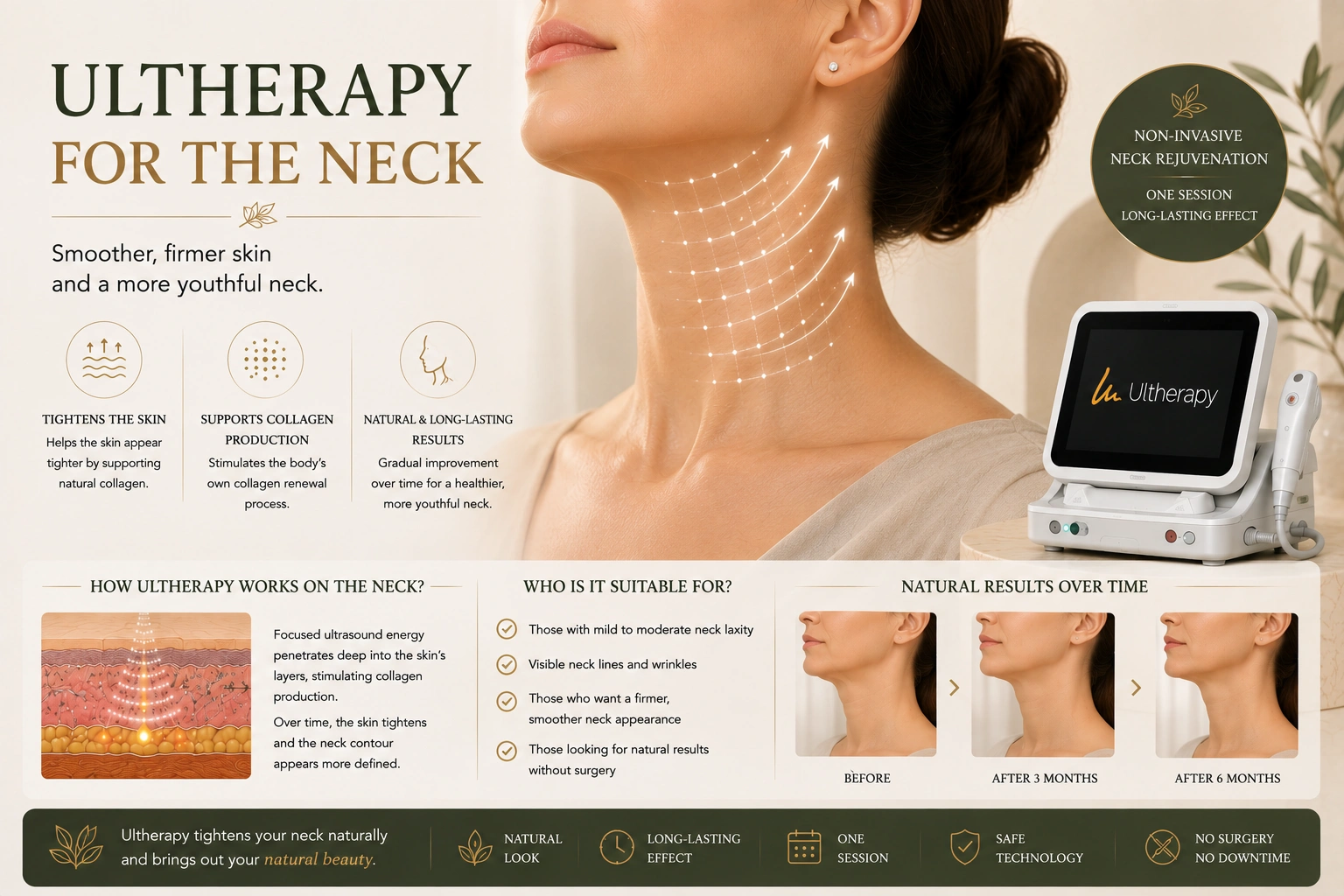
How Does Ultherapy Work on the Neck?
Ultherapy uses microfocused ultrasound technology. Real-time ultrasound imaging helps the doctor visualise selected tissue levels during treatment.
Controlled energy points are delivered to selected tissue depths. The aim is not to resurface the skin or add volume to the neck, but to support the tissue's natural remodelling process.
Ultherapy therefore:
- Does not penetrate the skin surface with microneedles.
- Does not add volume like filler.
- Does not aspirate submental fat like liposuction.
- Does not surgically remove excess neck skin.
- Aims for a gradual tissue response.
For a broader overview of the technology, see Ultherapy Istanbul: Non-Surgical Face and Neck Lift.
Is Every Ageing or Loose-Looking Neck Caused by the Same Problem?
No. Neck appearance can change because several anatomical structures are involved.
| Problem | How It Affects Appearance | Possible Role of Ultherapy |
|---|---|---|
| Mild-to-moderate tissue laxity | The neck contour may look softer and less supported. | May be one of the more relevant indications in suitable patients. |
| Submental fat | Can obscure the chin-neck angle. | Ultherapy is not a fat-removal procedure; fat volume should be assessed separately. |
| Platysmal bands | Vertical neck bands may become more visible. | Pronounced muscle bands may not respond sufficiently to Ultherapy alone. |
| Advanced skin excess | Loose or folding skin may become more visible. | Non-invasive treatment potential may be limited; surgical assessment may be more appropriate. |
| Limited chin or jawline support | The neck can appear shorter and the submental area fuller. | Ultherapy does not create skeletal projection. |
The same complaint — “my neck is sagging” — can therefore require completely different treatment plans in two different patients.
Who May Be Suitable for Neck Ultherapy?
Selected patients without advanced surgical-level skin excess.
People with early or moderate loss of support around the neck contour.
Patients with suitable anatomy who wish to avoid surgery.
Patients seeking measured tightening rather than dramatic structural change.
When May Neck Ultherapy Be Insufficient?
Understanding the limits of Ultherapy is as important as identifying good candidates.
Different or additional approaches may be more appropriate when there is:
- Advanced excess skin
- Pronounced neck sagging
- Prominent platysmal bands
- Submental fat as the dominant concern
- Markedly limited chin projection
- An expectation of surgical neck-lift-level change
More energy or more Ultherapy sessions do not turn the wrong indication into the right one.
Does Ultherapy Remove a Double Chin?
It is not accurate to describe Ultherapy as a direct “double-chin melting” procedure or as an alternative to liposuction.
A fuller submental appearance may be influenced by:
- Fat tissue
- Skin laxity
- Chin projection
- Jawline structure
- Neck muscles
- Genetic anatomy
If laxity is the dominant concern, Ultherapy may be considered. If fat is the dominant concern, treatments that specifically address fat may be more relevant.
For more detail on lower-face contouring, see Double Chin and Jawline Contouring.
Does Ultherapy Remove Neck Lines?
Not all neck lines have the same cause.
Horizontal neck lines can be present even in younger patients and may relate to natural anatomy, movement, skin structure and age-related change.
Ultherapy primarily focuses on lifting and supporting lax tissue. It should therefore not be presented as a treatment that completely erases every horizontal neck line.
Lines, skin quality and laxity should be assessed separately, and different treatments may be needed for different concerns.
Does Ultherapy Treat Platysmal Bands?
The platysma is a superficial muscle that plays an important role in neck appearance. Vertical bands may become more visible with ageing or muscle activity.
Pronounced platysmal bands are not simply the same problem as loose skin. When banding is significant, Ultherapy alone may not provide the desired result.
The neck should therefore be assessed both at rest and dynamically while the neck muscles are activated.
Can Ultherapy Treat the Jawline and Neck Together?
The lower face, jawline, submental area and neck are visually interconnected. In some patients, planning only the neck may be less balanced than assessing the entire lower-face-to-neck transition.
For example:
- Jawline laxity
- Jowl formation
- Submental laxity
- Neck laxity
may coexist.
The skeletal-support and fat-related components of jawline appearance should still be assessed separately.
How Many Ultherapy Sessions Are Needed for the Neck?
Suitable patients may begin with one comprehensive Ultherapy treatment. It is not a procedure that automatically requires three or four sessions for everyone.
After the initial treatment:
- The tissue is given time to remodel.
- The neck and submental area can be photographed again.
- Remaining laxity is reassessed.
- The need for another treatment is considered individually.
For more on session planning, see How Many Ultherapy Sessions Do You Need? and Is One Ultherapy Session Enough?.
When Will Neck Ultherapy Results Appear?
Ultherapy should not be judged only by the appearance immediately after treatment.
| Period | Assessment |
|---|---|
| First days | Redness, mild swelling or tenderness may influence appearance. |
| First weeks | Remodelling continues and it is still early for final assessment. |
| Around 2–3 months | Comparison with baseline photographs may become more meaningful. |
| Later follow-up | Individual tissue response and ongoing ageing changes can be reviewed. |
For result-assessment principles, see Ultherapy Before and After.
Are Neck Ultherapy Results Permanent?
Ultherapy does not stop the ageing process. The tissue response achieved after treatment can change over time as ageing continues.
Duration may be influenced by:
- Age
- Baseline degree of laxity
- Tissue quality
- Individual collagen response
- New age-related changes over time
Rather than promising that results are permanent or that every patient must repeat treatment annually, future treatment should be based on current tissue needs.
Is Neck Ultherapy Painful?
Some patients may experience warmth, tingling or brief deeper tenderness at treatment points.
Discomfort can vary according to:
- Treatment area
- Anatomical structure
- Treatment plan
- Individual sensitivity
It would not be accurate to describe Ultherapy as completely painless for every patient.
What Is Recovery Like After Neck Ultherapy?
Ultherapy does not require surgical incisions. Many patients return to normal activities relatively quickly, although temporary reactions may occur.
May occur temporarily after treatment.
Mild temporary swelling may occur.
The area may temporarily feel tender to touch.
Temporary sensory or nerve-related effects can occur.
For more detailed safety information, read Ultherapy Side Effects and Ultherapy Recovery Time.
Ultherapy or Morpheus8 for the Neck?
Ultherapy and Morpheus8 are different technologies and do not necessarily address the same neck concern.
| Feature | Ultherapy | Morpheus8 |
|---|---|---|
| Technology | Microfocused ultrasound | RF microneedling |
| Typical focus | Deeper lifting and tissue support | Dermal quality, texture and selected remodelling goals |
| Needles through the skin | No | Yes |
| Can they be combined? | They may be considered together in selected patients when genuinely different anatomical goals coexist. | |
For combination planning, see Can Ultherapy Be Combined With Morpheus8?.
Ultherapy or Endolift for the Neck?
Ultherapy is a non-invasive microfocused ultrasound treatment. Endolift is a minimally invasive laser-based approach.
Treatment choice can depend on:
- Degree of tissue laxity
- Contribution of submental fat
- Neck skin quality
- Jawline and chin structure
- The patient's preference for a non-invasive or minimally invasive treatment
For more on the alternative approach, see Endolift for the Neck.
Ultherapy or Surgical Neck Lift?
The two approaches do not provide the same scale of change.
| Feature | Neck Ultherapy | Surgical Neck Lift |
|---|---|---|
| Approach | Non-invasive | Surgical |
| Tissue repositioning | Does not surgically reposition tissue. | Tissues can be physically repositioned. |
| Advanced skin excess | Potential may be limited. | Surgical assessment may be more relevant. |
| Expected change | Measured and gradual | Can create greater structural change in suitable patients |
Rather than trying to compensate for advanced neck sagging with repeated non-invasive sessions, it may be more appropriate to compare the limits of surgical and non-surgical options openly.
Can Ultherapy and Morpheus8 Be Combined on the Neck?
Combination treatment may be considered in selected patients when separate treatment targets are present.
For example, deeper tissue laxity may coexist with dermal-quality changes. In such cases, each technology may have a separate role.
The purpose of combination treatment is not to deliver as much energy as possible to the same neck area, but to address genuinely different concerns with appropriately selected technologies.
How Should Neck Ultherapy Before-and-After Photos Be Taken?
Neck assessment can be strongly influenced by photography conditions.
Keep head position consistent.
Lifting the chin upward can make the neck look tighter than it actually is.
Match the profile angles.
Small changes in the chin-neck angle can create a dramatic visual difference.
Use similar lighting.
Shadows can change the visibility of laxity and neck lines.
Use a neutral posture.
The neck should not be stretched and the head should not be tilted backwards.
Allow enough time.
Day-one appearance or early swelling should not be treated as the final result.
For broader result-assessment principles, see Ultherapy Before and After.
How Is the Cost of Neck Ultherapy Determined?
There is no single standard neck Ultherapy price because treatment scope can vary considerably between patients.
Factors that may influence pricing include:
- How much of the neck is being treated
- Whether the submental area is included
- Whether the jawline or lower face is assessed and treated as part of the same plan
- Overall treatment scope
- Individual treatment planning
For more information, see Ultherapy Cost and What Affects Ultherapy Cost?.
The Efem Method: Assess the Chin–Jawline–Neck Transition, Not the Neck in Isolation
Within the Efem Method, “neck sagging” is not treated as a complete diagnosis by itself.
We first separate the anatomical factors creating the neck appearance. How much true skin laxity is present? Is there submental fat? Are platysmal bands visible? How strong is the jawline support? Is chin projection affecting the chin-neck angle?
If laxity is the main problem, Ultherapy may have a meaningful role. If the dominant concern is different, adding Ultherapy simply because a device is available may not be appropriate.
Likewise, adding unnecessary fillers or additional devices to an appropriate Ultherapy patient does not automatically make the plan more sophisticated.
A layered approach is not about performing more procedures. It is about treating each anatomical factor only when it genuinely needs treatment.
How Does Dr Abdurrahman Efem Assess Neck Ultherapy?
Dr Abdurrahman Efem is a medical aesthetic physician who does not plan neck treatment by looking only at the skin surface.
Assessment may include:
- Neck skin laxity
- Chin-neck angle
- Jawline and jowl appearance
- Submental fat
- Platysmal bands
- Chin projection
- Skin quality
- The transition between the face and neck
- Previous energy-based procedures
- The scale of change the patient expects
If Ultherapy is not appropriate, a different treatment or surgical assessment may be discussed more openly rather than trying to force a device-based solution.
Neck Ultherapy in Levent, Istanbul
Efem Clinic provides doctor-led medical aesthetic planning in a private villa clinic environment in Levent, Istanbul.
Neck Ultherapy is not planned as a standard “neck package.” The chin, jawline, submental area and neck are assessed together before determining treatment scope.
The goal is not to perform the greatest possible number of procedures, but to preserve natural chin-neck proportions while choosing only the treatments that are genuinely needed.
Meet Dr Efem Dr Efem's Philosophy Contact Efem ClinicTravelling to Istanbul for Neck Ultherapy
For international patients, preliminary photo review may help establish whether Ultherapy is likely to be relevant before travel.
Patients can send through WhatsApp:
- A neutral front-view photograph
- Right profile
- Left profile
- Two slight oblique views
- A neck photograph without lifting the chin upward
- Approximate dates of previous Ultherapy, HIFU, Endolift, Morpheus8 or filler treatments
Preliminary review may help with travel planning, but definitive treatment scope is established after in-person medical assessment.
Because Ultherapy is non-surgical, a prolonged surgical recovery period is not expected, although individual tenderness, redness or swelling should still be considered when planning travel.
Related Treatments and Guides
Frequently Asked Questions About Neck Ultherapy
Can Ultherapy tighten the neck?
In suitable patients, Ultherapy may help improve mild-to-moderate neck laxity and support a firmer-looking neck contour.
Is Ultherapy FDA-cleared for the neck?
The ULTHERA System has FDA clearance for lifting lax tissue on the neck and under the chin.
Does Ultherapy remove a double chin?
Ultherapy is not liposuction or a direct fat-removal procedure. It may be relevant when laxity contributes to the submental appearance, while significant fat should be assessed separately.
Does Ultherapy remove neck lines?
The primary goal of Ultherapy is not to erase every horizontal neck line. The cause of the lines and overall skin quality should be assessed separately.
Does Ultherapy treat platysmal bands?
Pronounced platysmal bands are not simply a skin-laxity problem. Ultherapy alone may be insufficient when muscle banding is significant.
Who is a good candidate for neck Ultherapy?
It may be considered in selected adults with mild-to-moderate tissue laxity, without advanced excess skin, who are seeking a natural and gradual change.
How many Ultherapy sessions are needed for the neck?
Suitable patients may begin with one comprehensive treatment. The need for additional treatment is reassessed individually after the first remodelling response has developed.
When will neck Ultherapy results appear?
Results develop gradually. Day one is not the final result, and around 2–3 months may provide a more meaningful comparison with baseline photographs.
Are neck Ultherapy results permanent?
Ultherapy does not stop ageing. The changes achieved after treatment can be affected by new age-related changes over time.
Is neck Ultherapy painful?
Some patients may experience warmth, tingling or brief deeper tenderness. Comfort varies between individuals.
Can swelling occur after neck Ultherapy?
Mild temporary swelling can occur. Redness, tenderness and temporary sensory changes may also occur.
Can I return to work after neck Ultherapy?
Many patients return to normal activities relatively quickly. Temporary swelling, redness or tenderness varies between individuals.
Ultherapy or Morpheus8 for the neck?
Neither treatment is universally better. Ultherapy may be more relevant for deeper lifting goals, while Morpheus8 may have a stronger role in dermal-quality and RF microneedling goals.
Ultherapy or Endolift for the neck?
Ultherapy is a non-invasive ultrasound treatment, while Endolift is a minimally invasive laser-based approach. Laxity, fat, anatomy and preference regarding invasiveness all influence treatment choice.
Can Ultherapy replace a surgical neck lift?
No. A surgical neck lift can physically reposition tissues and surgically manage excess skin. Ultherapy is non-invasive and generally produces a more measured change.
Can Ultherapy treat the neck and jawline in the same session?
In selected patients, the lower face, jawline, submental area and neck can be considered within one anatomical treatment plan. Final treatment scope depends on individual assessment.
Can neck Ultherapy be combined with Morpheus8?
Combination treatment may be considered in selected patients when genuinely different tissue targets coexist. Using more devices does not automatically mean a better result.
How much does neck Ultherapy cost?
Cost varies according to treatment scope, whether the submental area or jawline is included and the individual treatment plan.
How do I know whether neck Ultherapy is suitable for me?
Neck laxity, submental fat, platysmal bands, jawline anatomy, chin projection and skin quality should be assessed together. Photos can support preliminary review, while the final plan is established after medical assessment.
Efem Note
One of the most common mistakes I see in neck treatment is assuming that every poorly defined chin-neck contour is simply caused by loose skin.
In some patients, laxity is genuinely the main issue. In others, submental fat, limited chin projection or pronounced platysmal bands contribute more significantly to the neck appearance.
Ultherapy can support natural and gradual tightening in the right patient. Trying to fully correct surgical-level sagging with a device, however, is not a realistic treatment expectation.
For me, a good neck result is not about pulling the skin as tightly as possible. It is about creating a more balanced transition between the chin, jawline and neck.
Is Neck Ultherapy Suitable for You?
Send clear, unfiltered photographs from the front, both profiles and slight oblique angles. Photos taken without lifting the chin can help assess neck laxity, submental tissue, jawline structure and the chin-neck angle together and provide preliminary guidance on whether Ultherapy may be suitable.
Send Your Photos on WhatsApp Explore Ultherapy Before and After Gallery Contact Efem ClinicThis content is intended for general information. Suitability for neck Ultherapy, treatment planning and expected change vary according to skin laxity, neck anatomy, submental fat, platysmal structure, age, previous procedures and individual tissue response.
About Dr. Abdurrahman Efem

Dr. Abdurrahman Efem
Dr. Abdurrahman Efem is a medical aesthetic physician specializing in facial rejuvenation, non-surgical aesthetic treatments, and regenerative medicine. His approach focuses on enhancing natural beauty through personalized treatment plans designed around each patient's unique features and goals. Dr. Efem works with both local and international patients, emphasizing balanced, natural-looking results and long-term aesthetic wellbeing. This content has been prepared or medically reviewed by Dr. Abdurrahman Efem to ensure accuracy and relevance.