


Ultherapy: Before and After
Ultherapy Preparation, Result Tracking and Photo Comparison Guide
Ultherapy Before and After: How Should Results Be Evaluated?
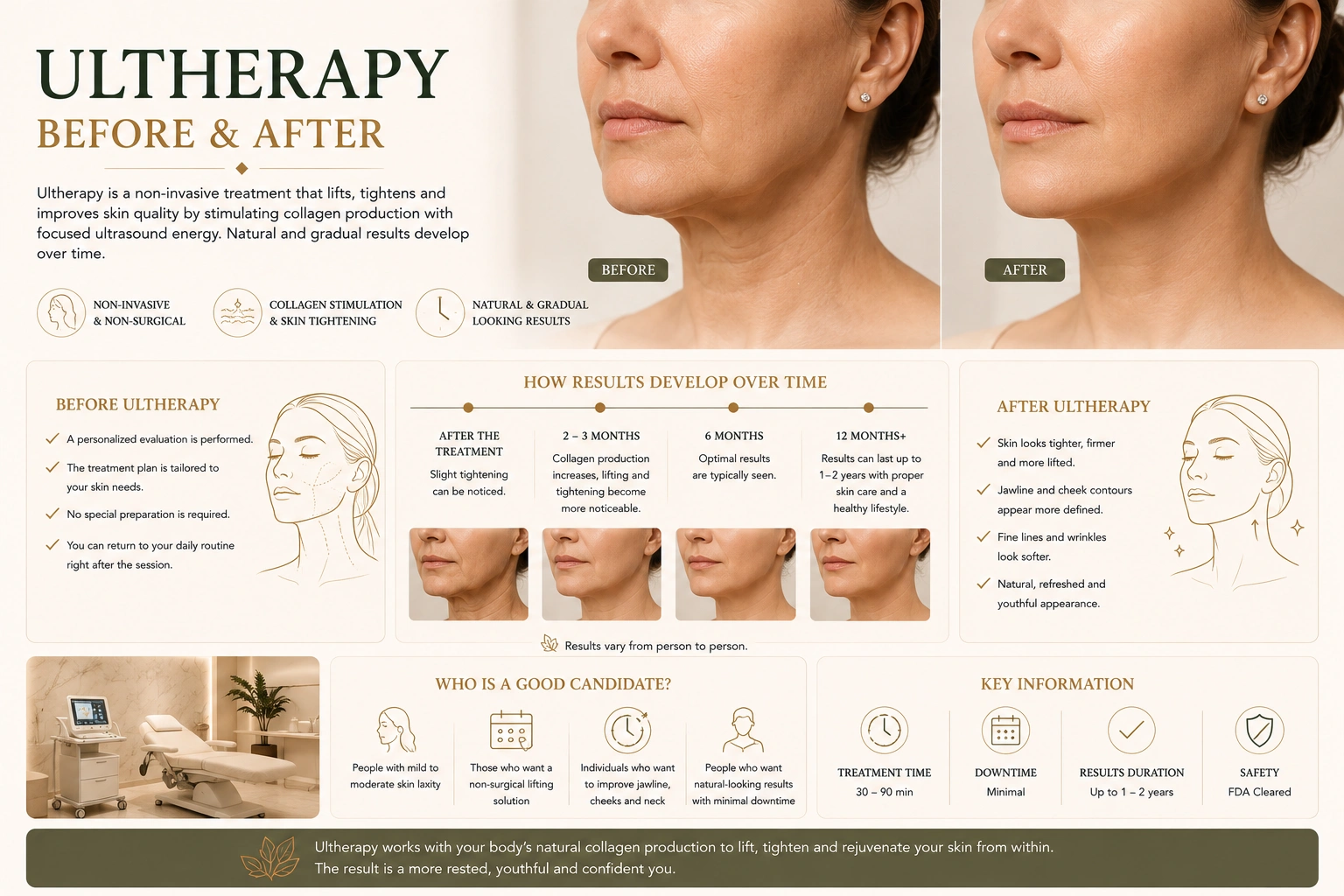
Comparing Ultherapy before and after is not simply a matter of placing two photographs side by side. Appropriate patient selection and standardised photography should begin before treatment, while early swelling should be distinguished from genuine tissue-remodelling changes afterwards.
A meaningful Ultherapy before-and-after comparison requires similar lighting, camera angle, head position, facial expression and sufficient follow-up time. Changes seen immediately after treatment should not be interpreted as the final result.
Send Your Photos on WhatsApp Explore Ultherapy Before and After GalleryFor preliminary assessment, front, right and left profile, and slight oblique photographs taken in natural light without filters and with a relaxed facial expression are more useful.
Differences in angle, lighting or expression can make comparisons misleading.
Early redness or swelling should not be confused with a true lifting result.
Collagen remodelling develops over time.
Another patient's before-and-after result does not guarantee your outcome.
Quick Answer: What Changes Can Be Expected Before and After Ultherapy?
In appropriately selected patients, the goal after Ultherapy is not a dramatic transformation of the face, but support for a firmer and more lifted appearance in suitable areas such as the brow, submental region, jawline and neck.
Some early changes may be noticed, but tissue remodelling develops gradually, so results should not be judged immediately after treatment.
The degree of change can vary according to age, skin quality, baseline laxity, facial and neck anatomy, treatment area and individual collagen response.
Ultherapy is not a surgical facelift. In advanced sagging, surgical-level tissue repositioning should not be expected.
What Is Assessed Before Ultherapy?
The quality of a before-and-after result begins before treatment. The first step is determining whether Ultherapy genuinely matches the patient's main concern.
The medical assessment may consider:
- The degree of skin and soft-tissue laxity
- Jawline and jowl appearance
- Whether the submental concern is mainly laxity or excess fat
- Neck skin quality
- Midface and cheek volume
- Skeletal support and facial proportions
- Previous filler or energy-based procedures
- Whether the desired change is realistic with Ultherapy
For a more detailed explanation of the mechanism, read How Does Ultherapy Work?.
Why Are Before Photos Important?
Pretreatment photographs are not taken only for record keeping. They provide the baseline against which later follow-up photographs can be compared.
A useful baseline photograph should ideally include:
- Neutral and reasonably consistent lighting
- A camera positioned at a similar height to the face
- Front, profile and oblique views
- A natural head position without excessive upward or downward tilt
- No deliberate projection of the chin
- A relaxed facial expression
- No filter, beauty mode or face-slimming effect
This standardisation is especially important for the jawline and neck, where even small changes in head position can significantly alter appearance.
How Can Ultherapy Before-and-After Photos Be Misleading?
Even photographs of the same person can make a difference look larger or smaller than it really is if the conditions change.
| Variable | Why It Matters |
|---|---|
| Lighting | Harsh overhead or side lighting can make the jawline, folds and shadows appear more pronounced. |
| Head angle | Even slightly raising the chin can change the appearance of the jawline and neck. |
| Camera distance | Close wide-angle photography can distort facial proportions. |
| Facial expression | Smiling or tightening the jaw muscles can change lower-face contours. |
| Neck position | Lengthening the neck or tilting the head forward can significantly change the submental appearance. |
| Filters / retouching | These can alter skin texture, contour and shadow distribution. |
The purpose of a good before-and-after photograph is not to make the treatment look more dramatic, but to show genuine change under as similar conditions as possible.
How Should You Prepare Before Ultherapy?
Ultherapy is not surgery, but it is still a medical procedure, so accurate pretreatment information is important.
Tell your doctor about:
- Your medical history
- Current medications
- Active skin conditions
- Previous Ultherapy or HIFU procedures
- Previous dermal fillers
- Thread-lift history
- Morpheus8, Endolift or other energy-based treatments
- Previous facial or neck surgery
This information can affect treatment planning.
Decisions about stopping or changing medication should be made with the relevant doctor rather than based on general online information.
How Should Expectations Be Set Before Ultherapy?
Before judging a before-and-after result, it is important to define what the patient is actually expecting from treatment.
Ultherapy may generally be considered to support:
- Firmness in appropriately selected tissue
- Subtle lifting support in selected regions
- A more supported jawline and neck appearance
- Gradual and natural-looking change
Ultherapy does not:
- Replace significant volume loss in the same way as filler
- Create the surgical tissue repositioning of a facelift in advanced sagging
- Resolve substantial submental fat in every patient by itself
- Primarily treat pigmentation or visible pores
Setting realistic expectations is important both for treatment selection and for interpreting the eventual result.
What Might You See in the Mirror on the First Day?
Appearance immediately after treatment can vary between patients.
Some may notice:
- Temporary redness
- Mild swelling
- A temporary feeling of fullness
- Tenderness
This early appearance is not the final before-and-after result. Temporary contour changes caused by oedema should not be interpreted as genuine lifting.
Is It Useful to Take Result Photos During the First Week?
Photographs taken during the first week can be useful for monitoring recovery, but they should not be treated as final result photographs.
During this period:
- Early swelling may not have fully settled.
- Tenderness may still be present.
- Collagen remodelling is still at an early stage.
For more detail about early recovery, see Ultherapy Recovery Time.
When Should Ultherapy Results Be Compared?
It is not useful to reduce Ultherapy results to one single day because tissue remodelling develops gradually.
A practical approach is to evaluate photographs at several stages:
| Timing | Purpose of the Photograph |
|---|---|
| Before treatment | Record the genuine baseline |
| First days | Monitor recovery and early reactions rather than judge the final result |
| Around 2–3 months | Assess the gradual tissue response more meaningfully |
| Later follow-up | Track ongoing remodelling and the individual's final treatment response |
For a deeper discussion of timing, read When Will You See Ultherapy Results?.
Which Areas Are Commonly Evaluated in Ultherapy Before-and-After Photos?
Different anatomical features can be assessed depending on the treatment area.
Brow position and overall upper-face balance can be assessed.
Soft-tissue laxity and contour around the lower jaw can be compared.
Skin laxity and fat fullness beneath the chin should be distinguished.
Changes in neck skin and the transition between lower face and neck can be monitored.
For area-specific guidance, see Ultherapy for Brow Lift, Ultherapy for the Jawline and Ultherapy for the Neck.
How Should Jawline Ultherapy Before and After Be Evaluated?
Head position is especially important when evaluating jawline photographs.
Moving the chin slightly forwards or upwards can make the jawline appear sharper even without a treatment-related change. Before-and-after photographs should therefore aim to keep:
- Head height the same
- Camera distance similar
- Jaw muscles relaxed
- Profile and 45-degree views standardised
If poor jawline definition is mainly related to skeletal structure, volume loss or submental fat, Ultherapy should not be expected to correct every component by itself.
How Should Neck Ultherapy Before and After Be Evaluated?
Head position is one of the biggest sources of error in neck comparisons.
Lifting the head can mechanically stretch neck skin and create an appearance that looks better independently of treatment.
For neck before-and-after photographs:
- Maintain a natural head position.
- Keep shoulder position similar.
- Use the same camera height.
- Avoid excessively lifting the chin.
In advanced skin excess, Ultherapy should not be expected to create the same degree of change as surgical neck lifting.
How Should Brow Ultherapy Before and After Be Compared?
Facial-expression control matters when assessing the brow. Even mild activation of the forehead muscles can alter brow position.
For comparison:
- The patient should not intentionally raise the brows.
- The forehead should remain relaxed.
- The camera and eye level should be similar.
- Both photographs should use a comparable expression.
The purpose is not to create the appearance of a dramatic brow lift, but to assess any genuine change conservatively.
Can Swelling Affect Ultherapy Before-and-After Photos?
Yes. Early swelling can temporarily change facial contour.
A difference seen immediately after treatment may reflect:
- True tissue change
- Temporary oedema
- A difference in head position
or a combination of these.
For more information about early reactions, see Ultherapy Side Effects.
Why Are Ultherapy Results Different for Everyone?
Before-and-after galleries can be useful references, but another patient's result does not guarantee the same outcome for someone else.
Factors that can influence the result include:
- Baseline degree of laxity
- Skin thickness and quality
- Age
- Facial and neck anatomy
- Soft-tissue distribution
- Treatment area
- Treatment scope
- Individual biological response
The goal of consultation is therefore not to say “give me the same result as this patient,” but to understand what change may realistically be expected from your own starting anatomy.
Does Facial Volume Change Before and After Ultherapy?
Ultherapy is not performed to add facial volume in the way dermal fillers do.
A more supported appearance can make some facial contours look different, but Ultherapy does not replace substantial midface volume loss.
If both laxity and volume loss are present, fillers or another treatment may need separate consideration for a different indication.
Are Ultherapy and Facelift Before-and-After Results the Same?
No. Ultherapy and surgical facelift belong to different treatment categories.
| Feature | Ultherapy | Surgical Facelift |
|---|---|---|
| Approach | Non-invasive microfocused ultrasound | Surgical tissue repositioning |
| Change sought | Gradual firmness and lifting support in suitable patients | Surgical correction of more advanced sagging and excess tissue |
| Recovery | No surgical incision | Requires surgical recovery |
| Before-after expectation | Usually a more subtle and gradual change | More substantial tissue repositioning in appropriately selected patients |
A surgical facelift photograph should therefore not be used as the expected reference result for Ultherapy.
Ultherapy or Endolift: Why Are the Before-and-After Goals Different?
Endolift and Ultherapy are different procedures.
Ultherapy uses non-invasive microfocused ultrasound to support firmness and lifting, while Endolift can be considered in selected patients for different lower-face, jawline and submental contour concerns.
The relevant question is not simply which before-and-after photograph looks more dramatic, but which treatment better matches the anatomical problem.
How Can You Keep Follow-Up Photos Consistent?
Use similar lighting.
Whenever possible, use soft and consistent natural light.
Keep the same distance.
Avoid moving the phone very close in one photograph and much farther away in another.
Maintain the same head position.
Raising or projecting the chin changes the jawline and neck appearance.
Keep the expression neutral.
Raising the brows, smiling or tightening the jaw can affect comparison.
Do not use filters.
Turn off beauty mode, face slimming and automatic retouching.
Repeat the same angles.
Front, both profiles and both oblique views are useful for comparison.
What Should You Ask When Looking at a Before-and-After Gallery?
Rather than looking only at how dramatic the difference appears, consider:
- Is the lighting genuinely similar?
- Are camera angle and distance comparable?
- Is the head and neck position the same?
- Is the facial expression similar?
- How long after treatment was the after photograph taken?
- Which areas were actually treated?
- Was another treatment performed during the same period?
- Is it made clear that results vary between individuals?
To review patient results across different treatments at Efem Clinic, visit the Before and After Gallery.
The Efem Method: Treating Before-and-After Photography as a Clinical Record, Not a Marketing Image
Within the Efem Method, the purpose of before-and-after photography is not to make results appear more dramatic than they are.
Taking standardised photographs before treatment, maintaining the same conditions afterwards and separating early oedema from genuine results provides a more meaningful assessment.
A significant result in one patient does not mean that the same degree of change will occur in another. Treatment should be planned according to age, anatomy, degree of laxity and individual goals.
The best before-and-after image is not the most dramatic one; it is the most honest and comparable one.
Ultherapy Result Planning With Dr Abdurrahman Efem
Dr Abdurrahman Efem is a medical aesthetic physician. At Efem Clinic, Ultherapy assessment considers not only the requested treatment area, but also the patient's baseline anatomy and realistic potential for improvement.
The jawline, submental area, neck and facial volume are assessed separately. If Ultherapy alone is unlikely to address the main anatomical issue, other treatment options can be discussed.
After treatment, follow-up photographs can be reviewed at meaningful time points so that early appearance is not confused with the genuine remodelling result.
The goal is not to make the face look like somebody else's, but to support a more balanced and natural appearance while respecting existing anatomy.
Meet Dr Efem Dr Efem's Philosophy Request a Photo AssessmentTravelling to Istanbul for Ultherapy
International patients can send standardised photographs through WhatsApp before travelling for preliminary assessment.
Useful photographs should ideally include:
- No filters
- A front view
- Right and left profiles
- Two oblique views
- The jawline and neck within the frame
- A neutral facial expression
This can make preliminary assessment more informative.
The definitive treatment decision, treatment area and realistic result expectations are established after in-person medical assessment.
Ultherapy in Levent, Istanbul
Efem Clinic provides treatment in a private villa clinic environment in Levent, Istanbul, with an emphasis on privacy and personalised planning.
Ultherapy planning considers facial and neck anatomy, degree of laxity, previous treatments and patient expectations together.
The purpose of before-and-after follow-up is to assess genuine change as objectively as possible under comparable photographic conditions.
Related Ultherapy Guides
Frequently Asked Questions About Ultherapy Before and After
Can you see a difference immediately after Ultherapy?
Some early changes may be noticeable, but the immediate appearance is not the final result. Tissue remodelling develops gradually after Ultherapy.
When should the after photo be taken?
Early photographs can document recovery, but meaningful result comparison should allow time for tissue remodelling. Around 2–3 months can be an important follow-up point, although individual follow-up plans vary.
What should I look for in Ultherapy before-and-after photos?
Lighting, camera angle, distance, head and neck position, and facial expression should be as similar as possible. Filters and face-shaping effects should not be used.
Can swelling make the Ultherapy result look better?
Early oedema can temporarily alter facial contour and should not be interpreted as the final lifting result.
How many months does it take to see Ultherapy results?
Results develop gradually. Tissue remodelling is usually assessed more meaningfully over the weeks and months following treatment.
Can Ultherapy make the jawline more defined?
In appropriately selected patients, Ultherapy may support tissue firmness around the lower face and jawline. Jawline appearance is also influenced by skeletal structure, volume loss and fat distribution.
Can Ultherapy completely remove a double chin?
Submental appearance is not always caused only by laxity. If substantial fat or another anatomical factor is present, Ultherapy alone may not be sufficient.
Can Ultherapy completely correct neck sagging?
It may support firmness in selected patients with mild-to-moderate laxity. In advanced skin excess, the degree of tissue repositioning associated with surgical neck lifting should not be expected.
Can Ultherapy lift the brow?
Ultherapy can be used for lifting in the brow region. The degree of change depends on baseline anatomy and individual tissue response.
Does Ultherapy completely change the face?
The aim is not to reshape the face into a different identity, but to support firmness and lifting while preserving natural anatomy in appropriately selected patients.
Are Ultherapy before-and-after results the same for everyone?
No. Age, anatomy, skin quality, baseline laxity, treatment area and individual biological response can all affect the result.
Do other patients' Ultherapy photos show what my result will look like?
No. Other patients' photographs can help illustrate possible types of change but do not guarantee an individual outcome.
Does Ultherapy give the same result as a facelift?
No. Ultherapy is a non-invasive ultrasound procedure, while facelift surgery physically repositions tissue and can produce a different level of change in advanced sagging.
How should I take photos before Ultherapy?
Take unfiltered photographs in natural, even lighting from the front, both profiles and both oblique angles. Keep the head and neck in a natural position and use a neutral facial expression.
Should I tell my doctor about previous fillers before Ultherapy?
Yes. Previous fillers, thread lifts, Ultherapy, HIFU, Morpheus8, Endolift and other facial or neck procedures should be disclosed during medical assessment.
How can I track my Ultherapy result more objectively?
Take baseline and follow-up photographs using similar lighting, camera distance, head angle and facial expression, and avoid treating early swelling as the final result.
Efem Note
When looking at before-and-after photographs, the size of the difference should not be the first thing you examine.
First look at the lighting, head position, facial expression and how long after treatment the second photograph was taken.
A good Ultherapy result is not a face that changes completely within hours. In appropriately selected patients, it is a gradual improvement in firmness and lifting while preserving natural anatomy.
The purpose of before-and-after evaluation is not dramatization, but seeing genuine change under comparable conditions.
Request a Personal Ultherapy Assessment
Send clear, unfiltered daylight photographs from the front, both profiles and slight oblique angles. The jawline, submental area, neck, facial laxity and volume can be reviewed together to provide preliminary guidance on whether Ultherapy may be appropriate for you.
Send Your Photos on WhatsApp Before and After Gallery Meet Dr Efem Contact Efem ClinicThis article is intended for general information. Before-and-after photographs do not guarantee individual results. Ultherapy suitability and the degree of change can vary according to baseline anatomy, skin quality, degree of laxity, treatment plan and individual tissue response.
About Dr. Abdurrahman Efem

Dr. Abdurrahman Efem
Dr. Abdurrahman Efem is a medical aesthetic physician specializing in facial rejuvenation, non-surgical aesthetic treatments, and regenerative medicine. His approach focuses on enhancing natural beauty through personalized treatment plans designed around each patient's unique features and goals. Dr. Efem works with both local and international patients, emphasizing balanced, natural-looking results and long-term aesthetic wellbeing. This content has been prepared or medically reviewed by Dr. Abdurrahman Efem to ensure accuracy and relevance.