

Endolift vs Ultherapy: Which Treatment Is Better for Jawline, Double Chin and Facial Sagging?
ENDOLIFT VS ULTHERAPY IN ISTANBUL
Endolift vs Ultherapy: Which Non-Surgical Face and Neck Lifting Treatment Is Right for You?
Endolift and Ultherapy are two of the most discussed non-surgical treatments for jawline definition, double chin appearance, lower-face laxity, neck tightening and natural facial rejuvenation. They are not the same treatment and they do not work in the same tissue layer.
At Efem Clinic in Levent, Istanbul, the decision is not based on which device is more popular. The correct question is: which layer of your face or neck actually needs treatment?
International patients can send clear front, side and neck photographs before travelling to Istanbul for preliminary guidance. Final suitability requires doctor assessment.
Laser-assisted, fiber-based contour and tightening support.
Focused ultrasound lifting with visualization-supported planning.
Treatment is selected according to anatomy, tissue and indication.
Pre-travel communication, appointment and recovery guidance.
Quick Answer: Endolift or Ultherapy?
Endolift may be considered when the main concern involves lower-face contour, jawline blurring, double chin appearance, selected under-chin fullness or the transition between the face and neck.
Ultherapy Prime may be considered when the main concern is mild to moderate skin laxity, deeper lifting support, jawline or neck firmness, brow-area support or gradual collagen stimulation through a non-invasive procedure.
Morpheus8 may be more relevant when the main concern is pores, acne-scar appearance, surface texture or RF microneedling-based skin remodeling.
Filler may be more relevant when jawline weakness is caused by insufficient chin projection or structural support rather than laxity or fat distribution.
MEDICALLY REVIEWED COMPARISON
Why Experience With Both Technologies Matters
A clinic that offers only one device may naturally try to solve every problem with that device. A meaningful Endolift vs Ultherapy comparison requires practical experience with both technologies and the ability to recognise when neither is the correct first choice.
Dr. Abdurrahman Efem is an experienced medical aesthetic physician and Ultherapy Trainer. He also provides physician training to doctors from Türkiye and abroad in advanced procedures including Endolift, Ultherapy, Morpheus8, advanced filler applications and anti-wrinkle treatments.
His treatment planning focuses on facial anatomy, tissue thickness, fat distribution, laxity pattern, recovery expectations and natural-looking results rather than selling a standard device package.
Dr. Efem has also participated in advanced international education and continuing medical training in Europe, including Paris and the United Kingdom.
Written and medically reviewed by Dr. Abdurrahman Efem. Last content and internal-link review: August 2026.
Page Contents
Not Sure Which Treatment Fits Your Face?
Send your photos on WhatsApp. Preliminary guidance can help identify whether your concern appears more related to jawline contour, double chin, skin laxity, structural volume loss, skin texture or a combination.
Ask on WhatsApp Request AppointmentEndolift vs Ultherapy at a Glance
Endolift
Laser-based, minimally invasive and fiber-assisted. Often considered when lower-face contour, under-chin fullness, jawline definition and selected tightening goals exist together.
Ultherapy Prime
Focused ultrasound-based and non-invasive. Often considered for deeper support, mild to moderate laxity and gradual face, jawline, brow or neck tightening.
Main Difference
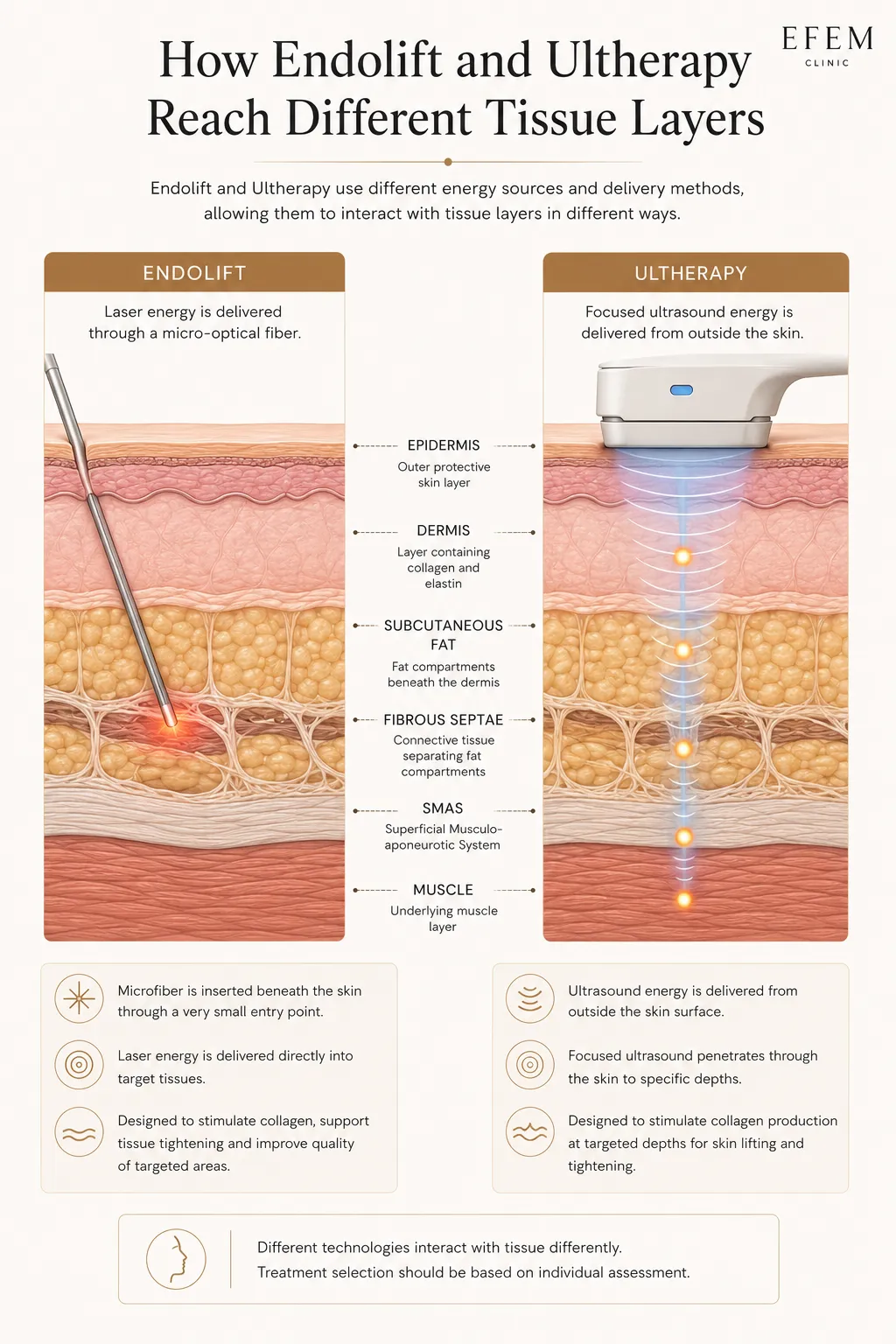
Endolift delivers laser energy through a thin fiber beneath the skin. Ultherapy delivers focused ultrasound energy from the skin surface with tissue visualization, reaching depths comparable to the SMAS layer targeted in surgical facelifts.
Both treatments are included within Efem Clinic’s broader lifting and contouring treatment approach. Ultherapy can also be directly compared against a third energy technology in our XERF vs Ultherapy guide and our Ultherapy vs HIFU technology guide.
What Is Endolift?
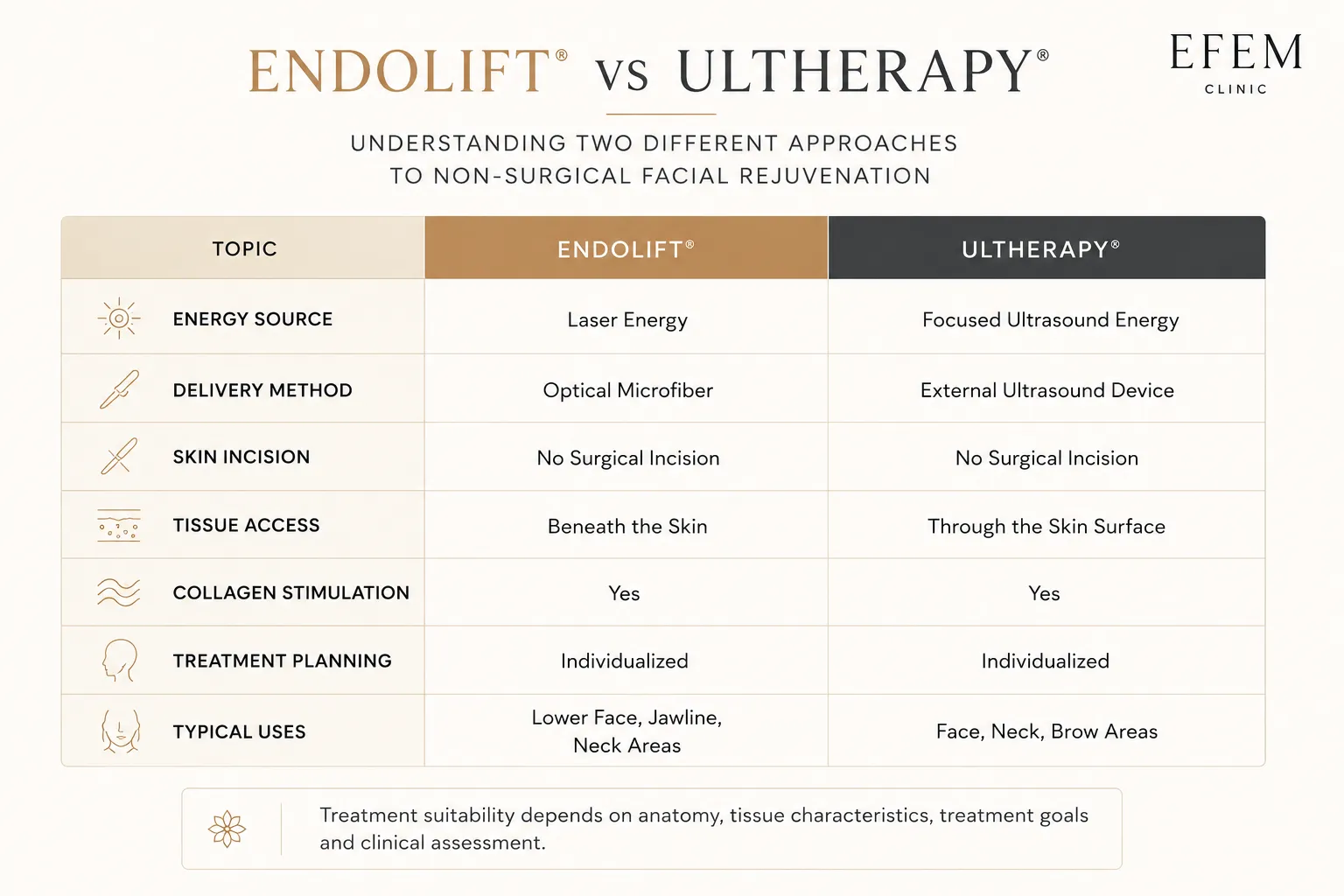
Endolift is a minimally invasive laser treatment performed with a very thin optical fiber placed beneath the skin. Controlled laser energy is delivered to selected tissue areas to support tightening, collagen remodeling and contour refinement in suitable patients.
At Efem Clinic, Endolift treatment may be evaluated for early jowls, lower-face heaviness, jawline softening, double chin appearance, neck contour concerns or selected body-contour goals.
Endolift is not a surgical facelift. Advanced skin excess, major tissue descent or severe laxity may require surgical evaluation rather than another non-surgical device.
Endolift May Be Discussed For
- Double chin and selected under-chin fullness
- Jawline blurring or lower-face heaviness
- Early jowls
- Mild to moderate lower-face laxity
- Face-to-neck transition concerns
- Selected localized fat and contour problems
- Patients seeking contour support without surgical lifting
For a deeper explanation, read the Endolift Istanbul guide, how Endolift works and how Endolift supports skin tightening. Area-specific guides are also available for Endolift for the jawline, Endolift for the double chin and Endolift for the neck.
What Is Ultherapy Prime?
Ultherapy Prime uses focused ultrasound energy to target selected deeper support layers from the skin surface. It is commonly evaluated for non-surgical lifting support, collagen stimulation and gradual tightening in areas such as the face, jawline, under-chin area, neck and brow region.
Unlike Endolift, Ultherapy Prime treatment does not use a fiber beneath the skin. Ultrasound visualization can support tissue-layer assessment and personalized energy planning – see exactly which skin layers Ultherapy targets.
Ultherapy is not primarily a fat-reduction treatment. It may be a better fit when mild to moderate laxity and deeper support are the central concerns and the patient prefers a non-invasive procedure.
Ultherapy May Be Discussed For
- Mild to moderate face and neck laxity
- Jawline and lower-face lifting support
- Loose-looking skin under the chin
- Neck-tightening goals
- Brow-area support
- Gradual collagen stimulation
- Patients who prefer a non-invasive treatment
Read the detailed Ultherapy Istanbul guide and the explanation of how Ultherapy works.
Detailed Comparison: Endolift vs Ultherapy
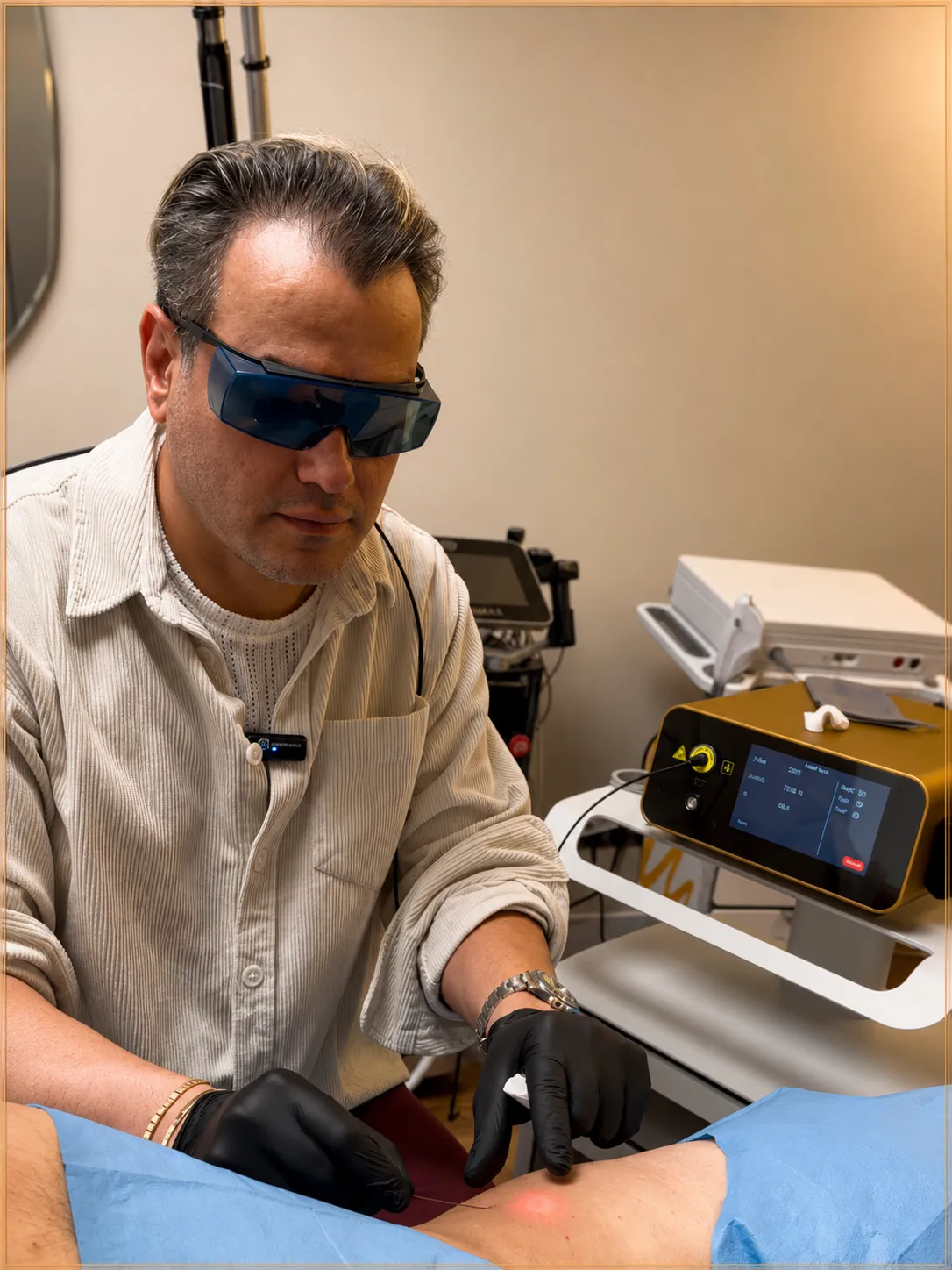
| Criteria | Endolift | Ultherapy Prime |
|---|---|---|
| Technology | Laser energy | Focused ultrasound energy (HIFU) |
| Application method | Thin optical fiber beneath the skin | Applied externally from the skin surface |
| Invasiveness | Minimally invasive | Non-invasive |
| Main treatment logic | Contour refinement, selected tightening and lower-face definition | Lifting support, deeper collagen stimulation and gradual tightening |
| Double chin | May be evaluated when localized fullness and contour loss are present | May support firmness but is not primarily a fat-reduction treatment |
| Jawline | Often considered for blurred contour, heaviness or early jowls | Often considered for laxity and deeper lifting support |
| Brow area | Not usually the primary indication | May be considered in suitable patients |
| Visible downtime | May involve swelling, tenderness, bruising, tightness or temporary firmness | Usually limited, although tenderness or temporary sensitivity may occur |
| Result development | Contour and tightening develop gradually with tissue response | Lifting and firmness develop gradually through collagen renewal |
| Surgery replacement? | No | No |
Which Layer Is Causing the Problem?
The same visible complaint can come from different anatomical causes. This is why “I want a sharper jawline” is not enough information to select a treatment.
Endolift may be considered when selected soft-tissue fullness contributes to blurred contour.
Ultherapy may be considered when the main concern is deeper lifting support and collagen stimulation.
Chin filler or jawline filler may be more relevant when structural projection is missing.
Morpheus8 may be more relevant when the main problem is skin texture rather than contour.
A surgical consultation may be more appropriate than Endolift, Ultherapy or another non-surgical treatment.
Which Is Better for a Double Chin?
A double chin can be related to localized fat, skin laxity, chin structure, neck anatomy, weight changes, muscle position or genetic factors. Two patients with the same complaint may therefore need completely different plans.
When localized under-chin fullness and contour loss are central problems, Endolift may be discussed. When mild laxity and deeper support are the main concerns, Ultherapy may be considered.
When the chin itself lacks projection, adding structural support may improve the profile more logically than treating the skin alone. Read the detailed double chin and jawline contouring guide and the area-specific Endolift for double chin guide.
Which Is Better for Jawline Definition?
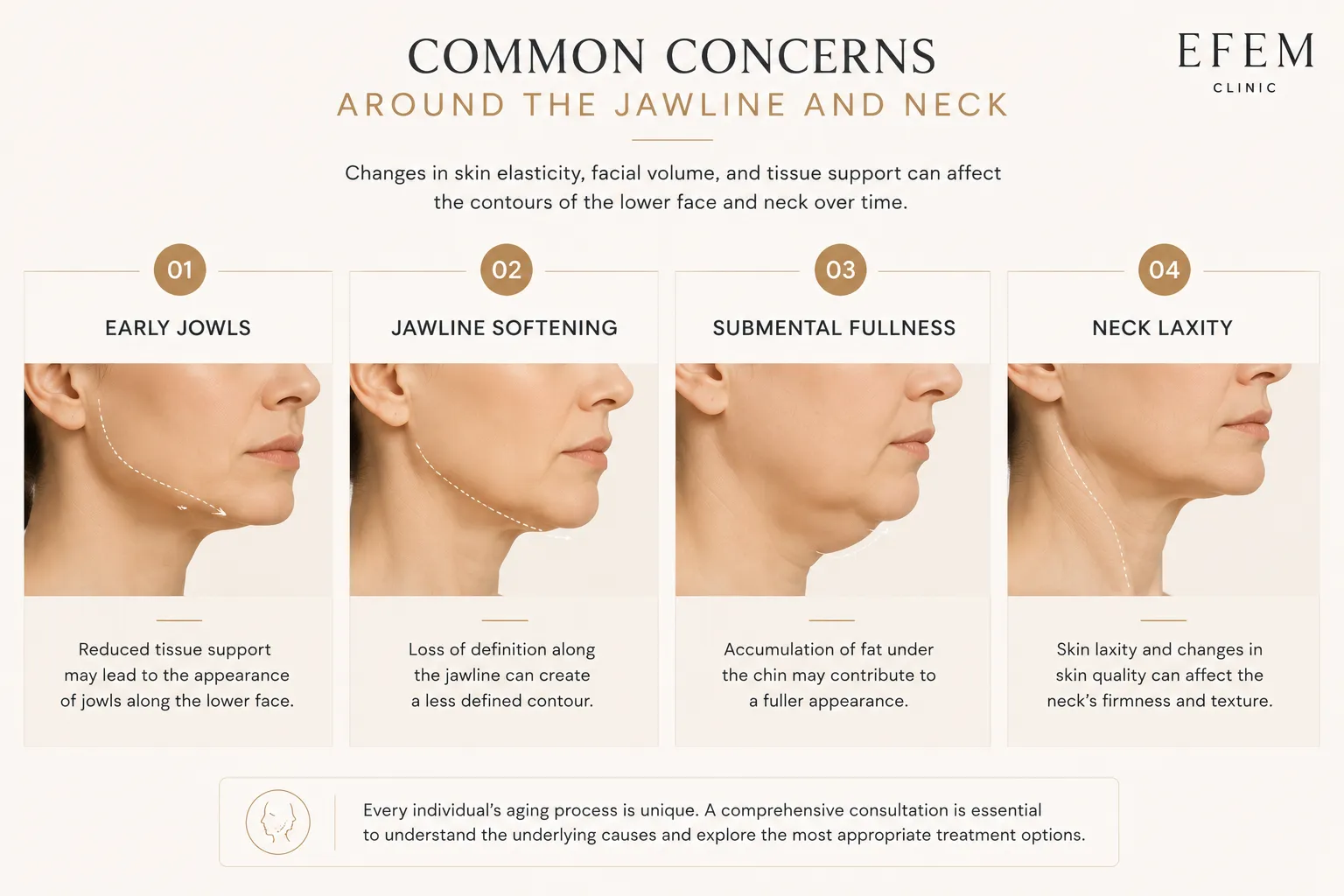
Jawline definition depends on bone structure, chin projection, fat distribution, skin laxity, lower-face heaviness and the transition between the chin and neck.
Endolift may be useful when the jawline looks blurred because of lower-face fullness, early jowls or contour loss – see the dedicated Endolift for jawline guide. Ultherapy may be useful when the jawline needs deeper support and gradual tightening without a fiber-based procedure.
When the jawline lacks structure rather than lift, jawline or chin filler may be more logical. The jawline filler guide explains why adding filler to a heavy lower face is not always the correct decision.
Which Is Better for Neck Tightening?
Ultherapy may be considered when mild to moderate neck laxity and deeper support loss are the primary concerns. Endolift may be considered when the neck concern is connected with under-chin fullness, lower-face contour or the jawline-to-neck transition – see the dedicated Endolift for neck guide.
Neither treatment corrects every neck-ageing pattern. Horizontal neck lines, platysma bands, surface texture, pigmentation and advanced skin excess require different approaches.
For a broader treatment decision, review the non-surgical neck-tightening guide.
Which Is Better for Skin Tightening?
Both treatments may support collagen-related tissue response, but their roles differ. Ultherapy is commonly discussed for focused ultrasound lifting and deeper support. Endolift is commonly discussed when tightening and contour refinement are needed together in selected areas.
If the main concern is pores, acne scars, rough texture or surface quality, neither may be the first choice. In those cases, Morpheus8, medical skincare, mesotherapy and skin boosters or another skin-quality treatment may be more relevant.
Read the Morpheus8 Istanbul guide and the broader non-surgical skin-tightening guide.
Endolift vs Ultherapy vs Morpheus8 vs Filler
Facial rejuvenation is layer-based. The support layer, fat distribution, skin surface and facial structure may each require different tools.
Lower-face contour, under-chin fullness, early jowls and selected tightening goals.
Non-invasive lifting support, deeper collagen stimulation, jawline, brow and neck tightening.
Skin texture, pores, acne-scar appearance, fine lines and RF microneedling-based remodeling.
Chin projection, jaw structure, volume loss, profile balance and structural support.
For a direct technology comparison, read Endolift vs Morpheus8, XERF vs Ultherapy, or the broader Ultherapy vs HIFU technology guide.
Candidacy and Safety: Who Should Think Twice?
A responsible comparison should be equally clear about who is less likely to benefit, not only who is a good candidate. See our full Ultherapy candidacy guide and Ultherapy safety guide for detail.
Endolift May Not Be the First Choice For
- Patients with advanced skin excess where a fiber-based tightening effect is unlikely to be sufficient
- Patients wanting zero downtime before an imminent event
- Patients whose primary concern is volume loss rather than fat excess or laxity
Ultherapy May Not Be the First Choice For
- Patients whose main concern is localized under-chin fat rather than laxity
- Patients expecting a dramatic, surgery-level lift from a single session
- Patients with advanced sagging where deeper structural correction is needed
Both treatments carry the standard cautions common to energy-based and minimally invasive procedures – active skin infection, certain pacemaker or implant considerations, pregnancy, and unrealistic single-session expectations are all reviewed during consultation before either is recommended.
Sessions, Discomfort, Downtime and Aftercare
Often planned as a main procedure for selected areas. The plan depends on anatomy, laxity, under-chin structure and treatment goals.
Many patients are assessed for one principal session, but maintenance or future treatment may be discussed according to response and ageing pattern.
Ultherapy may feel like warmth, tingling or deep energy pulses. Endolift may involve pressure, warmth, pulling or stinging sensations.
Ultherapy usually has less visible downtime. Endolift may involve swelling, tenderness, bruising, tightness or temporary firmness.
Both treatments benefit from consistent sun protection during the collagen-remodeling period; see our post-treatment sun protection guide and the specific Ultherapy aftercare guide.
Both treatments produce gradual changes. Our dedicated guide covers when Ultherapy results become visible; more meaningful improvement generally develops over weeks and months as tissue response and collagen remodeling continue for both technologies.
Individual response, treatment intensity and recovery vary. Important events, flights and work commitments should be discussed before scheduling.
Results and Before-After Expectations
Neither Endolift nor Ultherapy produces an instant, dramatic change – both work by triggering the body's own collagen response, which unfolds over weeks and continues developing for months. Photos taken at the same angle, lighting and distance at planned intervals give a far more honest picture than a single post-treatment photo taken under flattering conditions.
Results also vary meaningfully by patient: skin quality, degree of laxity, age, lifestyle and how closely aftercare instructions are followed all influence the outcome. Two patients treated with the same technology can see genuinely different timelines.
You can review real patient examples, with the understanding that individual results vary, in our before-after gallery.
Cost of Endolift and Ultherapy in Istanbul
Endolift and Ultherapy prices depend on the treatment area, degree of laxity, under-chin anatomy, treatment intensity, line or energy planning, session needs and whether another procedure is included.
A lower-face plan, jawline plan, full-face plan and face-plus-neck plan do not involve the same treatment scope.
Although Istanbul prices may be more accessible than in many UK, European or North American clinics, the lowest price should not be the primary decision factor. Doctor experience, patient selection, technology authenticity, treatment planning and follow-up matter more.
Request Personalised PricingInternational Patients: Planning Treatment in Istanbul
International patients can send clear front, side, three-quarter and neck photographs before travelling. Photos may help organise the correct consultation pathway, but they do not replace in-person tissue assessment. Patients travelling from the UK specifically may also find our doctor-led Ultherapy guide for UK patients useful for planning.
Share your main concern, medical history, previous treatments and photographs.
Facial structure, tissue laxity, fat distribution and skin quality are assessed.
Flights, meetings, events and expected social recovery should be considered.
Personalised recovery instructions and follow-up communication are provided.
Efem Clinic is located in Levent, close to Etiler, Beşiktaş and central Istanbul business districts. The clinic holds international health-tourism authorisation and supports English-friendly appointment planning.
Plan Your Visit on WhatsApp Contact Clinic
Doctor-Led Planning by Dr. Abdurrahman Efem
Dr. Abdurrahman Efem’s approach is not device-first. It is anatomy-first, indication-first and safety-focused.
Because he works with Endolift, Ultherapy, Morpheus8, injectables and other non-surgical technologies, the treatment decision can be based on what the patient actually needs rather than forcing every concern into one device category.
He trains doctors from Türkiye and abroad in Endolift, Ultherapy, Morpheus8, advanced filler techniques and anti-wrinkle treatments. This experience is particularly relevant when comparing technologies that operate in different tissue layers.
A responsible plan may recommend Endolift, Ultherapy, another treatment, a staged combination or no treatment at all.
About Dr. Efem View Education & ExpertisePrivate Clinic Experience in Levent
Efem Clinic is a private medical aesthetic clinic in Levent, Istanbul. The villa setting includes private consultation areas, a garden, parking and a patient flow designed around discretion and personal attention.
This environment is particularly relevant for patients who want detailed facial analysis, clear communication and a quieter experience than a high-volume clinic setting.
Efem in Media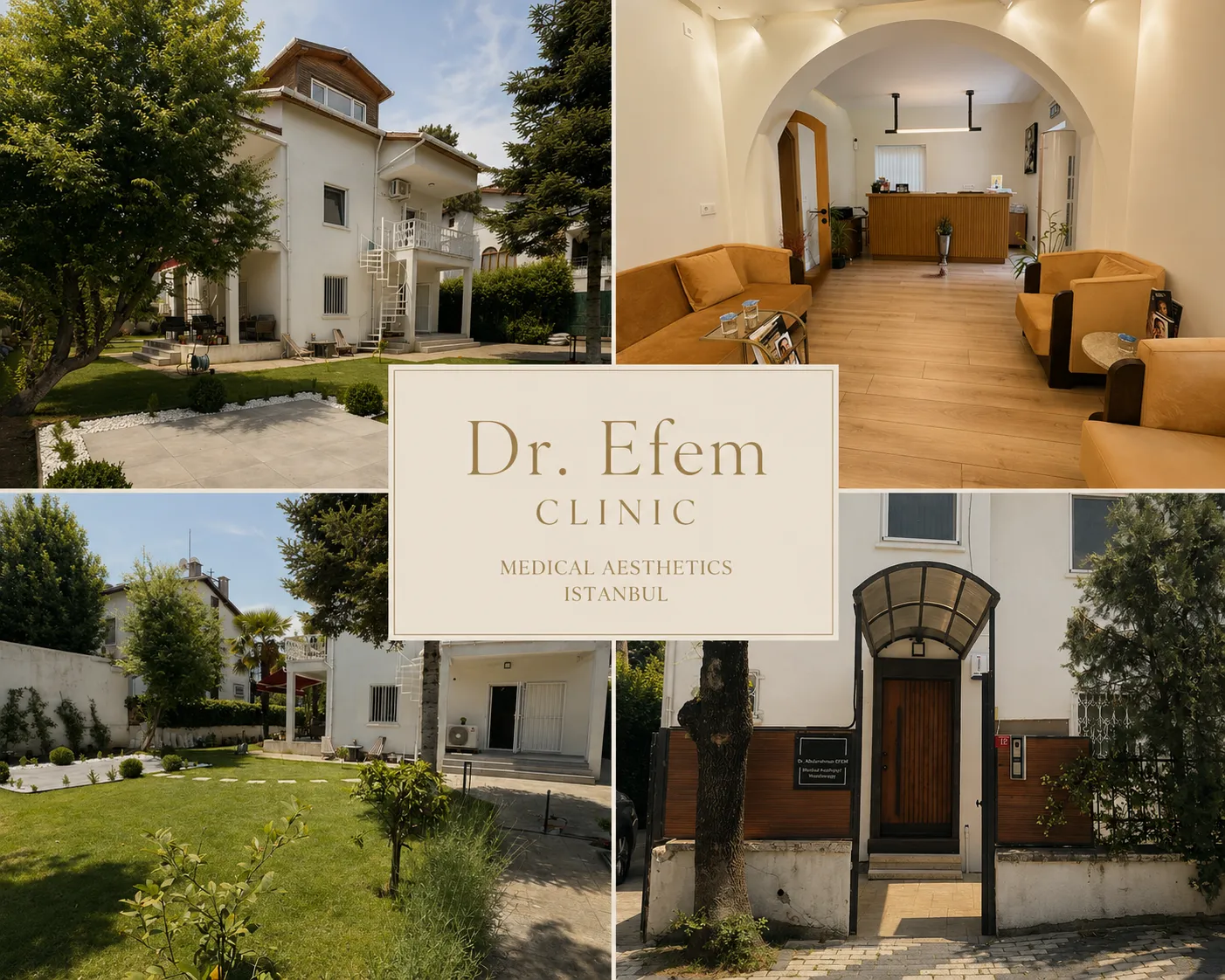
Can Endolift and Ultherapy Be Combined?
They may be combined or staged in selected patients when more than one tissue layer contributes to the concern. For example, a patient may have under-chin fullness together with deeper neck laxity.
Combination treatment should not be presented as a standard package. Adding more procedures does not automatically create a better result.
Some patients need Endolift, some need Ultherapy, some need Morpheus8, skin-quality or regenerative support, filler or no treatment at all.
When Is Surgery a Better Option?
Endolift and Ultherapy are not replacements for a surgical facelift or neck lift. Severe skin excess, advanced neck laxity, major tissue descent or expectations of dramatic lifting may require surgical consultation.
A trustworthy aesthetic assessment should explain the limitations of non-surgical treatment instead of overselling a device to a patient outside the ideal indication.
Related Decision Guides
Continue with the guide that most closely matches your concern:
Frequently Asked Questions
Is Endolift better than Ultherapy?
Not universally. Endolift may be more relevant for selected contour, under-chin and lower-face concerns. Ultherapy may be more relevant for non-invasive lifting and deeper collagen support.
Is Ultherapy better than Endolift?
It may be more suitable when mild to moderate laxity is the main concern and the patient prefers a non-invasive procedure. It may be less relevant if localized fullness or lower-face heaviness is central.
Which treatment is better for double chin caused by fat?
When selected localized under-chin fullness contributes to the problem, Endolift may be evaluated. Ultherapy is not primarily a fat-reduction treatment.
Which treatment is better for a sagging jawline?
Ultherapy may support deeper lifting when laxity is the main cause. Endolift may be discussed when jawline blurring is connected with lower-face heaviness, early jowls or contour loss.
Is Endolift good for early jowls?
It may be considered for early jowls and lower-face contour loss in suitable patients. Advanced jowls or major skin excess may require surgical evaluation.
Is Ultherapy good for neck tightening?
Ultherapy may be considered for mild to moderate neck laxity and deeper collagen support. It does not replace neck-lift surgery in advanced cases.
Is Endolift non-surgical?
Endolift is not surgery, but it is minimally invasive because a thin optical fiber is used beneath the skin. Ultherapy is non-invasive and applied from the skin surface.
Which treatment has less downtime?
Ultherapy generally has less visible downtime. Endolift may involve swelling, bruising, tenderness, tightness or temporary firmness.
Which treatment is more painful?
Both can cause discomfort. Ultherapy may feel like heat, tingling or deep pulses. Endolift may involve pressure, warmth, pulling or stinging. Sensation varies by area and patient.
Which treatment is better before a wedding or important event?
Ultherapy may be easier to plan close to an event because visible downtime is usually limited. Endolift should be scheduled with more allowance for possible swelling or bruising.
Can Endolift and Ultherapy be performed together?
They may be combined or staged in selected patients with concerns in more than one tissue layer. Combination treatment is not necessary for everyone.
Can Endolift and Ultherapy replace a facelift?
No. They may support non-surgical improvement in suitable patients, but advanced sagging, major tissue descent and significant skin excess may require surgery.
How long do Endolift and Ultherapy results last?
Duration varies according to age, anatomy, skin quality, laxity, lifestyle, treatment plan and individual collagen response. Neither treatment permanently stops ageing.
How many sessions are needed?
Many patients are assessed for one main Endolift or Ultherapy procedure, but the correct plan depends on anatomy, treatment area, severity and response. Standard session packages are not appropriate for everyone.
Can Morpheus8 be better than Endolift or Ultherapy?
Yes, when the primary concern is skin texture, enlarged pores, acne-scar appearance or surface quality. Endolift and Ultherapy address different contour and lifting concerns.
Can jawline filler be better than both treatments?
It may be more relevant when the main issue is weak chin projection or insufficient structural support. Filler does not remove under-chin fat or correct significant laxity.
How much do Endolift and Ultherapy cost in Istanbul?
Cost depends on the treatment area, degree of laxity, energy or fiber planning, session scope and whether a combined treatment is required.
Can I fly after Endolift or Ultherapy?
Flight planning depends on the treatment and individual recovery. Ultherapy usually involves limited visible downtime. Endolift may require more allowance for swelling, tenderness or bruising.
Is either treatment unsafe for certain patients?
Both carry standard precautions for energy-based and minimally invasive procedures, including active skin infection, pregnancy and certain implant or pacemaker considerations. See our full Ultherapy safety guide and discuss your history openly during consultation.
When will I actually see results from Ultherapy?
Initial changes can appear within weeks, but the most meaningful lifting and firmness typically continue developing over two to three months as collagen remodels; see our detailed Ultherapy results timeline.
How should I choose between Endolift and Ultherapy?
The decision should follow facial and neck assessment. Tissue laxity, fat distribution, skin quality, chin structure, treatment area, recovery expectations and medical suitability should all be reviewed.
Doctor’s Note
The first step is not choosing a device. The first step is understanding facial anatomy, skin quality, lower-face contour, neck structure and realistic goals.
Endolift and Ultherapy can both be useful, but the wrong treatment for the wrong layer will disappoint. Correct patient selection matters more than the popularity of the device.
Dr. Abdurrahman Efem
Endolift or Ultherapy: Which One Fits Your Face?
If you are comparing Endolift and Ultherapy for jawline definition, double chin, lower-face sagging, neck tightening or natural facial rejuvenation, contact Efem Clinic for a doctor-led assessment in Istanbul.
Treatment planning is personalised. Results, recovery and suitability vary according to anatomy, skin quality, treatment area, lifestyle, collagen response and individual healing.
About Dr. Abdurrahman Efem

Dr. Abdurrahman Efem
Dr. Abdurrahman Efem is a medical aesthetic physician specializing in facial rejuvenation, non-surgical aesthetic treatments, and regenerative medicine. His approach focuses on enhancing natural beauty through personalized treatment plans designed around each patient's unique features and goals. Dr. Efem works with both local and international patients, emphasizing balanced, natural-looking results and long-term aesthetic wellbeing. This content has been prepared or medically reviewed by Dr. Abdurrahman Efem to ensure accuracy and relevance.