Morpheus8 vs XERF For Body Tightening
Body Tightening Technology Comparison
Morpheus8 vs XERF for Body Tightening: Which Is More Suitable?
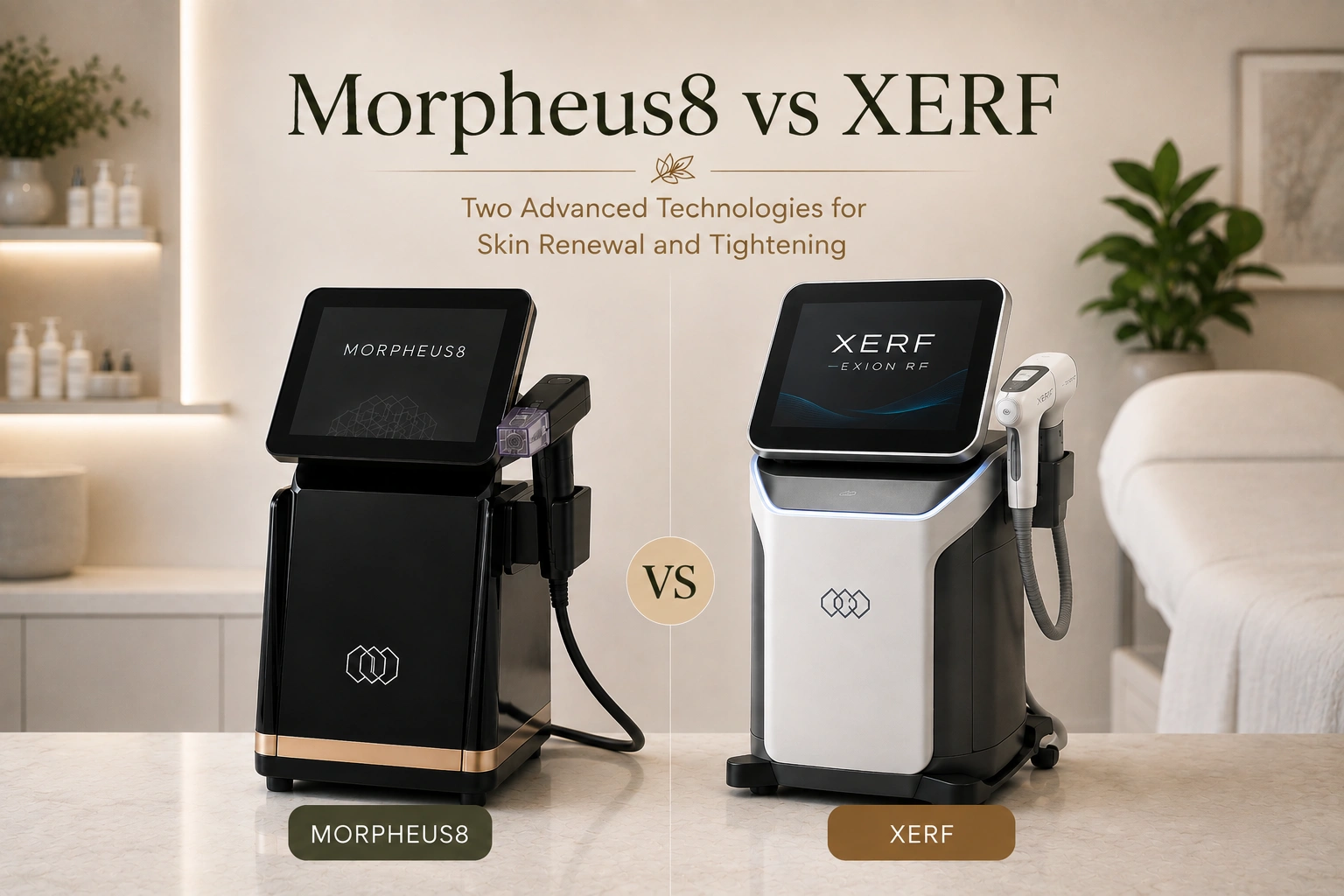
Morpheus8 and XERF are two different radiofrequency technologies that may be considered when the goal is firmer-looking body skin and improved tissue quality. Their treatment mechanisms are not the same: Morpheus8 combines microneedling with bipolar radiofrequency, while XERF uses needle-free multifrequency monopolar radiofrequency.
For this reason, the more useful question is not simply “Which treatment is stronger?” The degree of skin laxity, presence of stretch marks or texture concerns, treatment-area size, downtime expectations and preference regarding needles should all be considered.
Send Photos for Preliminary Guidance Morpheus8 XERFDelivers bipolar radiofrequency through microneedles.
Uses needle-free multifrequency monopolar radiofrequency.
Morpheus8 may be more relevant when texture is also a concern; XERF may suit broad-area non-invasive tightening.
The right choice depends on anatomy and treatment goals.
Quick Answer: Morpheus8 or XERF?
If stretch marks, crepey texture, fine surface irregularity or fractional tissue remodelling are important parts of the treatment goal, Morpheus8 may be more relevant. If the priority is needle-free radiofrequency treatment over a broader area with minimal visible downtime, XERF may be more suitable.
This is not an absolute rule. Morpheus8 can deliver bipolar RF to selected dermal and subdermal tissue levels through microneedles. XERF combines 6.78 MHz and 2 MHz monopolar RF frequencies and is designed to distribute energy across shallow, middle and deeper tissue levels without needles.
Treatment area, skin thickness, degree of laxity and individual goals should determine the final plan.
How Does Morpheus8 Work on the Body?
Morpheus8 is a fractional radiofrequency technology that combines microneedling with bipolar RF energy. The microneedles reach selected tissue depths, where controlled radiofrequency energy can be delivered.
For body treatments, the aim may include controlled coagulation and remodelling of dermal and subdermal tissues according to the patient's anatomy and treatment goals.
Morpheus8 may be considered when treatment goals include:
- Mild to moderate skin laxity
- Crepey or finely wrinkled body skin
- Uneven skin texture
- The appearance of selected stretch marks
- Skin-quality and firmness support
- Targeted dermal or subdermal remodelling
Because the treatment involves microneedles, temporary redness, sensitivity, swelling or visible entry-point changes may occur. This usually makes Morpheus8 a different recovery experience from needle-free XERF.
How Does XERF Work on the Body?
XERF is a non-invasive monopolar radiofrequency system developed by Cynosure Lutronic. It combines 6.78 MHz and 2 MHz RF frequencies to allow energy delivery across different tissue levels.
Its major difference from Morpheus8 is that no microneedles penetrate the skin. Radiofrequency energy is delivered from the skin surface.
The system also uses technologies including Integrated Cryogen Delivery cooling, Wave Fit pulse control and real-time impedance feedback to help personalise energy delivery and support treatment comfort.
XERF may be considered when the goals include:
- Skin-tightening support over broader body areas
- A needle-free RF treatment
- Mild to moderate skin laxity
- Minimal visible downtime
- Non-invasive treatment of areas such as the abdomen or upper arms
XERF should not be described as a weight-loss or surgical fat-removal treatment. Its role is better understood as non-invasive RF-based skin and soft-tissue tightening.
Morpheus8 vs XERF: Key Differences
| Feature | Morpheus8 | XERF |
|---|---|---|
| Technology | Fractional bipolar RF microneedling | Multifrequency monopolar RF |
| Needles | Yes | No |
| Energy delivery | RF delivered through microneedles to selected tissue depths | RF delivered through the skin surface without needle penetration |
| Texture-focused treatment | May be particularly relevant when texture and fractional remodelling are treatment goals | More focused on non-invasive tightening than fractional resurfacing |
| Stretch marks | RF microneedling may be considered for selected stretch marks | Stretch-mark remodelling should not be treated as XERF's primary indication |
| Downtime | Temporary redness, sensitivity, swelling or pinpoint surface changes may occur | Designed as a non-invasive treatment with no significant downtime |
| Numbing | Comfort measures may be used depending on the treatment plan | Designed to be performed without numbing |
| Broader treatment areas | Possible, with treatment time and scope depending on the area | Needle-free approach may be practical for broader areas |
| Which is better? | Neither is universally superior. The main concern, body area, tissue quality and downtime preference should determine the choice. | |
Morpheus8 or XERF for the Abdomen?
The abdomen is one of the body areas where these treatments may be compared, but “loose abdominal skin” can represent several different anatomical problems.
The abdomen may show a combination of:
- Skin laxity
- Crepey or finely wrinkled texture
- Post-pregnancy skin changes
- Stretch marks
- Localised fat
- Significant excess skin
- Diastasis recti
If stretch marks and skin texture are also major concerns, Morpheus8 may address more of the relevant tissue-remodelling goals within the same overall strategy.
If the main issue is mild to moderate laxity over a broad area and the patient prioritises a needle-free, low-downtime treatment, XERF may be more appropriate.
When there is substantial excess skin or abdominal-muscle separation, neither treatment should be presented as a substitute for surgical assessment.
For more detail, see Morpheus8 for the Abdomen and XERF for the Abdomen.
Morpheus8 or XERF for the Upper Arms?
Upper-arm laxity can develop with age, weight change and individual skin quality.
When the skin is thin, crepey or has a more pronounced texture problem, Morpheus8's fractional RF microneedling approach may be more relevant.
If the main goal is broader-area tightening and the patient strongly prefers a needle-free treatment, XERF may be considered.
Significant hanging excess skin cannot be removed by either treatment, so expectations should remain realistic.
What About the Thighs and Area Above the Knees?
The inner thighs, upper thighs and area above the knees may show different combinations of laxity and skin-quality change.
When crepey texture, fine wrinkling or uneven skin quality is prominent, Morpheus8 may offer a more texture-focused strategy.
When broader tightening with minimal downtime is the priority, XERF may be considered.
Morpheus8 or XERF for Stretch Marks?
If improving the appearance of stretch marks is a major objective, Morpheus8 is generally the more directly relevant of the two technologies.
Published evidence on fractional RF microneedling supports its use as one option for improving selected cases of striae distensae, although complete removal of stretch marks should not be expected.
XERF is primarily positioned as a non-invasive RF tightening system. It does not use a fractional microneedling mechanism to directly target stretch-mark texture.
For a detailed discussion, see Morpheus8 for Stretch Marks.
Which Treatment Has Less Downtime?
In general, XERF has the lower-downtime profile.
XERF is a needle-free treatment and is positioned by its manufacturer as requiring no numbing, no needles and no downtime.
After Morpheus8, temporary effects may include:
- Redness
- Tenderness
- Swelling
- Dryness
- Pinpoint crusting or visible microneedle-entry marks
Recovery varies according to the body area, treatment intensity and individual skin response.
Which Is More Comfortable?
XERF is designed around treatment comfort, with no needles and Integrated Cryogen Delivery cooling used during RF energy delivery.
Morpheus8 involves microneedle penetration and radiofrequency energy, so pressure, heat, stinging or a pinching sensation may be more noticeable. Comfort measures may be used according to the treatment plan.
Individual pain perception varies, so neither treatment should be described as universally painless.
Which Treatment Goes Deeper?
“Deeper” should not automatically be interpreted as “better.”
Morpheus8 delivers RF energy through microneedles to selected dermal and subdermal levels, and current Morpheus8 Burst platforms can deliver bipolar RF at multiple treatment depths.
XERF uses 6.78 MHz and 2 MHz monopolar RF and offers different depth settings to distribute energy across shallow, middle and deeper tissue levels without needle penetration.
The clinically useful question is therefore not simply which device reaches deeper, but which energy-delivery pattern better matches the tissue problem being treated.
Can Morpheus8 and XERF Be Combined?
In selected patients, the two technologies may be considered at different stages of the same broader treatment plan when separate tissue concerns are present.
For example, broad-area laxity and a localised texture or stretch-mark problem may theoretically justify different approaches in different sessions.
Combination does not automatically produce a better result. Treatment timing and overall energy exposure should be planned conservatively to avoid unnecessary treatment of the same tissue.
Which Is Better for Post-Pregnancy Body Laxity?
After pregnancy, the abdomen may show more than simple skin laxity. Stretch marks, skin thinning, localised fat, excess skin and diastasis recti may coexist.
If texture and stretch marks are also significant concerns, Morpheus8 may provide a more relevant fractional tissue-remodelling approach.
If the principal problem is broader mild-to-moderate laxity and a needle-free approach is preferred, XERF may be considered.
When excess skin or abdominal-wall separation is substantial, the limits of both technologies should be discussed clearly.
Do Morpheus8 or XERF Remove Body Fat?
Neither treatment should be presented as a weight-loss procedure.
Certain Morpheus8 body platforms can deliver RF energy to subdermal tissue levels, but this is not equivalent to mechanically removing substantial amounts of fat through liposuction.
XERF is primarily a non-invasive RF tightening treatment rather than a conventional fat-removal procedure.
If excess fat rather than skin laxity is the principal concern, a different body-contouring strategy may be more appropriate.
Who May Be Better Suited to Morpheus8?
- People who want to address texture as well as skin firmness
- Patients for whom stretch marks are an important treatment concern
- People with crepey or finely wrinkled body skin
- Patients medically suitable for RF microneedling
- People comfortable with temporary visible recovery
- Those with more localised areas requiring fractional remodelling
Who May Be Better Suited to XERF?
- People who prefer a needle-free RF treatment
- Patients with mild-to-moderate laxity over broader body areas
- People who want minimal visible downtime
- Patients who prefer not to undergo microneedling
- Those whose primary goal is general skin tightening rather than stretch-mark remodelling
- People seeking a non-invasive, comfort-focused treatment approach
When Might Neither Treatment Be Enough?
| Concern | Why? |
|---|---|
| Significant excess skin | RF treatments do not surgically remove redundant skin. |
| Advanced skin sagging | The degree of change achievable with non-surgical treatment may be limited. |
| Substantial excess fat | If fat reduction is the main objective, other body-contouring methods may be more relevant. |
| Diastasis recti | Separation of the abdominal muscles is not repaired by skin RF treatment. |
| Unrealistic expectations | Neither technology reproduces the result of surgical body lifting. |
How Many Sessions Are Needed?
There is no universal number of Morpheus8 or XERF sessions suitable for every patient.
Planning may depend on:
- The body area being treated
- Size of the treatment area
- Degree of laxity
- Skin thickness and tissue quality
- Presence of stretch marks
- Previous treatment history
- Response to the first session
- Energy and depth settings
- Whether combination treatment is necessary
Rather than prescribing the same number of sessions in advance, treatment should be reassessed according to the patient's response.
When Should Results Be Assessed?
Neither treatment should be judged only by temporary firmness or swelling immediately after the procedure.
Radiofrequency-related collagen and tissue remodelling may continue over time. Before-and-after photographs are therefore most useful when lighting, position and body weight are kept as consistent as possible.
Meaningful assessment of body tightening often becomes more useful over the following weeks and months.
What Affects Morpheus8 and XERF Treatment Planning?
Body treatment plans can vary considerably according to the treatment area and patient goals.
Factors that may affect treatment scope include:
- Body area
- Size of the area
- Whether one or several regions are being treated
- Treatment depth and scope with Morpheus8
- XERF treatment coverage and selected settings
- Number of sessions
- Whether another treatment needs to be coordinated
The appropriate treatment scope should be determined after individual clinical assessment.
The Efem Method: Ask “Which Tissue?” Before “Which Device?”
One of the most common mistakes in body tightening is choosing a device first and then trying to make every patient fit that technology.
The Efem Method starts by identifying the real concern: Is the problem skin laxity? Stretch marks and texture? Excess fat? Redundant skin? Or a combination of several factors?
Morpheus8 offers fractional RF microneedling and targeted tissue remodelling, while XERF provides a needle-free multifrequency monopolar RF approach over broader areas.
Good treatment planning does not begin with using more energy. It begins with matching the treatment to the correct tissue.
How Does Dr Abdurrahman Efem Choose Between Morpheus8 and XERF?
Body assessment involves more than measuring the degree of laxity. Skin thickness, texture, stretch marks, fat distribution, redundant skin, treatment-area size and downtime expectations are considered together.
For example:
- Morpheus8 may be preferred when stretch marks and texture change are prominent.
- XERF may be considered for broader mild-to-moderate laxity when a needle-free approach is preferred.
- Different technologies may be staged when separate tissue problems coexist.
- If substantial excess skin is present, the limitations of device-based treatment should be discussed openly.
The aim is not to use Morpheus8 or XERF on every patient, but to design the simplest treatment plan capable of addressing the actual concern.
Morpheus8 and XERF Body Tightening in Istanbul
At Efem Clinic, Morpheus8 and XERF are assessed according to the anatomy of the body area and the patient's individual goals.
For the abdomen, upper arms, thighs and other suitable areas, treatment planning considers skin quality, degree of laxity and the tissue problem rather than automatically favouring one technology.
The clinic's approach emphasises natural-looking change, avoiding unnecessary intervention and being clear about the limits of non-surgical treatment.
Meet Dr Efem Dr Efem's Approach ContactRelated Treatments and Guides
Frequently Asked Questions About Morpheus8 vs XERF
Is Morpheus8 or XERF better?
Neither treatment is better for everyone. Morpheus8 combines RF microneedling with fractional tissue remodelling, while XERF provides needle-free monopolar RF over broader areas. The correct choice depends on skin quality and the treatment goal.
What is the main difference between Morpheus8 and XERF?
Morpheus8 delivers bipolar RF through microneedles. XERF uses needle-free multifrequency monopolar RF.
Which is better for abdominal tightening?
If stretch marks and texture are also important concerns, Morpheus8 may be more relevant. If the main goal is broad-area needle-free tightening with minimal downtime, XERF may be considered.
Which is better for stretch marks?
When stretch-mark texture is a principal treatment goal, Morpheus8 is generally more directly relevant because it uses fractional RF microneedling.
Which treatment is more comfortable?
XERF is needle-free and uses integrated cooling, so it generally offers a more comfortable treatment profile. Morpheus8 may involve more noticeable heat, pressure or stinging because microneedles are used.
Which has less downtime?
XERF is non-invasive and is designed without significant downtime. Morpheus8 may cause temporary redness, sensitivity or visible microneedle-entry changes.
Does XERF use needles?
No. XERF is a non-invasive monopolar RF system applied through the skin surface without microneedles.
Which frequencies does XERF use?
XERF combines 6.78 MHz and 2 MHz monopolar RF frequencies to personalise energy distribution across different tissue levels.
Does Morpheus8 go deeper than XERF?
The two technologies deliver energy differently. Morpheus8 uses microneedles to deliver RF at selected dermal and subdermal depths, while XERF uses two monopolar RF frequencies and different depth settings without needle penetration. Depth alone does not determine treatment quality.
Can Morpheus8 and XERF be combined?
They may be considered at different stages when separate tissue concerns are present. Combination is not automatically necessary and treatment timing should be planned individually.
Which is better after pregnancy?
If stretch marks and texture are prominent, Morpheus8 may be more relevant. If the principal problem is mild-to-moderate widespread laxity and a needle-free treatment is preferred, XERF may be considered. Significant excess skin or diastasis recti requires separate assessment.
Do Morpheus8 or XERF help with weight loss?
No. Neither treatment should be considered a weight-loss procedure. If substantial excess fat is the main concern, another body-contouring strategy may be more appropriate.
Can Morpheus8 or XERF replace a tummy tuck?
No when significant excess skin or abdominal-wall problems are present. Neither treatment surgically removes excess skin or repairs diastasis recti.
Which is better for upper-arm tightening?
Morpheus8 may be more relevant when crepey texture or local skin-quality change is prominent. XERF may be considered when broad-area needle-free tightening is the main goal.
How many sessions are needed?
There is no fixed number. Treatment planning depends on the body area, degree of laxity, tissue quality, treatment goals and response to previous sessions.
Which treatment is more suitable for me?
The degree of laxity, presence of stretch marks or texture concerns, size of the treatment area, fat distribution, excess skin, needle preference and downtime expectations should all be considered.
Efem Note
When comparing Morpheus8 and XERF, I think the important distinction goes beyond simply asking whether the treatment uses needles.
We need to understand whether the skin is mainly loose, or whether it is also thin, crepey, irregular or affected by stretch marks.
When texture is a major concern, the fractional RF microneedling approach of Morpheus8 may be more meaningful. When the main goal is broad-area firmness and the patient prefers a needle-free, low-downtime treatment, XERF may provide a simpler option.
Good treatment is not about choosing the most aggressive technology. It is about treating the correct tissue without unnecessary intervention.
Morpheus8 or XERF: Which Is More Suitable for You?
You can send front and side photographs of the abdomen, arms, thighs or another area you would like assessed, taken in natural light. Skin laxity, tissue quality, stretch marks and treatment-area size can be reviewed together to provide preliminary guidance.
Send Photos on WhatsApp Explore Morpheus8 Explore XERF Request a ConsultationThis content is for general information. Treatment suitability, body area, energy parameters, number of sessions, recovery and expected results vary according to anatomy, skin characteristics, previous procedures and individual response.
About Dr. Abdurrahman Efem

Dr. Abdurrahman Efem
Dr. Abdurrahman Efem is a medical aesthetic physician specializing in facial rejuvenation, non-surgical aesthetic treatments, and regenerative medicine. His approach focuses on enhancing natural beauty through personalized treatment plans designed around each patient's unique features and goals. Dr. Efem works with both local and international patients, emphasizing balanced, natural-looking results and long-term aesthetic wellbeing. This content has been prepared or medically reviewed by Dr. Abdurrahman Efem to ensure accuracy and relevance.