


Endolift Before and After
Endolift Before-and-After Assessment Guide
Endolift Before and After: Realistic Changes, Recovery and Photo Assessment
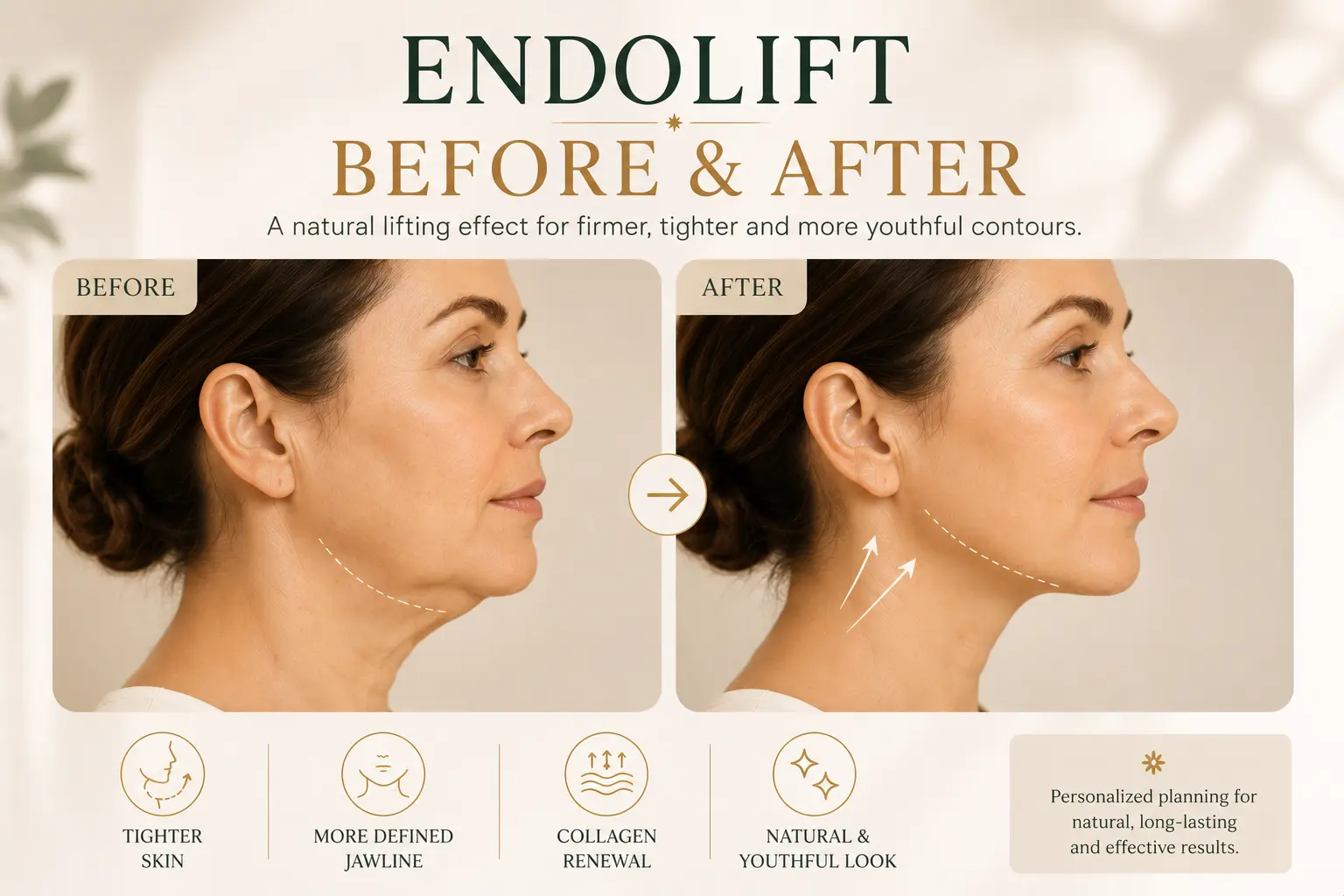
Endolift before-and-after changes may include a more defined jawline, reduced double-chin fullness, smoother lower-face transitions and improved firmness in areas with mild to moderate skin laxity. The degree of improvement depends on the patient’s starting anatomy and the tissue layers treated.
Endolift is not intended to completely transform the face or reproduce the result of a surgical facelift. In suitable patients, the aim is to refine the lower face, jawline, double chin or neck while preserving natural facial volume.
Send Your Photos on WhatsApp Explore Endolift Treatment Request a ConsultationThe information on this page is intended for general guidance. Your expected Endolift before-and-after result can only be estimated after a personal examination and tissue assessment.
The first appearance is not the final result; improvement may continue for months.
The aim is to refine existing anatomy rather than change facial identity.
Lighting, angle, expression and head position affect interpretation.
Skin, fat, skeletal support and age are different in every patient.
Quick Answer: What Changes Can You Expect Before and After Endolift?
In suitable patients, the jawline may look more defined, the double chin may appear lighter, lower-face transitions may look more balanced and the skin may appear firmer.
The degree of improvement depends on starting skin laxity, localised fat volume, skeletal support, age, skin quality and individual collagen response.
Endolift cannot completely correct advanced sagging, substantial excess skin or marked volume loss on its own. Another treatment or surgical assessment may be more appropriate in these situations.
What Is Assessed Before Endolift?
An Endolift consultation involves more than looking at the surface of the skin. The anatomical layers that shape the lower face and neck are assessed together.
- Skin thickness and elasticity
- Degree of laxity
- Jawline and jowl appearance
- Amount and depth of double-chin fat
- Chin and mandibular skeletal support
- Neck skin and platysma muscle structure
- Distribution of natural facial fat compartments
- Mid-face or lower-face volume loss
- Previous fillers, threads, lasers or surgical procedures
- Weight changes and future weight-loss plans
- Medical history, medication and healing characteristics
- Whether the expected change is realistic
This layered assessment helps determine whether Endolift is suitable and which tissue areas should be treated or protected.
How Should You Prepare Before Endolift?
Preparation varies according to medical history and the area being treated. General points that may be reviewed include:
- Informing the doctor about all medication and supplements
- Reporting a tendency to bleed or bruise
- Reporting active infections, cold sores or skin lesions
- Providing details of previous aesthetic procedures
- Discussing smoking or nicotine use
- Sharing any travel plans close to treatment
- Discussing major planned weight loss or weight gain
- Arriving with clean skin and, where possible, without make-up
- Planning transport and daily activities after treatment
Prescription medication should not be stopped or started without medical advice.
Personal instructions provided by your treating doctor should take priority over general online advice.
Why Are Before Photos Important?
Standardised photographs document the starting anatomy and make later changes easier to assess accurately.
A front photograph alone is not sufficient. Profile and 45-degree views help assess the jawline, double chin and neck transition.
The following conditions should remain as consistent as possible:
- The same camera or a similar lens
- The same camera distance
- The same head and neck position
- The same lighting direction and intensity
- A neutral facial expression
- No lifting or lowering of the chin
- Hair kept away from the jawline and neck
- No filters, retouching or artificial sharpening
Non-standardised photos can make a small change look either larger or smaller than it really is.
Endolift Before-and-After Timeline
| Stage | What May Be Visible | How It Should Be Interpreted |
|---|---|---|
| Before treatment | Starting laxity, fat distribution and contour are documented | This provides the treatment reference point |
| First 24–72 hours | Swelling, firmness, tenderness and temporary asymmetry may occur | This should not be judged as the final result |
| First week | Swelling and bruising may decrease, while firmness can remain | Early recovery is still continuing |
| 2–4 weeks | The true jawline and double-chin contour may become clearer | An early comparison may be more meaningful |
| 1–3 months | Collagen response and gradual tightening may develop | The change becomes easier to assess |
| 3–6 months | More settled and natural tissue transitions may be visible | A near-final comparison can be made |
For more detail about how the result develops, read when you will see Endolift results.
What Does the First Day After Endolift Look Like?
Early firmness or contour change may be noticeable immediately after treatment. However, swelling can make the face, double chin or neck look temporarily fuller.
Possible early changes include:
- Mild or more noticeable swelling
- Tenderness
- Bruising
- Temporary numbness
- Firmness beneath the skin
- Temporary differences between the two sides
- Small marks at fibre-entry points
This appearance does not indicate the final result or determine whether the procedure has been successful.
Unexpectedly increasing pain, progressive redness, marked heat, excessive swelling or worsening asymmetry should be reported to the clinic.
The First Week After Endolift
Swelling generally decreases gradually during the first week, although both sides may not recover at the same speed.
The jawline may look clearer on one day and more swollen on another. Daily variation can be part of normal early recovery.
Firmness or tightness beneath the skin may improve as healing progresses. Aggressive massage should not be performed unless specifically advised.
For further information, read the Endolift recovery-time guide.
The First Month After Endolift
By the end of the first month, the true jawline, double-chin and neck contour may be easier to assess if early swelling has substantially reduced.
Some patients may notice a clearer jawline, reduced double-chin fullness or a more balanced lower face.
Collagen remodelling is still continuing, so the first month is not usually considered the fully settled result.
A one-month review can help confirm that recovery is progressing appropriately, but it may be too early to plan another procedure.
Three to Six Months After Endolift
Collagen-related tightening may develop over several weeks and months. A more mature before-and-after comparison is therefore generally made after a few months.
At 3–6 months, the following may be assessed more meaningfully:
- Continuity of the jawline
- Change in jowl appearance
- Double-chin volume and the chin-to-neck angle
- Neck-skin firmness
- Overall lower-face balance
- Symmetry between the two sides
- Preservation of natural facial volume
- Natural transitions with surrounding tissues
For information about longevity, read how long Endolift results last.
Jawline Endolift Before and After
Jawline improvement may appear as a smoother mandibular border and reduced shadowing from mild jowls.
The most suitable patients often have mild to moderate lower-face laxity, reasonable skin quality and adequate skeletal support.
If the chin is recessed or mandibular support is limited, tightening alone may not create the desired definition.
Structural support may need separate assessment. Read our jawline filler vs Endolift guide.
Double-Chin Endolift Before and After
In the double-chin area, the expected change may include a reduction in small localised fat deposits and a clearer chin-to-neck transition.
Swelling can make this area look fuller during the first few days, so photographs taken immediately after treatment may be misleading.
Endolift alone may be insufficient when there is substantial fat, significant excess skin or prominent platysmal bands.
For greater fat volume, liposuction may need to be considered. Read our Endolift vs double-chin liposuction comparison.
Neck Endolift Before and After
Suitable patients with mild to moderate neck laxity may achieve a smoother and firmer appearance.
Head position is especially important in neck comparisons. Raising the chin can make the neck appear tighter than it really is.
Surgery may provide a more meaningful change when there is substantial excess skin, advanced neck sagging or prominent muscle bands.
Neck treatment should be planned according to skin, fat and muscle anatomy rather than photographs alone.
Cheek Endolift Before and After
Endolift planning in the cheek area requires caution. Natural cheek fat compartments contribute to a healthy, youthful and balanced appearance.
The aim should not be unnecessary facial slimming or indiscriminate volume reduction. Mild laxity in selected areas may be treated while preserving natural fullness.
Excessive fat reduction may look sharp initially but contribute to hollowing, tiredness and premature ageing over time.
Conservative planning is particularly important in already thin or volume-deficient faces.
Facial Endolift Before and After
Overall facial change does not come from one isolated area. It reflects the relationship between the jawline, double chin, lower cheek, neck and skeletal support.
A natural result preserves facial expression, character and personal proportions. The aim is not to make someone look like a different person, but to create a cleaner and more rested contour.
When volume loss is present, tightening alone may not provide the desired rejuvenation. Filler or a biostimulatory treatment may support a different anatomical layer in selected patients.
Read more in our guide to Endolift for the face.
Body Endolift Before and After
In areas such as the abdomen, upper arms, back, thighs and knees, the before-and-after change may include reduced small localised fat deposits and a firmer skin appearance.
Factors affecting body results include excess skin, fat volume, stretch marks, weight change, age and mechanical movement of the area.
Endolift does not reproduce the result of surgical skin removal or large-volume liposuction in patients with substantial excess skin or fat.
Body photographs should also be taken using the same posture, lighting, clothing and camera distance.
Are Endolift Before-and-After Photos Reliable?
Standardised and unedited photographs are useful, but photographs do not replace clinical examination.
The following differences may create a misleading comparison:
- Keeping the chin lower before treatment and higher afterwards
- Extending the neck in the after photograph
- Changing the camera distance
- Using a wide-angle lens
- Changing lighting direction
- Changing facial expression
- Presenting weight loss as a treatment result
- Using filters, shadows or retouching
- Selecting a photograph before early swelling has settled
A reliable comparison combines standardised photographs taken under the same conditions with clinical examination.
Does the Face Look Slimmer After Endolift?
The lower face may look lighter or more defined when a small localised fat pocket is treated appropriately.
However, Endolift is not a general facial-slimming procedure, and facial thinning should not be the goal in every patient.
Fat reduction may be unsuitable in thin, hollow or volume-deficient faces.
Treatment should focus on identifying unnecessary volume while preserving healthy and natural facial fullness.
Does the Jawline Become Sharper After Endolift?
The jawline may look more defined and orderly in suitable patients. The degree of sharpness depends on bone structure, chin position, fat distribution and skin laxity.
If skeletal support is limited, Endolift can only refine the soft tissues; it cannot create a new bony jawline.
Very sharp social-media results are therefore not realistic for every patient.
A natural result should remain balanced with the original facial proportions and expressions.
Does Endolift Completely Remove Sagging?
Endolift may provide measured tightening in mild to moderate laxity. It should not be expected to eliminate advanced sagging or a large amount of excess skin.
Sagging is not caused by the skin alone. Fat-compartment descent, ligament laxity, reduced skeletal support and muscle structure also contribute.
A surgical facelift or neck lift may provide a stronger option for more advanced changes.
Read our Endolift vs facelift comparison.
Who May See a More Noticeable Before-and-After Change?
Mild or Moderate Laxity
Improvement may be more predictable when laxity remains within the realistic scope of a minimally invasive treatment.
Small Localised Fat Pockets
Limited fat beneath the chin or around the lower face may make contour improvement easier to see.
Reasonable Skin Quality
Better elasticity and collagen response may support tightening.
Stable Weight
Weight stability helps make facial, neck and body contours easier to assess.
Realistic Expectations
Patients expecting measured, natural improvement can assess the outcome more accurately.
Correct Anatomical Planning
Results may be more balanced when the correct layer and treatment dose are selected.
Who May See a More Limited Change?
- Patients with advanced skin sagging
- Patients with substantial excess skin
- Patients with large localised fat deposits
- Patients with markedly weak skeletal support
- Patients with prominent neck-muscle bands
- Patients with severe sun damage and poor elasticity
- Patients with significant loss of natural facial volume
- Patients with frequent major weight changes
- Patients with dense fibrosis from previous procedures
- Patients expecting a surgical-level result
Endolift may still produce some improvement in these patients, but the result may be more limited and alternative options should be discussed honestly.
Is One Endolift Treatment Enough to Create a Before-and-After Difference?
Endolift is commonly planned as one main treatment followed by observation of the developing result.
A single treatment may produce a meaningful change in suitable patients with mild to moderate laxity.
Because the result does not finish developing immediately, another treatment should not be planned too early.
Read our guide: Is one Endolift treatment enough?
What Happens If the Result Appears Limited?
Swelling should first be allowed to resolve and collagen remodelling should be given time to develop.
After the result has settled, the remaining concern should be identified:
- Residual skin laxity
- Large fat volume
- Limited skeletal support
- Mid-face or chin-volume loss
- Surface skin-quality concerns
- Muscle-related lines
- Advanced excess skin
Depending on the remaining need, filler, Ultherapy, Morpheus8, botulinum toxin, another energy-based treatment or surgical consultation may be considered.
Targeting the remaining anatomical concern is often more appropriate than automatically repeating the same treatment.
Endolift Before and After When Combined With Filler
Endolift targets selected subdermal laxity and contour, while filler may restore missing volume or structural support.
When chin projection, mandibular support or mid-face volume is limited, Endolift alone may not create the desired proportions.
Combination treatment is not necessary for every patient. Unnecessary filler can make the face look heavier and reduce natural definition.
The decision should be based on separate anatomical needs rather than a routine combination protocol.
Endolift Before and After When Combined With Morpheus8
Morpheus8 may target texture, pores, acne scarring and dermal quality. Endolift works more directly within selected subdermal planes for tightening and contouring.
Combination treatment may be considered when different concerns are present in different tissue layers.
The order and interval between treatments should be planned according to healing and the tissue being targeted.
Read more about whether Endolift can be combined with Morpheus8.
Endolift Before and After When Combined With Ultherapy
Ultherapy delivers focused ultrasound energy through the skin without an optical fibre. Endolift uses a fine fibre within selected subdermal tissue planes.
Using both technologies does not automatically produce a better result.
Instead of applying unnecessary energy to the same area, the doctor should determine which technology is required for which anatomical layer.
Treatment choice should be based on tissue need, not on combining the greatest number of devices.
Endolift vs Facelift Before-and-After Difference
| Feature | Endolift | Surgical Facelift |
|---|---|---|
| Main aim | Measured tightening and local contour refinement | Mechanical repositioning of more advanced sagging |
| Suitable laxity | Mild or moderate | Moderate or advanced |
| Excess skin | Not surgically removed | May be surgically removed |
| Degree of change | More measured and gradual | May be stronger and more comprehensive |
| Recovery | Usually shorter | Requires surgical recovery |
The procedures do not promise the same result and are not direct equivalents. Read our Endolift vs facelift guide.
Does Aftercare Affect the Before-and-After Result?
Aftercare may support safe recovery and help make the early healing period more comfortable.
- Follow the doctor’s aftercare instructions.
- Avoid aggressive massage or unnecessary pressure during early recovery.
- Follow guidance regarding intense exercise and excessive heat.
- Use regular sun protection.
- Avoid smoking and nicotine products.
- Keep your weight as stable as possible.
- Attend recommended follow-up appointments.
- Report unexpected symptoms to the clinic.
Good aftercare is important, but it cannot compensate for unsuitable patient selection or poor anatomical planning.
Read the Endolift aftercare guide.
The Efem Method: Natural Anatomy Determines the Before-and-After Difference
The Efem Method does not aim to create the most dramatic possible difference between two photographs.
Skin, fat, connective tissue, muscle, skeletal support and natural facial volume are assessed separately. The plan identifies which layer should change and which should be preserved.
Unnecessary reduction of natural fat compartments is avoided, particularly in the cheeks and lower face. Treatment is directed only towards genuine laxity or localised fat.
When the expected change lies beyond the realistic limits of Endolift, this is discussed openly. Appropriate alternatives are considered instead of unnecessary treatment.
A good before-and-after result does not change facial identity. It makes the patient’s own anatomy appear more balanced and refined.
Why Are Follow-Up Appointments Important?
Follow-up is not only for photography. It is also used to assess clinical healing.
The following may be reviewed:
- Reduction in swelling and bruising
- Development of firmness beneath the skin
- Jawline and double-chin contour
- Symmetry of the lower face and neck
- Preservation of natural facial volume
- Unwanted hollowing or contour irregularity
- Progress of collagen remodelling
- Whether another treatment is required
Early follow-up focuses on healing, while later follow-up assesses the settled result.

Endolift Before-and-After Planning With Dr Abdurrahman Efem
Dr Abdurrahman Efem is a medical aesthetic physician and a Ministry-appointed trainer in medical aesthetics.
He provides physician education in Endolift, Ultherapy, Morpheus8, advanced filler techniques and facial contouring.
During consultation, the jawline, double chin, neck, natural facial volume, skeletal support, previous procedures and long-term expectations are assessed together.
When Endolift is unlikely to provide sufficient change, unnecessary treatment is not recommended. Filler, another energy-based treatment or surgical consultation may be discussed honestly when appropriate.
About Dr Efem Ask on WhatsAppA Privacy-Focused Villa Clinic in Levent, Istanbul
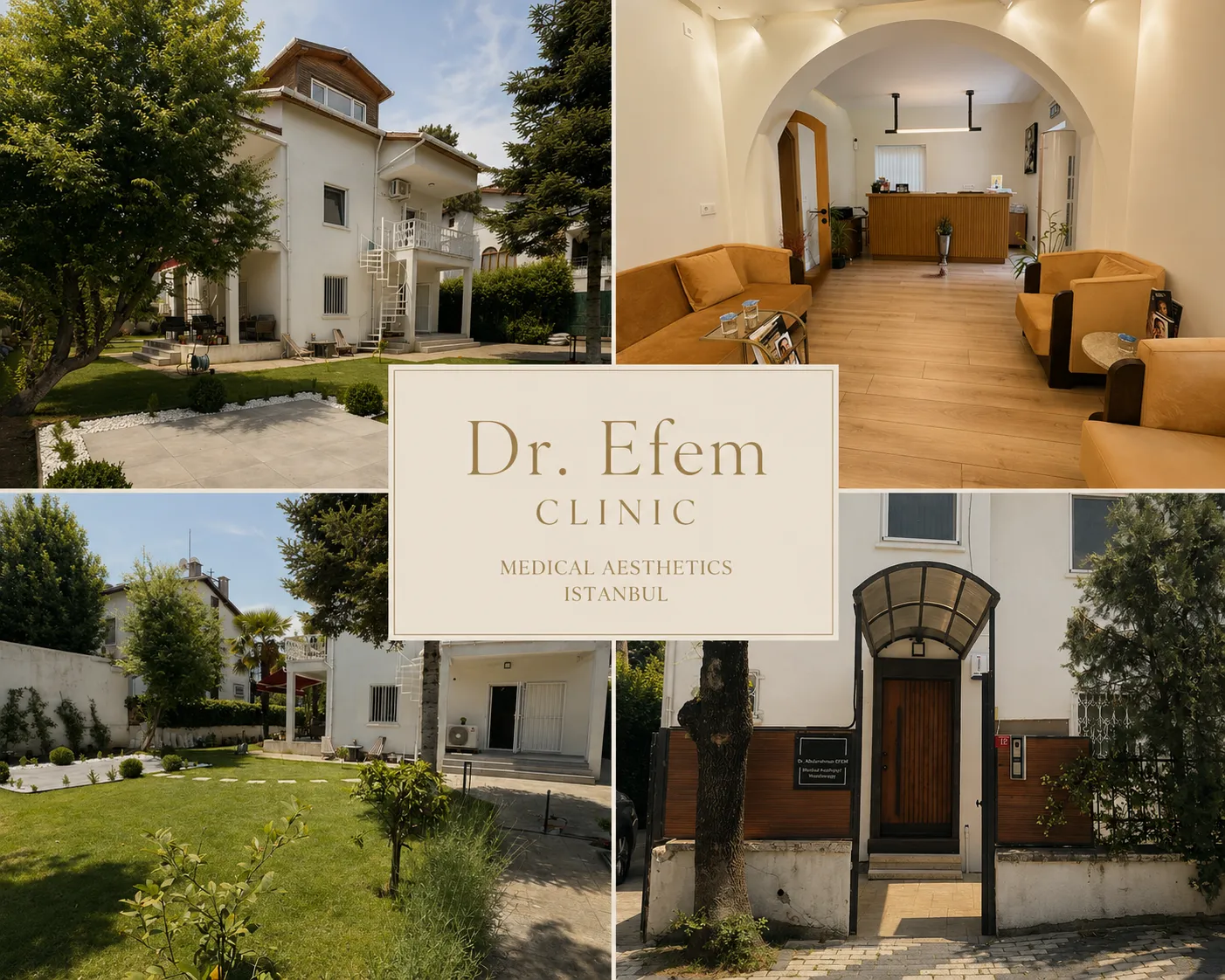
Efem Clinic provides care in a private villa clinic with a garden and parking in Levent, Istanbul.
Consultations are not rushed. Facial and neck anatomy, realistic outcomes, recovery and alternative treatments are discussed in detail before Endolift.
After treatment, recovery is followed using standardised photographs and clinical examination.
English and Turkish communication, international-patient planning and online follow-up support are available.
Efem Note
The best before-and-after difference is not always the most dramatic one.
Results that preserve natural facial fat, refine the jawline conservatively and maintain the character of facial expression may look more natural over time.
A successful Endolift result is not a change exaggerated by camera angle. It is a balanced improvement visible under the same light, in the same position and in real life.
Related Endolift Guides
Frequently Asked Questions
What changes can you expect before and after Endolift?
In suitable patients, the jawline may look more defined, the double chin lighter, lower-face transitions more balanced and the skin firmer.
Are Endolift results visible immediately?
Early firmness may be visible, but swelling means the appearance on the day of treatment is not the final result.
Why does the face look swollen after Endolift?
Treatment-related swelling may temporarily make the face, jawline or double-chin area look fuller.
When should final after photos be taken?
A more settled comparison is generally made after swelling has reduced and collagen remodelling has developed over several months.
Does the face become slimmer after Endolift?
The lower face may look lighter when selected localised fat is treated. Endolift is not a general facial-slimming procedure.
Does the jawline become sharper after Endolift?
The jawline may look more defined in suitable patients. The result depends on bone structure, fat distribution and skin laxity.
Does Endolift completely remove a double chin?
A small localised double-chin fat pocket may improve. Results may be limited with large fat volume or substantial excess skin.
Does Endolift completely remove sagging?
It may tighten mild to moderate laxity. It should not be expected to completely correct advanced sagging or substantial excess skin.
Is asymmetry normal after Endolift?
Temporary asymmetry may occur when swelling decreases at different speeds. Increasing or marked asymmetry should be reported.
When does firmness after Endolift improve?
Firmness beneath the skin may gradually reduce as healing progresses. Timing varies by treatment area and individual recovery.
Should medication be stopped before Endolift?
Prescription medication should not be stopped without medical advice. All medicines and supplements should be reported before treatment.
Can you wear make-up before Endolift?
Clean, make-up-free skin may be recommended on the treatment day. Personal clinic instructions should be followed.
How should before photos be taken?
Take front, profile and 45-degree views with a neutral expression, consistent lighting and unchanged chin position.
Are Endolift before-and-after photos reliable?
Standardised, unedited photographs taken under the same conditions are useful. Different lighting, angles or positions may be misleading.
Can one Endolift treatment create a visible difference?
A single treatment may create meaningful improvement in suitable patients. Several months may be required for the result to develop.
Can Endolift be repeated if the result is limited?
The first result should be allowed to settle. Repeat treatment should only be planned after the remaining anatomical need has been assessed.
Does Endolift work better when combined with filler?
Filler may help when volume or structural support is missing. Combination treatment is not required for every patient.
Does Endolift create the same result as a facelift?
No. A facelift surgically corrects more advanced sagging. Endolift aims for a more measured improvement in mild to moderate laxity.
Does weight loss affect Endolift before-and-after results?
Significant weight loss may alter facial volume and skin laxity. Treatment timing may need adjustment when major weight loss is planned.
Are Endolift before-and-after results permanent?
Tissue changes may be long-lasting, but natural ageing continues and the result may gradually change over time.
Can Endolift suitability be assessed from photos?
Photos may support a preliminary review, but skin quality, fat depth and tissue movement cannot be assessed fully without examination.
Request Your Personal Endolift Before-and-After Assessment
Send clear front, profile and 45-degree photographs for a preliminary review, or arrange an in-person consultation with Dr Abdurrahman Efem in Levent, Istanbul.
Request a Free Preliminary Assessment Contact Efem Clinic Meet Dr EfemThis content is intended for general information and does not replace an individual medical consultation. Endolift preparation, recovery, expected changes, longevity and possible risks vary between patients.
About Dr. Abdurrahman Efem

Dr. Abdurrahman Efem
Dr. Abdurrahman Efem is a medical aesthetic physician specializing in facial rejuvenation, non-surgical aesthetic treatments, and regenerative medicine. His approach focuses on enhancing natural beauty through personalized treatment plans designed around each patient's unique features and goals. Dr. Efem works with both local and international patients, emphasizing balanced, natural-looking results and long-term aesthetic wellbeing. This content has been prepared or medically reviewed by Dr. Abdurrahman Efem to ensure accuracy and relevance.