

Ultherapy For Brow
Brow Position, Upper Face and Non-Surgical Lifting Guide
Ultherapy for the Brow: Is a Non-Surgical Brow Lift Possible?
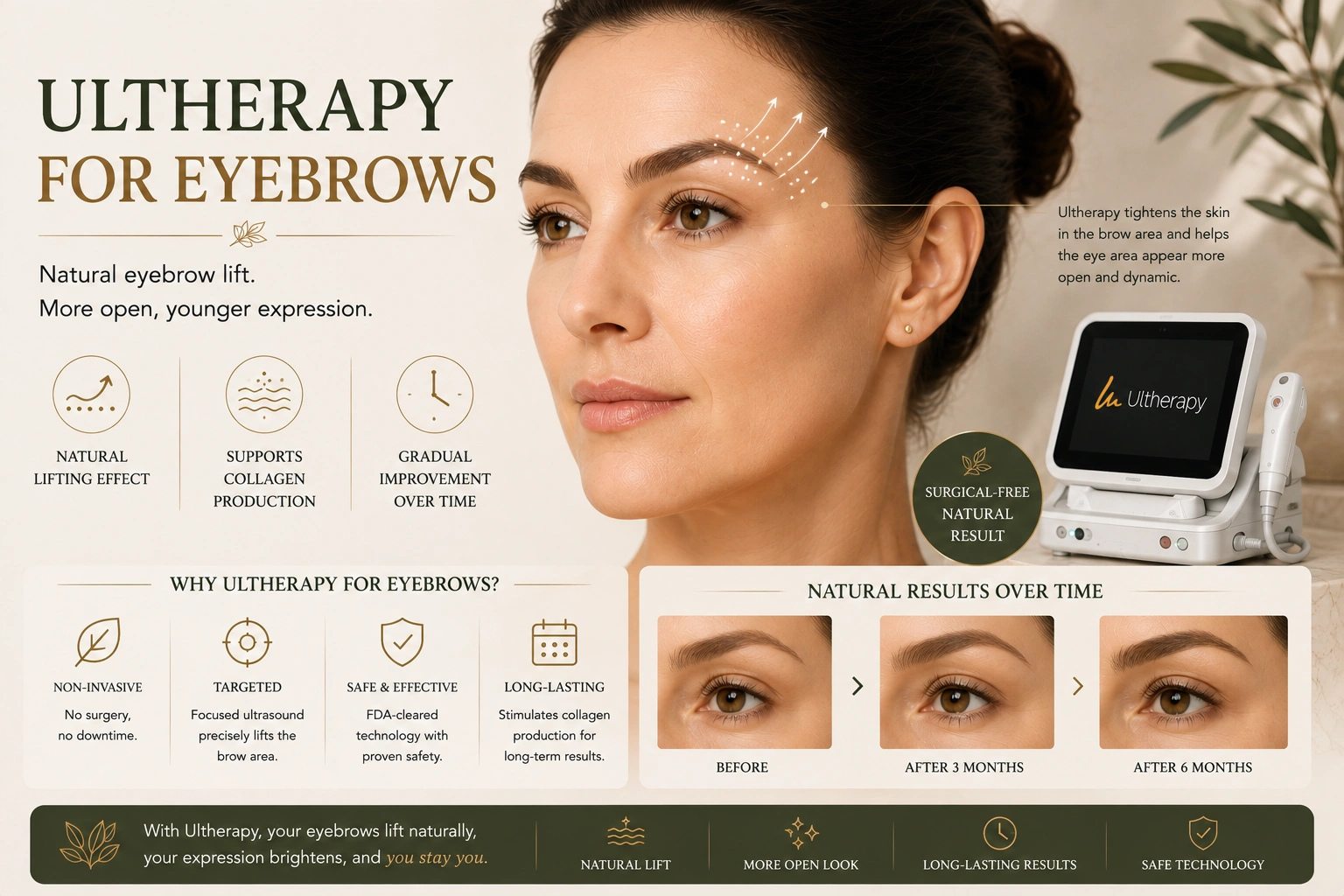
Ultherapy can be used in suitable patients to support a measured lifting effect in the brow area using microfocused ultrasound. The ULTHERA System has FDA clearance for lifting the brow. However, the treatment should not be viewed as a substitute for surgical brow lifting or upper eyelid surgery.
For brow Ultherapy, the most important question is not simply “how much can the brow be lifted?” but whether the heaviness around the upper eye area is actually caused by brow position, upper-eyelid skin excess, facial anatomy or dynamic muscle activity.
Request a Photo Assessment Explore Ultherapy Ultherapy Before and AfterFinal suitability depends on natural brow position, upper-eyelid anatomy, forehead muscle use, facial asymmetry and the amount of change the patient expects.
The ULTHERA System has FDA clearance for lifting the brow.
No surgical incision or surgical brow repositioning is performed.
The appearance develops over time through collagen remodelling.
Not every low-looking brow has the same anatomical cause.
Quick Answer: Can Ultherapy Lift the Brow?
In suitable patients, Ultherapy can support a measured lifting effect in the brow area.
Ultherapy has FDA clearance for brow lifting. The treatment uses microfocused ultrasound energy at selected tissue levels to support gradual collagen remodelling.
Results vary between patients. Ultherapy does not surgically reposition the brow, remove excess upper-eyelid skin or guarantee a fixed number of millimetres of elevation.
The best candidates are generally people with mild-to-moderate brow descent who are seeking a natural, gradual change rather than a dramatic surgical-level lift.
How Does Ultherapy Work for the Brow?
Ultherapy uses microfocused ultrasound technology. Real-time ultrasound imaging helps the practitioner visualise selected tissue levels during treatment.
Controlled ultrasound energy is delivered to appropriate anatomical areas, after which gradual tissue remodelling develops. The aim is not to add volume around the brow, but to support the existing tissue structure.
Ultherapy therefore:
- Does not add volume like filler.
- Does not temporarily relax facial-expression muscles like botulinum toxin.
- Does not surgically reposition tissue like a brow lift.
- Relies on a gradual biological remodelling response.
For more detail on the technology, read How Does Ultherapy Work?.
Which Part of the Brow Can Ultherapy Lift?
The brow is not a single straight line. The inner, middle and outer segments sit differently according to individual facial anatomy.
Treatment planning may consider:
- Current brow height
- Outer-brow position
- Natural asymmetry between the brows
- Forehead height
- Temple anatomy
- Upper-eyelid appearance
- How much the forehead muscles are compensating to lift the brow
The aim is not to pull the brow unnaturally high, but to support a more balanced upper-face appearance where appropriate.
Is Brow Descent the Same as Upper-Eyelid Drooping?
No. A heavy upper-eye appearance can have different anatomical causes, and distinguishing between them is one of the most important parts of treatment selection.
| Condition | What It May Mean | Role of Ultherapy |
|---|---|---|
| Lower brow position | The brow may sit lower because of ageing or natural anatomy. | May be considered for brow lifting in suitable patients. |
| Upper-eyelid skin excess | Extra skin may fold over the upper eyelid. | Does not surgically remove excess skin. |
| True eyelid ptosis | A different medical problem involving eyelid position may be present. | This is not the same as the standard brow-lift indication and requires appropriate medical assessment. |
| Forehead-muscle compensation | The patient may constantly raise the brows to keep the upper eye area open. | Dynamic facial assessment is needed before treatment planning. |
The same goal — “I want my eyes to look more open” — can require completely different treatment plans in different patients.
Who May Be Suitable for Brow Ultherapy?
Selected patients without advanced surgical-level sagging.
People seeking measured, gradual change rather than dramatic brow elevation.
People with suitable anatomy who are researching a non-invasive option.
Patients who want brow position assessed in the context of overall facial expression.
For general candidacy information, see Who Is a Good Candidate for Ultherapy?.
When May Brow Ultherapy Be Insufficient?
Not every heavy or low-looking upper-eye area can be corrected with Ultherapy.
Different or additional approaches may be more appropriate when there is:
- Significant upper-eyelid skin excess
- Advanced brow descent
- Surgical-level tissue sagging
- Possible true eyelid ptosis
- A desire for a dramatic, immediate brow lift
- Brow position strongly influenced by muscle activity
In these situations, adding more Ultherapy sessions may be less appropriate than reassessing the actual anatomical cause.
How Many Millimetres Can Ultherapy Lift the Brow?
There is no fixed number of millimetres that can be reliably promised to every patient in advance.
Factors that may influence the result include:
- Baseline brow position
- Age and tissue quality
- Forehead anatomy
- Upper-eyelid structure
- Natural facial asymmetry
- Treatment plan
- Individual biological response
Claims such as “Ultherapy will definitely lift the brow by 2 mm or 3 mm” are therefore not compatible with individualised treatment planning.
Can Ultherapy Lift the Outer Brow?
The outer brow is commonly considered during upper-face assessment. In selected patients, including the brow area within the treatment plan may support the appearance of the outer brow.
Outer-brow appearance is not determined by skin laxity alone. Temple anatomy, brow shape, muscle activity and upper-eyelid structure can all influence the result.
A standard treatment map should therefore not be created only from the visible height of the outer brow in a photograph.
Can Ultherapy Make the Eyes Look More Open?
An appropriate change in brow position may make the upper-eye area appear more open or rested in some patients.
Ultherapy, however:
- Is not surgery that changes eye shape.
- Does not remove upper-eyelid skin.
- Is not a surgical treatment for eyelid ptosis.
- Does not create a guaranteed “fox eye” or dramatically lifted eye appearance.
The treatment goal should remain within the patient's natural facial proportions.
What Is the Difference Between Brow Ultherapy and Botulinum Toxin?
Botulinum toxin and Ultherapy work through completely different mechanisms.
| Feature | Ultherapy | Botulinum Toxin |
|---|---|---|
| Mechanism | Microfocused ultrasound and tissue remodelling | Temporarily reduces activity in selected facial-expression muscles |
| Main target | Tissue support and brow lifting | Muscle balance and dynamic wrinkles |
| Result pattern | Gradual | May appear earlier as muscle activity changes |
| Do they replace each other? | No. The anatomical goals and mechanisms are different. | |
In selected patients, the treatments may be combined for different goals, but not everyone needs both.
Ultherapy or Botulinum Toxin for Brow Lifting?
The answer depends on what is mainly determining the brow position.
If the issue is related largely to the balance of facial-expression muscles around the brow, botulinum toxin may have a different role. If tissue laxity and lifting are the main concern, Ultherapy may be considered for a different purpose.
The better question is not “which treatment is stronger?” but “which treatment matches the actual anatomical problem?”
Ultherapy or Surgical Brow Lift?
The two approaches do not aim to create the same scale of change.
| Feature | Ultherapy | Surgical Brow Lift |
|---|---|---|
| Approach | Non-invasive microfocused ultrasound | Surgical repositioning |
| Scale of change | More measured and gradual | Can provide more substantial structural change in suitable patients |
| Incision | None | Depends on the surgical approach |
| Advanced brow descent | Potential may be limited. | Surgical assessment may be more appropriate. |
Rather than trying to overcome the limits of a non-invasive treatment with more sessions, surgical options should be discussed openly when appropriate.
How Many Ultherapy Sessions Are Needed for the Brow?
In suitable patients, Ultherapy may begin with one comprehensive treatment. It is not a protocol that automatically requires three or four sessions for everyone.
After the first treatment has had time to develop, the following can be reassessed:
- Change in brow position
- Patient satisfaction
- Natural asymmetry
- Newly developing laxity
- Whether another treatment would be more appropriate
For more detail, see How Many Ultherapy Sessions Do You Need? and Is One Ultherapy Session Enough?.
When Will You See Brow Ultherapy Results?
Ultherapy should not be assessed as an immediate brow-lifting procedure.
The biological remodelling process continues after treatment, so the appearance on day one is not the final result.
| Period | What May Be Seen? |
|---|---|
| First days | Temporary redness, swelling or tenderness may influence appearance. |
| First weeks | Remodelling continues; early assessment is possible but more time is needed. |
| Around 2–3 months | Comparison with baseline photographs may become more meaningful. |
| Later follow-up | Individual tissue response and ongoing ageing changes can be reviewed. |
For more detail, read When Will You See Ultherapy Results?.
How Long Do Brow Ultherapy Results Last?
The ageing process does not stop after treatment. New changes in the brow and forehead continue to develop over time.
Duration can be influenced by age, tissue quality, individual collagen response and ongoing ageing.
Treatment should therefore not be reduced to either “one session lasts forever” or “everyone must repeat it every year.” Current need should guide future planning.
Is Brow Ultherapy Painful?
Some patients may feel warmth, tingling or brief deeper tenderness at treatment points.
Comfort can vary according to:
- Individual pain sensitivity
- Treatment area
- Treatment plan
- Anatomical features
It would not be accurate to describe the treatment as completely painless for every patient.
Recovery After Brow Ultherapy
Ultherapy does not require surgical incisions, and many patients return to normal activities relatively quickly.
Temporary reactions may include:
- Redness
- Swelling
- Tenderness to touch
- Tingling
- Temporary sensory changes
For more detail on recovery and safety, read Ultherapy Recovery Time and Ultherapy Side Effects.
Will the Brows Become Symmetrical After Ultherapy?
Human faces are naturally asymmetrical. One brow may already sit higher before treatment, and this can result from forehead-muscle use, bone structure or soft-tissue differences.
The goal is therefore not to make both brows geometrically identical.
Documenting existing asymmetry before treatment helps make result assessment more objective.
How Should Brow Ultherapy Before-and-After Photos Be Compared?
Small changes in brow height can easily be exaggerated or hidden by photography conditions.
Use the same facial expression.
Slightly raising the brows can make the result look larger than it is.
Keep camera height consistent.
Moving the camera up or down changes eye and brow proportions.
Keep head position consistent.
Even a slight tilt can create artificial asymmetry.
Use similar lighting.
Shadows under the brow can make the upper eye look heavier or more open.
Allow enough time.
A day-one photograph should not be treated as the final Ultherapy result.
For more detail, see Ultherapy Before and After.
Can Brow Ultherapy Be Combined With Fillers?
Ultherapy and filler do not perform the same function. If genuine volume loss around the brow or temple also contributes to the appearance, filler may be considered for a separate anatomical purpose.
Brow descent should not, however, automatically be compensated for simply by adding volume.
For more detail on combination planning, read Can Ultherapy Be Combined With Fillers?.
Can Brow Ultherapy Be Combined With Morpheus8?
Ultherapy and Morpheus8 use different energy technologies. Ultherapy may be assessed for brow lifting and deeper support, while Morpheus8 may have a separate role for dermal texture, pores or RF microneedling goals.
To understand whether both technologies are genuinely needed, read Can Ultherapy Be Combined With Morpheus8?.
How Is the Cost of Brow Ultherapy Determined?
Ultherapy pricing should not be thought of only as a fixed “brow-area price.” Treatment scope is determined after medical assessment.
Factors may include:
- The overall treatment area
- Whether the brow is treated alone or with other facial areas
- Forehead and facial anatomy
- The patient's wider Ultherapy treatment plan
For more information, see Ultherapy Cost and What Affects Ultherapy Cost?.
The Efem Method: First Understand Why the Brow Looks Low
Within the Efem Method, the brow is not treated simply as a line that needs to be lifted upward.
The whole upper face is assessed first. Is the brow actually low? Is there upper-eyelid skin excess? Is the patient constantly using the forehead muscles to keep the eyes more open? Is there natural asymmetry between the brows?
If Ultherapy matches the actual problem, treatment is planned according to the patient's natural facial proportions.
If the main concern is not something Ultherapy can realistically address, the goal is to explain that clearly rather than simply adding more energy treatment.
A natural upper-face result is not about lifting the brow as high as possible. It is about preserving balance between the brow, eyelid, forehead and the rest of the face.
How Does Dr Abdurrahman Efem Assess Brow Ultherapy?
Dr Abdurrahman Efem is a medical aesthetic physician who evaluates the entire upper-face anatomy rather than looking only at brow height.
Assessment may include:
- Natural brow position
- Right-left asymmetry
- Forehead height
- Forehead-muscle activity
- Upper-eyelid appearance
- Temple anatomy
- Previous botulinum toxin, filler or energy-based treatments
- The amount of lifting the patient expects
The aim is not to create a standardised brow shape, but to produce a treatment plan that fits the patient's own anatomy and preserves a natural expression.
Brow Ultherapy in Levent, Istanbul
Efem Clinic provides personalised medical aesthetic planning in a private villa clinic environment in Levent, Istanbul.
Brow Ultherapy is not offered as a standard device package. Brow, forehead and upper-eye anatomy are assessed together before treatment planning.
When Ultherapy is not the most appropriate option, alternative approaches should be discussed openly.
Meet Dr Efem Dr Efem's Philosophy Contact Efem ClinicTravelling to Istanbul for Brow Ultherapy
Preliminary review can be especially useful for international patients because brow position and the upper-eye area are strongly influenced by dynamic facial anatomy.
Patients can send through WhatsApp:
- A neutral front-view photograph
- Right and left slight oblique views
- A close upper-face photograph without intentionally raising the brows
- A photograph with the eyes naturally open
- Approximate dates of previous botulinum toxin, filler or Ultherapy treatments
Photographs can provide preliminary guidance, but because the brow and upper-eye area are dynamic, the definitive treatment decision should be made after in-person medical assessment.
Related Ultherapy Guides
Frequently Asked Questions About Brow Ultherapy
Can Ultherapy lift the brow?
Ultherapy has FDA clearance for brow lifting. In suitable patients, it may support a measured lifting effect in brow position, although the degree of change varies.
How many millimetres can Ultherapy lift the brow?
There is no fixed number of millimetres that can be guaranteed for every patient. Baseline brow position, anatomy, tissue quality and individual response all influence the result.
Can Ultherapy lift the outer brow?
The outer brow may be included in treatment planning in suitable patients. Temple anatomy, muscle activity and upper-eyelid structure also influence its appearance.
Can Ultherapy make the eyes look more open?
A suitable change in brow position may make the upper-eye area appear more open in some patients. Ultherapy does not surgically change eye shape.
Does Ultherapy lift the upper eyelid?
A change in brow position may influence upper-eye appearance, but Ultherapy does not surgically remove excess upper-eyelid skin.
Does Ultherapy treat eyelid ptosis?
True eyelid ptosis is different from brow descent and requires appropriate medical assessment. It should not be treated as the same indication as brow Ultherapy.
Ultherapy or botulinum toxin for brow lifting?
The treatments work differently. Botulinum toxin changes muscle activity, while Ultherapy targets tissue remodelling and lifting. The better option depends on the anatomical cause.
How many Ultherapy sessions are needed for the brow?
Suitable patients may begin with one comprehensive treatment. The need for repeat treatment should be reassessed after the first result has developed.
When will brow Ultherapy results appear?
Results develop gradually. The day-one appearance is not the final result, and around 2–3 months may provide a more meaningful comparison point.
Is brow Ultherapy painful?
Some patients may feel warmth, tingling or brief tenderness at treatment points. Comfort varies between individuals.
Can swelling occur after brow Ultherapy?
Temporary redness or swelling may occur. Tenderness and temporary sensory changes can also occur.
Can the brows become asymmetrical after Ultherapy?
Natural facial asymmetry may already be present before treatment. Baseline photography and dynamic facial assessment help distinguish pre-existing asymmetry from post-treatment appearance.
Does Ultherapy create a fox-eye look?
Ultherapy is not intended to create a standard fox-eye appearance. Results depend on the patient's natural brow and upper-face anatomy.
Can Ultherapy replace a surgical brow lift?
No. Surgical brow lifting physically repositions tissue, while Ultherapy is non-invasive and generally produces a more measured change.
Can brow Ultherapy be combined with botulinum toxin?
Combination treatment may be considered in selected patients for different anatomical goals. Whether both are needed and how they should be sequenced requires medical assessment.
Can brow Ultherapy be combined with filler?
In selected patients with genuine volume loss, filler may be considered for a separate anatomical purpose. Ultherapy and filler do not replace each other.
How much does brow Ultherapy cost?
Cost depends on treatment scope and whether the brow is treated alone or together with other facial areas. The final plan is determined after assessment.
Can I return to work after brow Ultherapy?
Many patients return to normal activities relatively quickly. Temporary redness, swelling or tenderness can vary between individuals.
How do I know if brow Ultherapy is suitable for me?
Brow position, upper-eyelid anatomy, forehead-muscle use, facial asymmetry and the expected degree of change should be assessed together by a doctor.
Efem Note
When a patient asks for a brow lift, I do not look only at how low the brow appears. I also assess the upper eyelid, forehead, the relationship between the two brows and whether the patient is unconsciously raising the brows all the time.
Sometimes what a patient describes as a “low brow” is actually upper-eyelid skin excess. In other cases, the difference between the brows is simply part of the person's natural anatomy.
Ultherapy can support a natural brow-lifting effect in the right patient, but expectations should not be set at the level of surgical brow lifting.
For me, a good result is not about lifting the brow as high as possible. It is about making the upper face look more balanced without changing the person's natural expression.
Is Brow Ultherapy Suitable for You?
Send clear, unfiltered daylight photographs with a neutral facial expression from the front and slight oblique angles. Brow position, upper-eyelid appearance, natural asymmetry and forehead anatomy can be reviewed together to provide preliminary guidance on whether Ultherapy may be suitable.
Send Your Photos on WhatsApp Explore Ultherapy Before and After Gallery Contact Efem ClinicThis content is intended for general information. Suitability for brow Ultherapy, treatment scope and the degree of change that may be expected vary according to brow and forehead anatomy, upper-eyelid structure, pre-existing asymmetry, age and individual tissue response.
About Dr. Abdurrahman Efem

Dr. Abdurrahman Efem
Dr. Abdurrahman Efem is a medical aesthetic physician specializing in facial rejuvenation, non-surgical aesthetic treatments, and regenerative medicine. His approach focuses on enhancing natural beauty through personalized treatment plans designed around each patient's unique features and goals. Dr. Efem works with both local and international patients, emphasizing balanced, natural-looking results and long-term aesthetic wellbeing. This content has been prepared or medically reviewed by Dr. Abdurrahman Efem to ensure accuracy and relevance.