


How To Repair Damaged Skin?
A Guide to Skin Barrier Damage, Sensitivity, Dryness and Sun Damage
How to Repair Damaged Skin: A Guide to Restoring the Skin Barrier and Rebalancing Your Skin
“Damaged skin” is not a single medical diagnosis. The term is commonly used to describe dryness, stinging, burning, redness, flaking, dullness, rough texture, increased sensitivity or visible changes after excessive skincare, sun exposure or environmental stress.
The first step in repairing damaged-looking skin is usually not adding a stronger active ingredient or another procedure. It is identifying whether the main problem is barrier disruption, irritation, sun damage, pigmentation or a separate dermatological condition.
Request a Skin Assessment Explore Medical Skincare Read the Skin Barrier GuideYou can send clear, unfiltered photographs taken in natural daylight together with a list of the skincare products you currently use for preliminary guidance before visiting Istanbul.
Dryness, stinging, burning and sudden sensitivity to skincare products may occur.
Layering acids, retinoids and exfoliating products too aggressively may increase irritation.
UV exposure may contribute to uneven pigmentation, dullness and visible photoaging.
Calm the skin first, then treat persistent pigmentation, texture or ageing concerns if needed.
Quick Answer: How Do You Repair Damaged Skin?
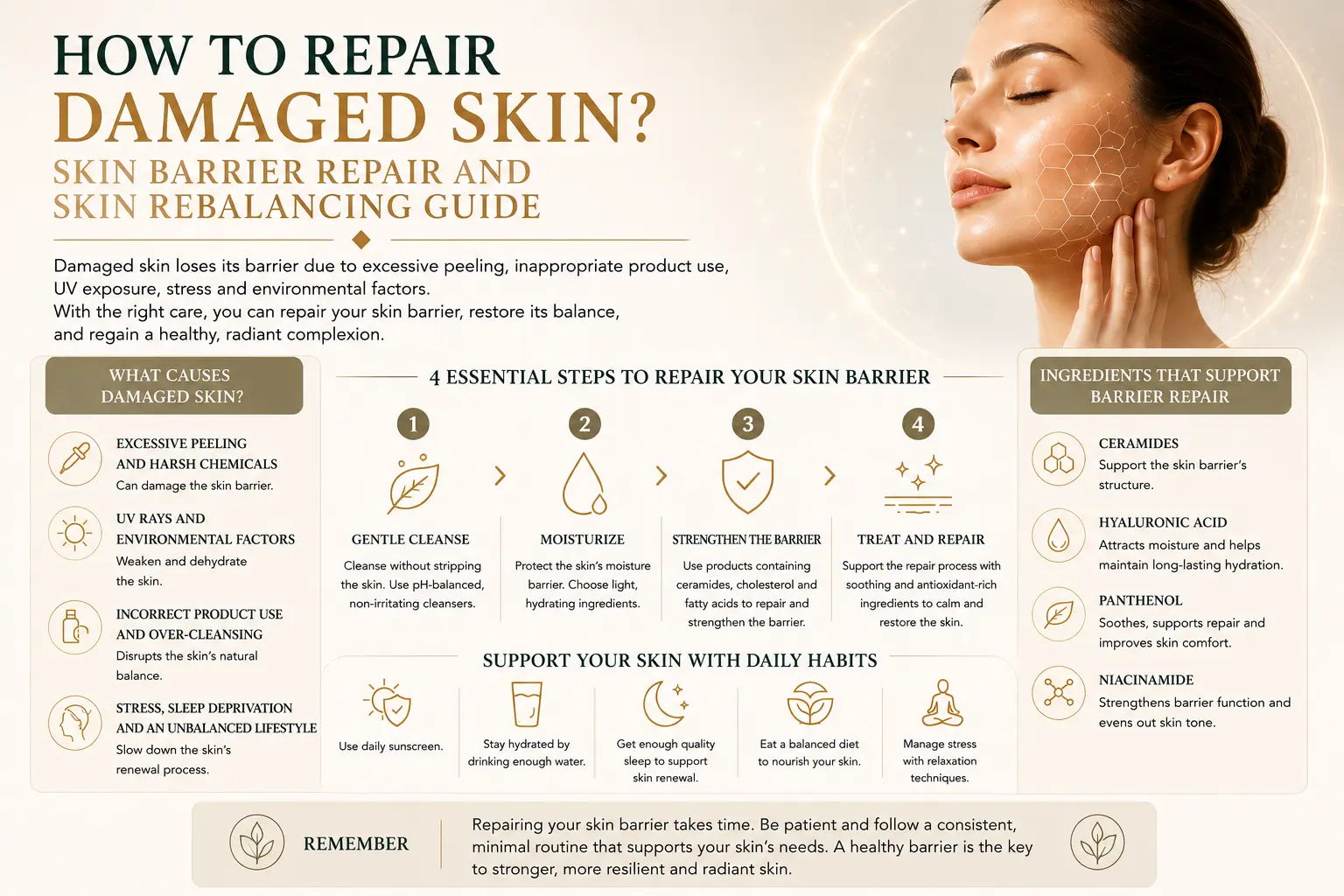
When skin is irritated or its barrier appears compromised, a sensible starting point is usually to simplify the skincare routine, reduce irritating products temporarily, cleanse gently, moisturise regularly and protect the skin from unnecessary UV exposure.
If your skin burns, stings or becomes red and products that were previously comfortable suddenly feel irritating, continuing to layer exfoliating acids, retinoids and other strong actives may prolong the problem.
Once the skin feels stable again, persistent concerns such as pigmentation, rough texture, pores, dullness or visible sun damage can be assessed separately.
Intense itching, widespread rash, crusting, swelling, discharge or persistent inflammation should not simply be labelled a “damaged skin barrier” and may require dermatological assessment.
What Does “Damaged Skin” Mean?
Damaged skin is a broad everyday term rather than one specific diagnosis.
People commonly use it to describe:
- Dryness and tightness
- Flaking
- Burning or stinging
- Increased sensitivity
- Redness
- Rough or uneven texture
- Dull-looking skin
- Makeup no longer sitting smoothly
- Uneven skin tone
- More visible sun spots
- Fine lines appearing more prominent
Some of these changes may occur with skin-barrier disruption, while others may reflect photoaging, dermatitis, rosacea, irritation from acne treatment or another dermatological condition.
What Is the Skin Barrier?
The outermost layer of the skin, particularly the stratum corneum, acts as an important protective interface between the body and the external environment.
A healthy barrier helps:
- Limit excessive water loss
- Reduce penetration of environmental irritants
- Protect against external stressors
- Maintain a more comfortable skin surface
When barrier function is impaired, the skin may lose water more easily and products that would normally be tolerated may begin to sting or irritate.
How Can You Tell if Your Skin Barrier Is Damaged?
No single symptom proves that the barrier is damaged, but several changes occurring together may be suggestive.
- Excessive tightness after cleansing
- Stinging even when applying moisturiser
- Products that were previously tolerated suddenly causing discomfort
- Fine flaking
- Diffuse dryness
- Mild-to-moderate redness
- Skin that looks shiny but still feels dehydrated
- Tenderness or sensitivity to touch
- Burning after active skincare products
Prominent itching, a persistent rash or recurrent inflammation may instead indicate dermatitis, rosacea or another dermatological disorder and deserves separate assessment.
What Causes Skin to Become Damaged or Irritated?
Over-Exfoliation
Using AHA, BHA, peeling solutions, scrubs or similar products too frequently may increase dryness and irritation.
Retinoid Irritation
Starting retinoids too aggressively or combining them with several irritating products may increase peeling and sensitivity.
Aggressive Cleansing
Frequent washing, very hot water or harsh cleansers may leave some skin types feeling dry and tight.
Sun and Heat
UV exposure and hot environments may contribute to irritation, dryness, pigmentation and visible photoaging.
Sea and Pool Exposure
Salt water, chlorine, frequent showering and sunlight together may increase discomfort in dry or sensitive skin.
Dermatological Conditions
Rosacea, atopic dermatitis and contact dermatitis may feel like a “damaged barrier” but require diagnosis-specific care.
Can Over-Exfoliation Damage the Skin Barrier?
Chemical and physical exfoliation can be useful when appropriately selected, but exfoliating more frequently does not automatically produce better skin.
Possible signs of over-exfoliation include:
- Burning
- Redness
- Fine peeling
- Dryness
- Increased product sensitivity
- A shiny yet tight-looking surface
When this happens, adding another exfoliating product may be less helpful than reducing irritation and allowing the skin to settle.
Can Retinol or Retinoids Damage Your Skin?
Retinoids are useful dermatological ingredients when appropriately used, but dryness, peeling and irritation can occur, particularly when treatment is started too rapidly or used too frequently.
If significant irritation develops, a more conservative approach may include:
- Reducing application frequency
- Temporarily limiting other irritating actives
- Increasing moisturising support
- Maintaining photoprotection
- Seeking professional advice if symptoms persist
The aim is not necessarily to avoid retinoids permanently, but to use them according to individual skin tolerance.
What Should a Damaged-Skin Routine Look Like?
| Step | Main Goal |
|---|---|
| Gentle cleansing | Remove sweat, dirt and sunscreen without unnecessarily stripping the skin |
| Moisturising | Support hydration and reduce excessive water loss |
| Reduce irritating actives | Avoid repeatedly provoking already-irritated skin |
| Photoprotection | Reduce additional UV damage and darkening of pigmentation |
| Gradual reintroduction | Restart genuinely useful active ingredients slowly once the skin is comfortable |
Which Products May Need a Temporary Break?
Not every active ingredient needs to be stopped in every person. However, when skin is actively burning, peeling or highly sensitive, the frequency of potentially irritating products may need review.
- AHA and BHA exfoliating acids
- Strong at-home peeling solutions
- Physical scrubs
- Retinol and other retinoids
- Irritating acne actives
- Fragranced or alcohol-heavy products that sting
- Complex routines containing several strong actives at once
The purpose is not to permanently ban active skincare. It is to stop repeatedly irritating the skin while tolerance is recovering.
Why Is Moisturiser Important for a Damaged Skin Barrier?
Moisturisers can support skin hydration and may help reduce transepidermal water loss.
Depending on the formulation, useful moisturising ingredients may include:
- Ceramides
- Glycerin
- Hyaluronic acid
- Dimethicone
- Squalane
- Petrolatum
- Panthenol
The overall formulation and whether the individual skin tolerates it are often more important than focusing on one fashionable ingredient.
Do Ceramides Help Repair the Skin Barrier?
Ceramides are important components of the lipid structure of the stratum corneum. Appropriately formulated ceramide-containing moisturisers may support dry or barrier-impaired skin.
Ceramides are not, however, a treatment for every inflammatory skin disorder. Active dermatitis or another medical condition may require separate diagnosis and treatment.
Should You Use Sunscreen on Damaged Skin?
Yes. Reducing additional ultraviolet exposure is particularly relevant when the skin is irritated, pigment-prone or already showing visible sun damage.
Some sunscreen formulations may sting very sensitive skin. In that situation, it may be useful to consider:
- Simpler formulations
- Fragrance-free products
- Products designed for sensitive skin
- A different sunscreen-filter system
Difficulty tolerating one sunscreen does not mean photoprotection should be abandoned; another suitable formulation may be better tolerated.
How Long Does It Take to Repair the Skin Barrier?
There is no single recovery time that applies to every damaged or irritated skin barrier.
Recovery can be influenced by:
- Severity of irritation
- Frequency of active skincare use
- Underlying dermatological conditions
- Baseline skin dryness
- Ongoing sun exposure
- Consistency of the skincare routine
- Continued exposure to irritants
Mild irritation may settle relatively quickly, while significant dermatitis or persistent inflammation may require longer recovery and medical treatment.
How Should You Restart Active Skincare?
Once active burning, marked tightness and visible irritation have settled, strong products should not necessarily all be restarted at once.
A more controlled approach may involve:
- Restarting one active product at a time
- Beginning at a lower frequency
- Watching how the skin responds for several days
- Avoiding several strong actives on the same day initially
- Reducing frequency again if irritation returns
The goal is to rebuild a useful routine rather than returning to the same combination that caused repeated irritation.
Is Damaged Skin the Same as Sensitive Skin?
Not necessarily. Sensitive skin may represent a longer-term tendency to react to cosmetics or environmental exposures, while previously tolerant skin can also become temporarily sensitive after irritation or excessive skincare.
Rosacea, atopic dermatitis and contact dermatitis can also present with burning, redness or sensitivity. Persistent symptoms should therefore not automatically be attributed to a damaged barrier.
Is Skin-Barrier Damage the Same as Sun Damage?
No. Barrier disruption is commonly associated with dryness, burning, stinging and increased sensitivity. Chronic sun damage tends to produce a different group of visible changes.
| Barrier Disruption | Sun / Photo Damage |
|---|---|
| Burning and stinging | Sun spots and uneven pigmentation |
| Dryness and flaking | Fine lines and elasticity changes |
| Sensitivity to skincare | Rougher or uneven texture |
| Temporary redness | Long-term visible photoaging |
For more information about ultraviolet damage, read Harmful Effects of Sun on Skin.
Why Can Skin Look Tired or Damaged After Summer?
Summer can combine prolonged sunlight, heat, seawater, chlorinated pools, sweating and more frequent cleansing.
By the end of the season, some people notice:
- Dryness
- Dullness
- Uneven skin tone
- Sun spots
- Rough texture
- Increased sensitivity
For a more detailed discussion, read Why Does the Skin Barrier Break Down in Summer?
Can Medical Skincare Help Damaged Skin?
Where the skin is suitable, professional medical skincare may be considered. However, highly inflamed, actively blistered, wounded or dermatitis-affected skin should not automatically receive an aggressive facial treatment.
Depending on the individual concern, professional skincare may focus on:
- Gentle cleansing
- Hydration support
- Improving skin comfort
- Reorganising the home skincare routine
Learn more on our Medical Skincare page.
Can Healite II LED Be Used for Damaged or Sensitive Skin?
LED-based treatment may be used as a supportive component of selected skin-care and recovery protocols.
However, LED should not be presented as a standalone cure for dermatitis, infection or every form of skin-barrier dysfunction.
Suitability depends on the condition of the skin. Learn more about Healite II LED.
Can You Have a Chemical Peel on Damaged Skin?
A chemical peel is not necessarily the right first step when the skin is actively burning, peeling or significantly irritated.
Once the skin is stable, controlled peeling may be considered in selected patients for concerns such as:
- Uneven skin tone
- Selected superficial pigmentation
- Dullness
- Certain texture concerns
The purpose of an appropriately selected peel is controlled exfoliation rather than uncontrolled barrier injury. Learn more about Chemical Peels.
When Can Dermapen or Microneedling Be Considered?
Microneedling is not an immediate treatment for actively inflamed barrier damage.
Once the skin is stable, selected patients may consider microneedling for:
- Texture irregularity
- Selected acne-scar types
- Visible pores
- General skin-quality concerns
Learn more about Dermapen Microneedling.
Which Treatments May Be Considered for Persistent Sun Spots?
If pigmentation remains after the skin barrier is stable, the pigmentation type should be identified before treatment is selected.
Melasma and solar lentigines are not the same pigmentation problem, so treatment should not be selected simply because “a dark spot is present.”
Can Morpheus8 Repair Damaged Skin?
Morpheus8 is not a first-line treatment for an actively irritated skin barrier.
Once barrier stability has been restored, it may be considered in selected patients for different objectives such as skin texture, visible pores, acne scars or firmness.
If the skin remains significantly red or sensitive, skin stability should be assessed before planning an energy-based procedure. Learn more about Morpheus8.
Can Mesotherapy or Skin Boosters Be Used for Damaged Skin?
If the primary problem is surface irritation and barrier dysfunction, barrier-focused skincare may be more logical before introducing injectable or regenerative skin-quality procedures.
After the skin has stabilised, mesotherapy or skin-quality treatments may be considered where hydration, fine texture or general skin quality remain the main concern.
These procedures do not replace daily skincare. Learn more about Mesotherapy and Skin Boosters.
Which Treatment Is Best for Damaged Skin?
| Main Concern | Typical First Approach |
|---|---|
| Burning, stinging and flaking | Simplify the routine and focus on barrier-supportive care |
| Dryness and dullness | Hydration support and, where suitable, medical skincare |
| Sun spots | Identify the pigment type before considering Lumecca, Q-Switch or another pigment-focused treatment |
| Texture and pores | Consider microneedling or selected energy-based procedures after barrier recovery |
| Persistent redness and rash | Evaluate dermatological causes before aesthetic treatment |
When Should You See a Dermatologist?
The following signs should not simply be managed as a cosmetic skin-barrier problem:
- Severe or progressively worsening redness
- Intense itching
- Widespread rash
- Blistering
- Discharge or yellow crusting
- Significant facial swelling
- Marked inflammation around the eyes
- Non-healing sores
- A rapidly worsening reaction
- Suspected allergic reaction after a product
In these situations, adding more active skincare is not an appropriate substitute for medical assessment.
The Efem Method: Correct Sequencing Instead of More Procedures
Within the Efem Method, the first question for irritated or damaged-looking skin is not “Which device should we use?”
Active irritation, barrier dysfunction, pigmentation, acne, rosacea tendency, sun damage and texture concerns are considered separately.
When the skin is actively burning or highly sensitive, stacking a peel, laser treatment and several aggressive home products may be less appropriate than allowing the skin to stabilise first.
Once the barrier is comfortable, the persistent concern becomes easier to identify and treatment can target that specific problem.
A layered approach does not mean doing more procedures. It means treating the right problem at the right stage.
Skin-Quality Planning With Dr Abdurrahman Efem
Dr Abdurrahman Efem is a medical aesthetic physician. At Efem Clinic, skin assessment considers barrier condition, sensitivity, pigmentation, texture, pores, previous procedures and the home skincare products currently being used.
If the skin is actively irritated, stabilising the skin and reorganising the skincare routine may be more appropriate before an aesthetic procedure is planned.
Avoiding unnecessary treatment when home skincare or further dermatological assessment is more appropriate is an important part of treatment planning.
Meet Dr Efem Request a Skin AssessmentPersonalised Skin Assessment in Levent, Istanbul
Efem Clinic provides care in a private villa setting with a garden and parking in Levent, Istanbul.
Skin-quality assessment considers skincare products, sun exposure, previous procedures, sensitivity, pigmentation and the patient's priorities together.
The aim is not to treat every damaged-looking skin concern with the same device. The first priority may sometimes be restoring comfort and barrier stability before any procedure is considered.
Efem Note
If your skin burns, stings and reacts to almost every product, the answer is often not adding three more active ingredients.
First reduce what is repeatedly irritating the skin and give it an opportunity to regain tolerance.
Once the barrier has settled, the real remaining problem becomes clearer: pigmentation, texture, pores, acne scars or photoaging.
Skin recovery often begins not by adding more, but by removing what the skin does not currently need.
Related Skin Guides and Treatments
Frequently Asked Questions
How do you repair damaged skin?
Simplifying the skincare routine, reducing irritants, cleansing gently, moisturising consistently and protecting the skin from excessive UV exposure are useful first steps for many barrier-related problems.
How do I know if my skin barrier is damaged?
Dryness, burning, stinging, flaking, tightness and increased sensitivity to products that were previously tolerated may occur.
How long does it take to repair a damaged skin barrier?
There is no exact recovery time for everyone. It depends on the severity of irritation, underlying skin conditions, ongoing irritant exposure and the skincare routine.
Can over-exfoliation damage the skin barrier?
Yes. Excessively frequent or aggressive exfoliation can increase dryness, burning, peeling and sensitivity in some skin types.
Can retinol damage the skin barrier?
Retinoids can cause dryness and irritation, particularly when introduced too quickly or used too frequently for the person's skin tolerance.
Should I stop acids if my skin barrier is damaged?
When skin is actively burning or irritated, reducing or temporarily pausing exfoliating acids may be appropriate.
Are ceramides good for a damaged skin barrier?
Ceramides form part of the skin's natural barrier lipids, and suitable ceramide-containing moisturisers may support dry or barrier-impaired skin.
Does hyaluronic acid repair the skin barrier?
Hyaluronic acid can provide hydration support but should not be considered a standalone treatment for every form of barrier dysfunction.
Should I wash my face if my skin barrier is damaged?
Yes, but gentle cleansing is generally preferable to aggressive cleansing that leaves the skin feeling very dry or tight.
Should I use sunscreen on damaged skin?
Yes. Reducing additional UV damage remains important. If one sunscreen stings, a more suitable sensitive-skin formulation may be better tolerated.
Can I wear makeup with a damaged skin barrier?
Makeup is not automatically prohibited, but reducing products that increase burning, dryness or irritation may make the skin more comfortable while it recovers.
Can medical skincare help damaged skin?
A gentle medical skincare treatment may be considered when appropriate. Active dermatitis or significant inflammation may need to settle before aesthetic skincare procedures.
Can Healite II LED help a damaged skin barrier?
LED may be used as supportive care in selected recovery protocols, but it is not a standalone treatment for every barrier disorder or inflammatory condition.
Can you have a chemical peel with damaged skin?
A peel may not be appropriate during active burning or significant irritation. It can be reconsidered for selected concerns after the skin has stabilised.
Does Dermapen repair the skin barrier?
Dermapen is not a first-line treatment for an actively irritated barrier. It may be considered later for selected texture, pore or acne-scar concerns.
Can Morpheus8 be used on damaged skin?
Significantly irritated skin should first be assessed for stability. Morpheus8 may later be considered for different skin-quality concerns in appropriately selected patients.
Is damaged skin the same as rosacea?
No. Rosacea is a separate dermatological condition. Persistent redness, burning or visible vessels may require specific assessment.
Could a damaged skin barrier actually be eczema?
Barrier dysfunction can occur in eczema and dermatitis. Significant itching, rash or recurrent inflammation should be medically assessed.
When should I see a doctor about damaged skin?
Seek medical assessment for severe redness, intense itching, swelling, blistering, discharge, open sores or reactions that persist or rapidly worsen.
Is Your Skin Constantly Burning, Dry or Sensitive?
Send clear, unfiltered photographs taken in daylight together with the cleanser, serum, acids, retinoid, moisturiser and sunscreen you currently use. You can request preliminary guidance about your skin barrier and overall skin quality.
Request an Assessment on WhatsApp Explore Medical Skincare Meet Dr EfemThis article is intended for general information. Persistent redness, dermatitis, rosacea, infection, allergic reactions or other suspected dermatological conditions may require assessment by a dermatologist.
About Dr. Abdurrahman Efem

Dr. Abdurrahman Efem
Dr. Abdurrahman Efem is a medical aesthetic physician specializing in facial rejuvenation, non-surgical aesthetic treatments, and regenerative medicine. His approach focuses on enhancing natural beauty through personalized treatment plans designed around each patient's unique features and goals. Dr. Efem works with both local and international patients, emphasizing balanced, natural-looking results and long-term aesthetic wellbeing. This content has been prepared or medically reviewed by Dr. Abdurrahman Efem to ensure accuracy and relevance.