


Cheek Filler Istanbul | Natural Midface Support and Facial Balance
Doctor-Led Medical Aesthetics · Levent, Istanbul
Cheek Filler Istanbul
Natural Midface Support, Facial Balance and a Softer Tired Appearance
If your cheeks look flatter, your under-eye area appears more hollow or the middle part of your face has lost support, cheek filler may provide a refined improvement in carefully selected patients.
The goal is not to create large, swollen or artificial cheeks. Treatment is planned to restore the amount of support that suits your facial anatomy while preserving your natural expression.
Photographs may help with an initial assessment. Final suitability and treatment planning require a medical consultation.
QUICK ANSWER
What Does Cheek Filler Do?
Cheek filler is an injectable medical aesthetic treatment used to improve volume loss, reduced support and contour changes in the midface.
In suitable patients, it may help soften the transition between the under-eye and cheek, improve facial support, reduce a tired appearance and indirectly soften nasolabial folds related to midface volume loss.
Cheek filler is not simply about making the cheeks larger. Correct treatment aims to restore lost support in a way that respects the natural proportions of the face.
What Is Cheek Filler?
Cheek filler is a non-surgical injectable treatment planned to improve volume loss, reduced structural support and contour changes in the middle part of the face.
In selected patients, it may help with:
- Cheek volume loss
- Midface flattening
- Reduced facial support
- A visible under-eye and cheek transition
- A tired facial expression
- Nasolabial folds associated with midface support loss
- Weaker facial contours
- Mild facial asymmetry
- Imbalanced facial proportions
When planned correctly, cheek filler may improve support and create a more rested, refined appearance.
When excessive volume is used or filler is placed incorrectly, the face may look swollen, wide, heavy or overfilled.
For this reason, cheek filler should be planned through full-face assessment rather than by copying social-media trends or standardised cheek shapes.
Why Do Cheeks Become Flatter or Lose Support?
The cheek area may change because of ageing, genetic facial structure, weight changes, skin-quality changes and previous treatments.
Midface Volume Loss
A reduction in fat and soft-tissue support can make the middle part of the face look flatter.
Fat-Pad Changes
Facial fat compartments may change position and volume over time, affecting support and contour.
Changes in Bone Support
Age-related skeletal changes may affect cheek projection and the under-eye transition.
Weight Loss
Significant weight loss may reduce cheek volume and make the face appear more tired.
Reduced Skin Quality
Collagen reduction, sun damage and laxity may contribute to a less supported appearance.
Genetic Facial Structure
Some people naturally have less cheekbone projection or midface support.
The correct question is not, “How much filler should be placed in the cheek?”
The correct question is whether midface support has genuinely decreased and which parts of the face are affected.
Who May Be Suitable for Cheek Filler?
Potentially Suitable Patients
- People with cheek volume loss
- People with midface flattening
- Patients concerned about a tired expression
- People with a pronounced under-eye and cheek transition
- Patients whose nasolabial folds are related to midface support loss
- People with mild facial asymmetry
- Patients seeking a subtle and natural-looking improvement
- People with realistic expectations
When Filler May Not Be the First Choice
- Visible facial swelling or a tendency towards oedema
- An already overfilled midface
- Advanced sagging as the primary concern
- Skin quality or laxity as the main concern
- A desire for exaggerated cheekbones
- Active infection or inflammation
- Certain medical conditions affecting treatment suitability
- Unrealistic expectations
Cheek Filler Is Not Planned the Same Way for Everyone
There is no single ideal cheek shape for every face. Bone structure, soft-tissue distribution, ageing pattern and natural facial character vary considerably.
A small amount of support may be enough for one patient. Another may benefit more from a lifting or skin-quality treatment. In some faces, not performing cheek filler may be the most appropriate decision.
Layered Approach: Which Treatment Is Appropriate?
Not every midface concern should be treated with filler. Treatment selection should consider volume loss, tissue laxity, under-eye anatomy and skin quality together.
Cheek Filler
May be considered when midface volume loss, cheek flattening or reduced structural support is the main concern.
View the cheek filler treatment pageUnder-Eye Filler
In selected patients, the under-eye area may be assessed after midface support has first been evaluated.
Read the under-eye filler guideUltherapy
May be more appropriate when tissue support loss and mild laxity are more significant than volume loss.
Read the Ultherapy Istanbul guideMorpheus8
May support treatment when skin texture, visible pores, acne scarring or mild laxity are the main concerns.
Read the Morpheus8 guideCollagen-Stimulating Treatments
Sculptra, Radiesse or other biostimulatory options may be considered when gradual support and skin quality are priorities.
Explore biostimulatory treatmentsFull-Face Filler Planning
Cheeks, chin, jawline, lips and under-eye balance may need to be evaluated together rather than as separate areas.
Read the natural-looking filler guideOur Approach: Natural Midface Support, Not Puffy Cheeks
One of the most common aesthetic problems in cheek filler treatment is unnecessary volume.
Excessive cheek filler may create:
- A swollen or heavy-looking face
- A wider facial appearance
- Artificial cheekbone projection
- Heaviness beneath the eyes
- Reduced natural expression
- Imbalanced facial proportions
- An overfilled appearance
Less is more.
The correct amount, anatomical layer and facial assessment are more important than adding more product.
About Dr. Abdurrahman Efem

Dr. Abdurrahman Efem is a medical aesthetic doctor whose treatment philosophy focuses on natural expression, facial balance, patient selection, medical safety and avoiding exaggerated results.
Cheek filler planning is not based only on cheek projection. The under-eye transition, nasolabial folds, lower-face balance, skin quality, movement and previous filler history are evaluated together.
If filler is not the most appropriate treatment, alternatives such as Ultherapy, Morpheus8, collagen-stimulating treatments or observation may be discussed.
Learn More About Dr. Abdurrahman EfemHow Is Cheek Filler Planned?
01 · CONSULTATION
Midface and Full-Face Analysis
Cheek volume, cheekbone structure, under-eye transition, nasolabial folds, lower-face balance, skin quality, expression and previous filler history are assessed.
02 · PRIMARY CONCERN
Volume Loss, Laxity or Skin Quality?
Filler may be appropriate for volume loss. Ultherapy may be more suitable for deeper support and laxity, while Morpheus8 may be considered for skin texture and firmness.
03 · PRODUCT AND AMOUNT
Anatomy-Based Selection
Product characteristics, amount and placement depth are selected according to facial anatomy, skin thickness, support requirements, movement and safety considerations.
04 · FOLLOW-UP
Settling and Result Evaluation
After swelling decreases, facial balance, symmetry, under-eye transition and the need for any further treatment are reviewed.
What Does Cheek Filler Feel Like?
During treatment, patients may experience:
- Needle or cannula sensation
- Pressure
- Mild stinging
- Temporary fullness
- Tenderness
- Mild tightness
Sensitivity varies from person to person. Treatment should not be described as completely sensation-free. Honest expectations are part of responsible medical care.
Recovery and Return to Social Life
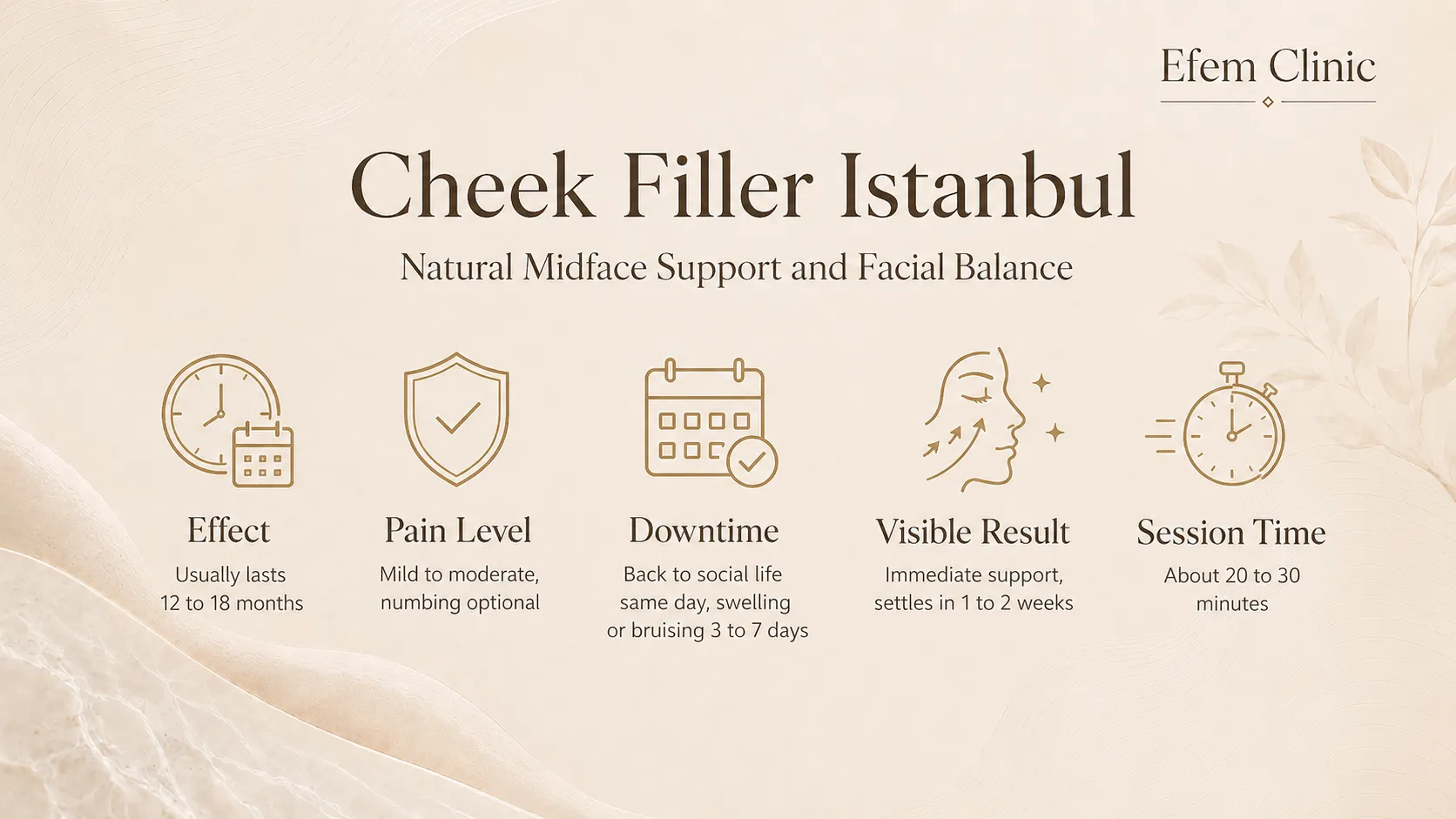
Recovery is generally short, but temporary effects may occur.
First 24–48 hours: Swelling, redness or tenderness may occur.
First few days: Bruising or temporary asymmetry related to swelling may be visible.
1–2 weeks: The filler may settle into a more natural appearance.
Follow-up: The result and any need for further treatment are assessed.
When Will I See Cheek Filler Results?
Changes in support and contour can usually be seen shortly after treatment. However, the initial appearance may be affected by temporary swelling.
A more settled and natural result is typically assessed after the early swelling has reduced. At follow-up, symmetry, facial balance and the need for any additional support may be reviewed.
How Long Does Cheek Filler Last?
Longevity varies between patients and may be influenced by the product used, amount, injection depth, metabolism, facial movement, lifestyle, previous treatments and individual tissue response.
Because the cheek is a structural support area, the effect may remain visible longer than in some highly mobile facial areas. An exact duration cannot be guaranteed for every patient.
Does Cheek Filler Lift the Face?
In selected patients, cheek filler may create a subtle lifting impression by improving midface support. It does not produce the same effect as surgery or deeper tissue lifting treatments.
If volume loss is the main concern, cheek filler may be considered. If laxity and reduced tissue support are more important, Ultherapy may be more appropriate. If skin texture and firmness are the priority, Morpheus8 may be discussed.
Is Cheek Filler Safe?
Cheek filler is a medical aesthetic procedure that requires detailed anatomical knowledge, appropriate patient selection and careful complication management.
Possible side effects and risks may include:
- Temporary swelling, redness or tenderness
- Bruising
- Temporary asymmetry
- Lumps or irregularities
- An overfilled appearance
- Infection
- An unsatisfactory aesthetic result
- Rare but serious vascular complications
Your medical history, medications, allergies and previous filler treatments should be discussed during consultation.
What If You Already Have Too Much Cheek Filler?
Previous cheek filler may sometimes make the face appear wide, swollen or heavy. It may also create heaviness beneath the eyes, artificial projection or reduced natural expression.
In these situations, adding more filler is usually not the first option. Depending on the examination, possible approaches may include:
- Waiting and reassessing
- Avoiding further filler
- Planning a correction
- Considering dissolving treatment in selected cases
- Restoring balance with less treatment
- Focusing on skin quality or lifting treatments instead
The objective is not to hide excess filler with more filler, but to reassess facial balance and naturalness.
How Is Cheek Filler Cost Determined?
Cheek filler cost is not determined only by the amount of product used. Facial anatomy, the degree of support loss, product characteristics, treatment areas, previous filler and correction needs may all affect the plan.
Factors That May Affect Treatment Cost
- The degree of midface volume loss
- One-sided or bilateral support requirements
- The under-eye and cheek transition
- Product characteristics
- The amount and depth of treatment
- Previous filler or correction requirements
- Personalised follow-up planning
Before and After Expectations
Cheek filler outcomes vary according to facial anatomy, the degree of volume loss, product choice, treatment plan and individual tissue response.
Before-and-after photographs should ideally use similar lighting, facial expression, angle and camera distance. Another patient’s result does not guarantee the same outcome for you.
View the Before and After GalleryWhy Choose Efem Clinic for Cheek Filler in Istanbul?

Frequently Asked Questions
What is cheek filler?
Cheek filler is an injectable medical aesthetic treatment used to improve volume loss, reduced support and contour changes in the midface.
Can cheek filler look natural?
A natural result may be achieved with appropriate patient selection, conservative amounts and anatomy-based placement.
Can cheek filler make the face look puffy?
Excessive or poorly planned filler may make the face appear swollen, wide or heavy. Full-face analysis and conservative planning are important.
Can cheek filler improve the under-eye area?
In selected patients, improving midface support may soften the transition between the under-eye and cheek. Not every under-eye concern is suitable for cheek filler.
Can cheek filler soften nasolabial folds?
Nasolabial folds associated with midface support loss may soften indirectly in selected patients. The cause of the fold should be assessed first.
Does cheek filler lift the face?
It may create a subtle lifting impression in selected patients by improving midface support. It does not replace surgical lifting or deeper tissue treatments.
Is cheek filler painful?
Needle or cannula sensation, pressure, mild stinging and temporary tenderness may occur. Sensitivity varies between patients.
Is there downtime after cheek filler?
Temporary swelling, redness, bruising or tenderness may occur. Many patients return to normal daily activities shortly after treatment.
When will I see the results?
Support and contour changes may be visible immediately, but early swelling can affect the appearance. A more settled result is generally assessed after one to two weeks.
How long does cheek filler last?
Longevity depends on product characteristics, amount, depth, metabolism, facial movement and individual tissue response.
Can cheek filler be combined with under-eye filler?
In suitable patients, midface support may be addressed first, followed by reassessment of whether the under-eye area requires additional treatment.
Can cheek filler be combined with Ultherapy?
If volume loss and tissue laxity are both present, treatment sequence and timing may be planned according to the individual patient.
Can cheek filler be combined with Morpheus8?
Morpheus8 and cheek filler have different roles. One focuses on skin remodelling, while the other may provide volume and structural support.
Can excessive cheek filler be dissolved?
Depending on the filler type and examination findings, dissolving treatment may be considered in selected cases.
Is cheek filler planned differently for men and women?
Treatment is personalised according to facial anatomy, bone structure, natural contour and aesthetic goals rather than using one standard approach.
What should I disclose before cheek filler?
Your medical history, medications, allergies and previous filler treatments should be shared during consultation.
How is cheek filler cost determined?
Cost is determined after assessing facial anatomy, required support, product characteristics, treatment amount, previous procedures and any correction needs.
Doctor’s Note
Cheek filler is not about inflating the face. It is about understanding the midface.
For one patient, a small amount of support may create a more rested appearance. For another, the under-eye and cheek transition may require attention. In some patients, a lifting or skin-quality treatment may be more appropriate than filler.
Too much cheek filler may make the face look heavier and less natural rather than younger.
Our focus is refined, balanced and safe midface planning that preserves the natural character of the face.
Dr. Abdurrahman Efem
PERSONALISED MIDFACE ASSESSMENT
Is Cheek Filler Right for You?
The first step is not deciding to have filler. It is understanding whether your concern is related to volume loss, under-eye transition, skin quality, laxity or a combination of factors.
Related Treatments and Guides
About Dr. Abdurrahman Efem

Dr. Abdurrahman Efem
Dr. Abdurrahman Efem is a medical aesthetic physician specializing in facial rejuvenation, non-surgical aesthetic treatments, and regenerative medicine. His approach focuses on enhancing natural beauty through personalized treatment plans designed around each patient's unique features and goals. Dr. Efem works with both local and international patients, emphasizing balanced, natural-looking results and long-term aesthetic wellbeing. This content has been prepared or medically reviewed by Dr. Abdurrahman Efem to ensure accuracy and relevance.