


Why Does Hair Loss Increase In Autumn? Telogen Effluvium Guide
Seasonal Hair Shedding, Telogen Effluvium and Diffuse Hair Loss Guide
Why Does Hair Loss Increase in Autumn? A Guide to Telogen Effluvium
Seeing more hair in the shower, on your brush or on your pillow during September and the autumn months can be worrying. Human studies suggest that the hair cycle can show seasonal variation, with shedding becoming more noticeable around late summer and early autumn. However, not every autumn increase in shedding should be labelled telogen effluvium.
Telogen effluvium is a form of diffuse, non-scarring hair shedding in which a larger-than-usual proportion of hair follicles enter the resting phase. Importantly, the shedding is often noticed not immediately after the trigger but approximately 2–4 months later.
Request a Hair-Loss Assessment Explore Hair-Loss Treatments Summer Hair-Loss GuideYou can send clear, unfiltered daylight photographs showing your centre part, frontal hairline, temples and crown for preliminary guidance before visiting Istanbul.
Human studies have demonstrated seasonal changes in hair cycling and shedding.
Androgenetic alopecia, thyroid disease, nutritional deficiency and other hair disorders may also cause shedding.
Hair shedding often appears several months after illness, surgery, childbirth or another major stressor.
Before adding supplements or procedures, identify the pattern of hair loss and potential trigger.
Quick Answer: Why Does Hair Shedding Increase in Autumn?
Hair follicles are not continuously in the same stage of growth. Human studies have found seasonal variation in the scalp-hair cycle, including a higher proportion of telogen hairs in summer and increased shedding around August and September.
However, intense autumn shedding may have another explanation. A febrile illness, infection, major surgery, childbirth, rapid weight loss, restrictive diet, medication change or significant stress approximately 2–4 months earlier may trigger telogen effluvium.
Telogen effluvium usually produces diffuse shedding across the scalp. Completely bald round patches, progressive recession of the hairline, increasingly patterned crown thinning or significant scalp inflammation may suggest another diagnosis.
If autumn shedding remains intense for weeks, produces visible thinning or is associated with other symptoms, it should not automatically be dismissed as seasonal.
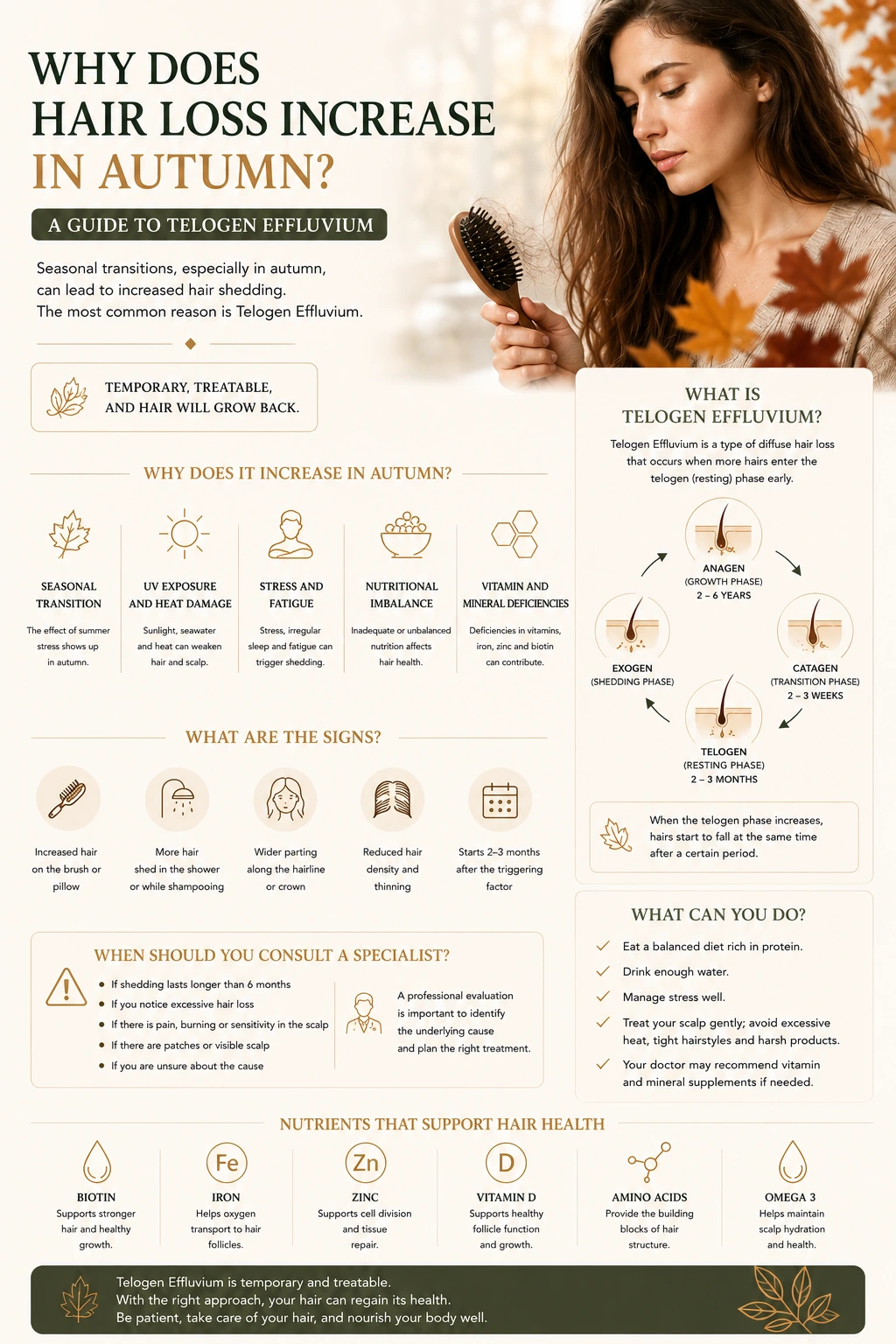
How Does the Normal Hair-Growth Cycle Work?
Hair follicles do not all grow and shed simultaneously. Individual follicles move through different stages at different times.
| Phase | What Happens? |
|---|---|
| Anagen | The active growth phase in which most healthy scalp follicles are normally found. |
| Catagen | A short transition phase during which active hair growth stops. |
| Telogen | The resting stage. Telogen hairs are eventually released as the follicle progresses into a new cycle. |
| New Growth | The follicle returns to active growth and a new hair shaft begins to develop. |
Some daily shedding is therefore a normal consequence of hair cycling. The important change is usually a sustained increase compared with your personal baseline or new visible thinning.
What Is Telogen Effluvium?
Telogen effluvium is a diffuse form of hair shedding in which more follicles than usual leave active growth and enter the telogen, or resting, phase.
Typical features may include:
- Diffuse shedding from across the scalp
- A noticeable increase in hair during washing or brushing
- A ponytail feeling thinner than before
- General loss of volume rather than one completely bald area
- Shedding beginning several months after a potential trigger
Telogen effluvium is generally a non-scarring process. The follicles are not usually permanently destroyed, so regrowth potential is generally preserved when the trigger resolves.
Is Seasonal Hair Shedding the Same as Telogen Effluvium?
Not necessarily.
Seasonal variation in the hair cycle has been documented even in otherwise healthy people. Studies have found higher telogen proportions around summer and increased shedding toward late summer and early autumn.
Physiological seasonal shedding may:
- Be relatively short-lived
- Cause little or no visible scalp thinning
- Vary considerably between individuals
- Not occur with the same intensity every year
Telogen effluvium, by comparison, usually refers to a more substantial shift of follicles into the resting phase, often associated with a physiological, medical or metabolic trigger.
The calendar alone therefore cannot tell you whether autumn hair loss is normal seasonal shedding, telogen effluvium or another type of alopecia.
Why Does Telogen Effluvium Start 2–4 Months After a Trigger?
One of the most confusing aspects of telogen effluvium is the delay between the trigger and visible shedding.
If shedding becomes obvious in September, it can therefore be useful to think back to the beginning and middle of summer rather than focusing only on what happened in September.
Possible events in June or July could include:
- A high-fever illness
- Significant infection
- Surgery
- Major psychological stress
- Rapid weight loss
- A very low-calorie diet
- Starting, stopping or changing medication
A useful hair-loss history therefore asks not only “When did the shedding begin?” but also “What happened several months before it began?”
What Can Trigger Telogen Effluvium?
Febrile Illness or Infection
A significant systemic illness or high fever can disturb hair cycling, with shedding becoming apparent several months later.
Surgery and Physical Stress
Major surgery and substantial physiological stress are recognised potential triggers.
Postpartum Changes
Hormonal changes after pregnancy can cause more follicles to enter telogen, leading to noticeable shedding several months after delivery.
Rapid Weight Loss
Rapid weight reduction, severe calorie restriction or inadequate protein intake may disturb normal hair cycling.
Iron or Nutritional Problems
Iron deficiency and selected nutritional problems may be considered when investigating diffuse shedding.
Thyroid and Systemic Disease
Thyroid disorders and other systemic conditions may contribute to diffuse hair loss.
Medication
Starting, changing or discontinuing certain medications may influence hair cycling. Prescribed medication should not be stopped without medical advice.
Significant Stress
Severe or prolonged psychological stress may contribute to excessive shedding in some people.
How Much Hair Loss Is Normal Per Day?
A degree of daily hair shedding is normal. Figures around 50–100 hairs per day are commonly used as a general reference, but daily counting is neither practical nor necessary for most people.
More useful warning signs include:
- A clear increase in the amount of hair seen in the shower
- Consistently large amounts of hair on the brush
- A ponytail becoming noticeably thinner
- A widening centre part
- More scalp becoming visible
The change from your personal baseline is usually more meaningful than trying to count every individual strand.
Telogen Effluvium vs Androgenetic Alopecia
| Feature | Telogen Effluvium | Androgenetic Alopecia |
|---|---|---|
| Onset | May become noticeable relatively suddenly | Usually develops gradually |
| Distribution | Diffuse shedding across the scalp | Patterned thinning becomes more prominent |
| Trigger | May follow illness, childbirth, surgery, stress or dietary change | Genetic predisposition and androgen sensitivity are central |
| Course | Acute cases are often temporary | May progressively worsen without appropriate management |
The two conditions can also occur together. A sudden telogen effluvium episode may make previously subtle androgenetic thinning much more noticeable.
Is Telogen Effluvium the Same as Alopecia Areata?
No.
Alopecia areata commonly causes clearly defined round or oval areas of hair loss. Telogen effluvium usually causes diffuse shedding rather than isolated completely bald patches.
Sudden patchy hair loss should therefore not simply be attributed to seasonal shedding and warrants dermatological assessment.
How Long Does Telogen Effluvium Last?
In acute telogen effluvium, excessive shedding commonly lasts for several months.
After the trigger resolves:
- Shedding can gradually decrease.
- New short hairs may become visible.
- Restoration of overall hair volume can take considerably longer than the shedding phase itself.
Hair shedding persisting beyond approximately six months may prompt consideration of chronic telogen effluvium or another ongoing cause.
Because scalp hair grows slowly, visible recovery of density may lag behind improvement in shedding.
Does Hair Grow Back After Telogen Effluvium?
In acute telogen effluvium, follicles are generally not permanently destroyed. When the trigger is removed, follicles can return to active growth.
Visible density takes time to recover because newly growing hairs must gain length before they contribute substantially to overall volume.
If patterned thinning continues to become more visible even as shedding improves, an underlying condition such as androgenetic alopecia should be considered separately.
How Is Telogen Effluvium Diagnosed?
Assessment usually begins with a detailed history and examination of the scalp and hair-loss pattern.
Relevant questions may include:
- When the shedding began
- What happened 2–4 months before it started
- Whether hair loss is diffuse or localised
- Whether the centre part has widened
- Family history of patterned hair loss
- Pregnancy and childbirth history
- Recent fever or significant illness
- Dieting and weight loss
- Current medications
- Menstrual or hormonal symptoms
- Scalp itching, pain, redness or scaling
Where appropriate, a hair-pull test, dermoscopy or trichoscopic examination may provide additional information.
Do You Need Blood Tests for Hair Loss?
Not everyone with hair shedding needs the same broad laboratory panel.
Depending on the history and examination, a doctor may consider investigations such as:
- Complete blood count
- Iron status and ferritin
- Thyroid-function tests
- B12, folate or other nutritional testing when clinically indicated
- Relevant hormonal investigations when symptoms suggest a hormonal disorder
Testing should be individualised. One abnormal laboratory result does not necessarily explain every aspect of hair loss by itself.
Can Low Ferritin Cause Hair Loss?
Iron deficiency is one of the factors that may be considered during the investigation of diffuse hair loss.
However:
- Not every patient with telogen effluvium has iron deficiency.
- Ferritin should be interpreted in clinical context.
- Iron supplementation is not appropriate simply because someone has hair loss.
If iron deficiency is confirmed, understanding why the deficiency developed can be as important as correcting it.
Does Biotin Stop Hair Loss?
Biotin is frequently included in hair supplements, but strong clinical evidence supporting routine high-dose biotin for hair loss in people without biotin deficiency is limited.
High-dose biotin can also interfere with some laboratory test results.
Rather than starting multiple supplements automatically, it is more useful to determine whether a genuine deficiency or another cause of shedding is present.
How Is Telogen Effluvium Treated?
The main principle in acute telogen effluvium is to identify and correct the trigger where possible.
Management may therefore involve:
- Correcting inadequate nutrition
- Treating confirmed iron deficiency appropriately
- Managing thyroid disease when present
- Avoiding unnecessarily restrictive dieting
- Maintaining adequate protein and overall nutrition
- Reducing hair practices that cause traction or breakage
- Treating an ongoing systemic medical problem
Once the trigger of acute telogen effluvium has resolved, the hair cycle often needs time to normalise.
Not every patient with telogen effluvium requires scalp injections, regenerative procedures or device-based treatment.
Can Hair PRP Be Used for Telogen Effluvium?
Hair PRP Treatment involves preparing platelet-rich plasma from the patient's own blood and applying it to the scalp.
Most clinical evidence for PRP in hair loss relates to androgenetic alopecia. Small clinical studies have also investigated PRP in chronic telogen effluvium, but the evidence base is considerably more limited.
PRP therefore does not need to be performed automatically in everyone experiencing a new episode of acute telogen effluvium.
The diagnosis, trigger and possibility of coexisting androgenetic thinning should be assessed first. PRP can then be discussed if there is a meaningful treatment target.
Is Hair Exosome Therapy Appropriate for Telogen Effluvium?
Hair Exosome Therapy is one of the regenerative approaches being investigated for hair restoration.
Clinical evidence for exosome-based hair treatments remains developing, and published human studies have predominantly investigated androgenetic alopecia rather than routine acute telogen effluvium.
Exosome treatment should therefore not be presented as a standard first-line treatment for a new episode of seasonal shedding or acute telogen effluvium.
Is Hair Stem Cell Therapy Used for Telogen Effluvium?
Hair Stem Cell Therapy is part of an evolving field of regenerative hair treatments.
Clinical research into stem-cell and stem-cell-derived hair approaches is developing, but much of the human evidence currently focuses on androgenetic alopecia.
For this reason, increased autumn shedding alone is not a sufficient reason to proceed directly to stem-cell treatment without first establishing the cause and pattern of hair loss.
When May Sanakin Hair Therapy Be Considered?
Sanakin Hair Therapy is one of the hair-regeneration options available at Efem Clinic.
Before selecting any regenerative procedure, it remains important to determine whether the underlying problem is telogen effluvium, androgenetic alopecia or another hair disorder.
The treatment name should come after the clinical indication, not before it.
Is Morpheus8 for Hair Regeneration a Telogen Effluvium Treatment?
Morpheus8 for Hair Regeneration is a different technology-based approach to scalp and hair-support treatment.
It should not be considered the fundamental treatment for acute telogen effluvium. Because acute telogen effluvium may recover as the normal hair cycle re-establishes itself, the underlying cause should be assessed before a device-based procedure is selected.
If another chronic hair-density or hair-quality concern coexists, that issue may be considered separately after medical assessment.
Which Approach Comes First for Different Types of Hair Loss?
| Hair-Loss Pattern | First Approach | When Might Additional Treatment Be Considered? |
|---|---|---|
| Short seasonal increase | Observation, balanced nutrition and gentle hair care | If shedding persists or visible thinning develops |
| Acute telogen effluvium | Identify and correct the trigger where possible | If another hair-loss condition or persistent problem is identified |
| Chronic telogen effluvium | Investigate continuing causes | Supportive treatments may be discussed according to diagnosis and evidence |
| Androgenetic alopecia | Assess pattern and follicular miniaturisation | Medical therapies and selected supportive treatments such as PRP may be discussed |
| Patchy hair loss | Dermatological evaluation | Diagnosis-specific treatment |
How Should You Care for Your Hair in Autumn?
During periods of increased shedding, reducing practices that unnecessarily stress or break the hair shaft can be useful.
- Avoid repeatedly pulling the hair into very tight styles
- Reduce tight braids and traction-heavy hairstyles
- Avoid aggressive brushing when the hair is wet
- Limit excessive heat styling
- Distinguish hair-shaft breakage from true shedding from the root
- Maintain adequate protein intake and balanced nutrition
Washing your hair less often does not stop telogen effluvium. Hairs that have already entered the shedding stage may simply become more visible when you wash.
For additional seasonal guidance, read Summer Hair Care Tips.
Does Washing Your Hair Less Reduce Hair Loss?
Usually not.
If more time passes between washes, hairs that were already ready to shed can accumulate. More strands then appear during the next shower, creating the impression that washing itself caused the hair loss.
Washing frequency can instead be based on scalp oiliness, product use, scalp conditions and personal needs.
Can Stress Cause Hair Loss?
Significant physiological or psychological stress can be associated with telogen effluvium.
However, it is also unhelpful to attribute every episode of hair loss to stress.
Even when stress is present, androgenetic alopecia, nutritional deficiency, thyroid problems and other causes may still need to be considered.
Can Rapid Weight Loss Increase Hair Shedding?
Yes. Rapid weight loss, significant caloric restriction and inadequate protein intake are recognised potential triggers for telogen effluvium.
If someone followed an aggressive diet before or during summer and begins shedding heavily in autumn, the timing should not automatically be explained by seasonal change alone.
Healthy hair growth depends on adequate overall energy, protein and micronutrient intake rather than one single “hair vitamin.”
When Should You See a Dermatologist About Hair Loss?
Hair loss should not simply be attributed to autumn if you experience:
- Shedding lasting longer than approximately six months
- Clear progressive scalp thinning
- Round or patchy areas of complete hair loss
- Loss of eyebrows or eyelashes
- Marked redness, pain or severe itching of the scalp
- Crusting, sores or inflammation
- Rapid recession of the hairline
- Irregular periods, excess facial/body hair or other hormonal symptoms
- Unexplained weight changes, fatigue or other systemic symptoms
- Pronounced shedding after starting a new medication
Early dermatological diagnosis is particularly important when a scarring form of alopecia is suspected.
The Efem Method: Treat the Cause of Hair Loss Before Treating the Hair
Within the Efem Method, the same injection or device protocol is not automatically recommended to everyone experiencing hair shedding.
The first step is to determine whether loss is diffuse, patterned or localised; when it began; and whether illness, stress, dieting or another trigger occurred several months earlier.
If acute telogen effluvium is suspected, the possibility of natural recovery of the hair cycle is taken into account. Rather than adding unnecessary procedures immediately, an identifiable trigger is addressed and the course is followed.
If androgenetic thinning or another chronic hair-density problem is also present, it can be assessed separately and the potential role of PRP or another supportive treatment can then be discussed.
A layered approach does not mean doing more procedures. It means separating temporary telogen shedding from persistent or progressive hair loss and treating only the problem that genuinely needs intervention.
Hair-Loss Planning With Dr Abdurrahman Efem
Dr Abdurrahman Efem is a medical aesthetic physician. At Efem Clinic, hair-loss assessment considers the duration and distribution of shedding, recent health history, lifestyle factors, previous treatments and visible hair-density changes together.
The fact that Hair PRP, Hair Exosome Therapy, Sanakin Hair Therapy, Hair Stem Cell Therapy and other hair-regeneration procedures are available at the clinic does not mean that every episode of shedding requires one of these treatments.
If the pattern suggests that dermatological or systemic investigation should come first, the patient may be directed toward the appropriate evaluation. Avoiding an unnecessary procedure is also part of appropriate treatment planning.
Meet Dr Efem Request a Hair AssessmentPersonalised Hair-Loss Assessment in Levent, Istanbul
Efem Clinic provides care in a private villa setting with a garden and parking in Levent, Istanbul.
Hair loss is not approached with one universal treatment protocol. Temporary telogen effluvium and progressive androgenetic thinning, for example, do not require identical management.
International patients can send daylight photographs showing the centre part, frontal hairline, temples and crown for preliminary guidance before travelling to Istanbul.
If the hair-loss pattern suggests a systemic disease or dermatological disorder, investigating that cause takes priority over aesthetic hair procedures.
Efem Note
Seeing more hair fall in autumn does not automatically mean that you are permanently losing your hair.
But it is equally unhelpful to dismiss persistent shedding for months by saying, “It is just the season.”
Think back several months: Was there an illness, major stress, surgery, restrictive diet or rapid weight loss?
Before choosing PRP or another regenerative treatment, establish what type of hair loss you actually have.
The best starting point for hair loss is not more products or more procedures. It is the right timeline and the right diagnosis.
Related Hair-Loss Guides and Treatments
Frequently Asked Questions
Is hair loss normal in autumn?
Some healthy people may experience increased seasonal shedding around late summer and early autumn. Significant thinning or persistent heavy shedding should not automatically be attributed to the season.
What is telogen effluvium?
Telogen effluvium is diffuse, usually non-scarring hair shedding caused by more follicles than usual entering the resting phase of the hair cycle.
Is seasonal hair shedding the same as telogen effluvium?
Not necessarily. Seasonal hair-cycle variation can occur in healthy people, while telogen effluvium usually describes more substantial diffuse shedding often associated with a physiological, medical or metabolic trigger.
Why does telogen effluvium start months after the trigger?
Hair follicles need time to move into the resting phase and reach the shedding stage, so visible hair loss commonly begins several months after the triggering event.
How long does telogen effluvium last?
Acute telogen effluvium commonly improves over several months. Shedding lasting beyond approximately six months may warrant assessment for chronic telogen effluvium or another ongoing cause.
Does hair grow back after telogen effluvium?
In acute telogen effluvium, follicles are generally not permanently destroyed, and new growth can begin after the trigger resolves. Visible restoration of density takes longer.
Can stress cause telogen effluvium?
Significant psychological or physiological stress can be a trigger, although other causes of hair loss may still need to be investigated.
Can rapid weight loss cause hair shedding?
Yes. Rapid weight loss, severe calorie restriction and inadequate protein intake may trigger telogen effluvium.
Can iron deficiency cause hair loss?
Iron deficiency may contribute to diffuse hair loss in some people. Ferritin and other iron parameters should be interpreted together with the clinical history.
Can thyroid problems cause hair loss?
Yes. Thyroid disorders can be associated with diffuse hair shedding and thyroid testing may be appropriate when the history or examination suggests it.
Does biotin stop hair loss?
Strong evidence for routine high-dose biotin in people without biotin deficiency is limited, and high doses may interfere with certain laboratory tests.
Does PRP help telogen effluvium?
Most PRP evidence in hair loss relates to androgenetic alopecia. Small studies have investigated chronic telogen effluvium, but acute telogen effluvium should first be assessed for an underlying trigger.
Is exosome treatment a treatment for telogen effluvium?
Clinical evidence for hair exosome treatment is still developing and currently focuses mainly on androgenetic alopecia. It should not be considered standard first-line treatment for acute telogen effluvium.
Is stem cell therapy necessary for telogen effluvium?
No. It is not necessary for every patient. Clinical evidence for regenerative stem-cell hair treatments is still developing and has focused largely on androgenetic alopecia.
Does washing your hair less reduce shedding?
Usually not. Hairs already ready to shed can accumulate between washes and then appear in larger numbers during the next shower.
Does telogen effluvium cause permanent baldness?
Acute telogen effluvium usually causes diffuse thinning without permanently destroying follicles. Progressive patterned hair loss should be evaluated for another condition.
Can telogen effluvium and androgenetic alopecia occur together?
Yes. A telogen effluvium episode can make previously subtle androgenetic thinning more noticeable, and the two conditions may require different management.
When should I see a doctor for hair loss?
Assessment is advisable when shedding persists for months, visible thinning progresses, patchy loss occurs, the scalp becomes inflamed or eyebrows and eyelashes are also affected.
What is the best treatment for autumn hair loss?
There is no single best treatment. Seasonal shedding, telogen effluvium and androgenetic alopecia require different approaches, so treatment should follow the diagnosis.
How can international patients request a hair-loss assessment in Istanbul?
You can send unfiltered daylight photographs showing the centre part, frontal hairline, temples and crown through WhatsApp together with the date your shedding began and relevant health or dietary changes from the preceding months.
Is Your Autumn Hair Loss Seasonal or Telogen Effluvium?
Send clear, unfiltered daylight photographs showing your frontal hairline, centre part, temples and crown. Include when the shedding started and whether you experienced illness, surgery, major stress, dieting or rapid weight change in the preceding months.
Send Your Photos on WhatsApp Explore Hair-Regeneration Options Meet Dr Efem Contact Efem ClinicThis article is intended for general information. Patchy hair loss, suspected scarring alopecia, significant scalp inflammation or symptoms suggesting systemic disease may require assessment by a dermatologist or another appropriate medical specialist.
About Dr. Abdurrahman Efem

Dr. Abdurrahman Efem
Dr. Abdurrahman Efem is a medical aesthetic physician specializing in facial rejuvenation, non-surgical aesthetic treatments, and regenerative medicine. His approach focuses on enhancing natural beauty through personalized treatment plans designed around each patient's unique features and goals. Dr. Efem works with both local and international patients, emphasizing balanced, natural-looking results and long-term aesthetic wellbeing. This content has been prepared or medically reviewed by Dr. Abdurrahman Efem to ensure accuracy and relevance.