


Under Eye Dark Circles Causes and Treatment
Under-Eye Dark Circles, Hollowing, Pigmentation and Tired-Looking Eyes Guide
Under-Eye Dark Circles: Causes and Treatment
Dark circles under the eyes do not have one single cause. The same complaint may be related to pigmentation, blood vessels showing through thin skin, shadowing from tear-trough hollowing, under-eye bags, fluid retention or a combination of several factors.
The right question is therefore not simply “Which treatment removes dark circles?” but “Why does this particular under-eye area look dark?” A structural shadow caused by hollowing and true skin pigmentation are not treated in the same way.
Request an Under-Eye Assessment Explore Under-Eye Light Filler Under-Eye MesotherapyYou can send clear, unfiltered photographs taken from the front and slight right and left angles in natural daylight for preliminary guidance before visiting Istanbul.
The skin itself may appear brown or darker than the surrounding skin.
A tear-trough hollow can change how light falls across the lower eyelid and create darkness.
Blood vessels and deeper tissues may become more visible through thin under-eye skin.
Swelling and the shadows around it can make the under-eye area look darker.
Quick Answer: What Causes Under-Eye Dark Circles and How Are They Treated?
Under-eye dark circles are usually not one single condition. They are a visible result of different anatomical and skin-related factors.
If hollowing and volume loss are creating most of the shadow, under-eye filler may be considered in an appropriately selected patient. If the skin itself is pigmented, filler does not lighten that pigment, so pigment-directed skincare or carefully selected technologies may be more relevant.
If thin or lower-quality skin is an important component, under-eye mesotherapy or another skin-quality approach may be considered. When pronounced bags, oedema or fat prolapse are present, adding further volume may not be the right option.
The most useful approach is therefore to assess pigment, vascular visibility, volume, skin quality and bags separately rather than treating every dark circle as the same problem.
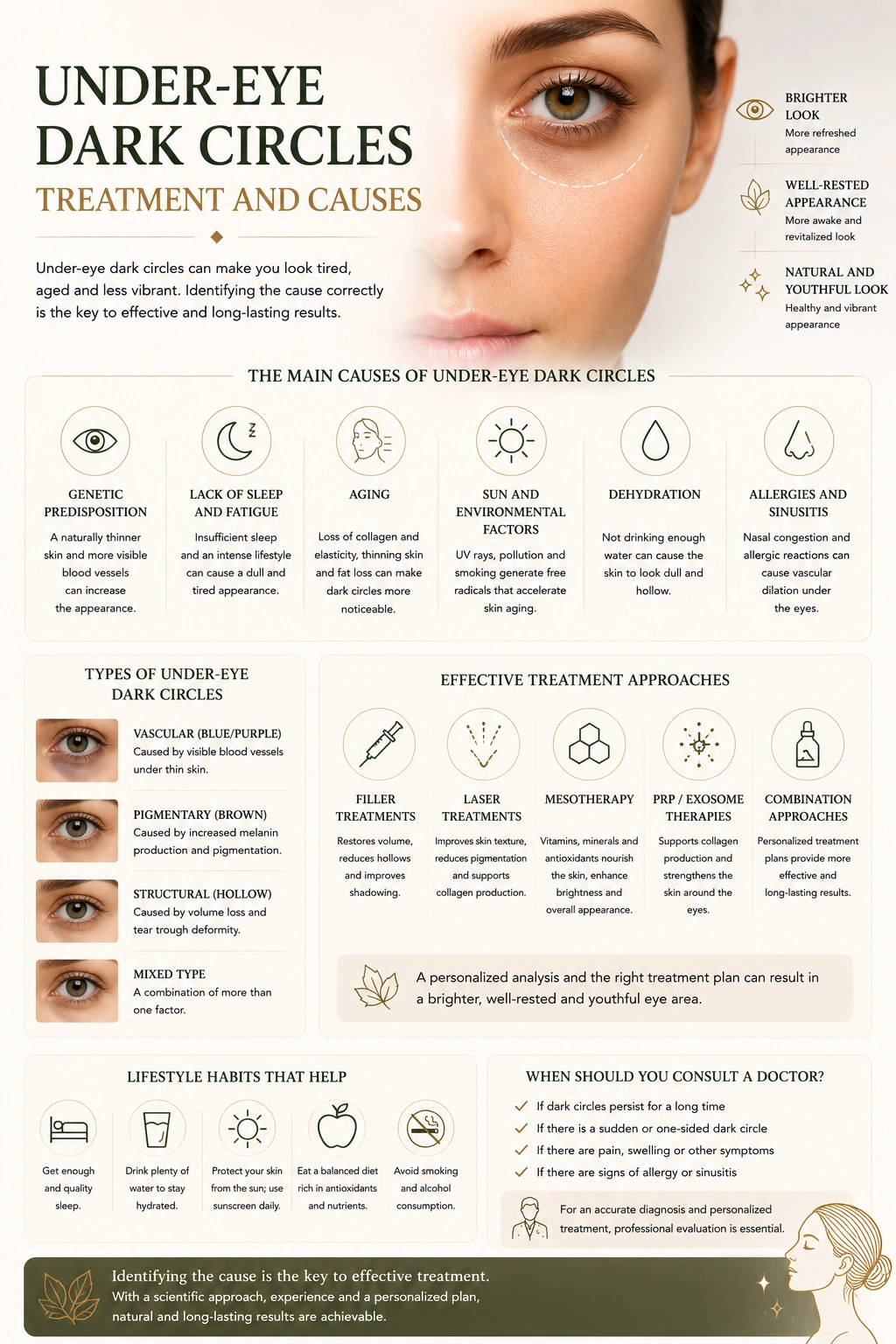
What Are Under-Eye Dark Circles?
Under-eye dark circles, sometimes described medically as infraorbital or periorbital darkening, refer to a darker, shadowed or tired-looking appearance around the lower eyelids.
The colour may appear:
- Brown
- Grey-brown
- Bluish
- Purple
- Dark primarily because of shadow
Different colours may provide clues to the underlying mechanism, but colour alone is not enough to establish the correct treatment.
In many patients several mechanisms are present at the same time.
What Are the Main Causes of Under-Eye Dark Circles?
Pigmentation
Increased melanin around the eyes can make the skin itself appear darker. Genetics, sun exposure, inflammation and selected skin conditions may contribute.
Tear-Trough Hollowing
The anatomical groove between the lower eyelid and cheek can create a shadow even when the skin itself is not significantly pigmented.
Thin Under-Eye Skin
The skin around the eyes is naturally thin. When it is particularly thin or becomes thinner with age, underlying vessels and tissues may become more visible.
Visible Blood Vessels
Superficial vessels showing through thin skin may create a bluish or purplish under-eye tone.
Under-Eye Bags
Prominent lower-eyelid bags can create a strong shadow beneath the bulge, increasing the impression of dark circles.
Oedema and Fluid Retention
Morning puffiness or persistent fluid retention can alter the contour around the lower eyelid and make shadows more noticeable.
Allergy and Rubbing
Repeated rubbing, itching and inflammatory skin conditions can contribute to irritation and pigmentation around the eyes in some people.
Ageing and Midface Volume
Changes in facial volume and lower-eyelid anatomy with age can make the lid-cheek junction and tear trough more visible.
How Can the Type of Dark Circle Be Assessed?
| Dominant Feature | Possible Mechanism | Treatment Logic |
|---|---|---|
| Brown skin colour | Pigmentation | Pigment- and skin-directed approach |
| Blue or purple tone | Thin skin and vascular visibility | Assess skin quality and vascular component |
| Deep groove and shadow | Tear-trough hollowing | Consider volume and midface support in suitable patients |
| Puffiness with shadow | Bags or oedema | Assess the bag rather than automatically adding filler |
| Several features together | Mixed type | Layered combination approach |
What Are Shadow-Type Dark Circles?
In some people, the under-eye skin itself is not particularly dark. Instead, the hollow between the lower eyelid and cheek creates a shadow.
This appearance may:
- Be present from a young age because of facial anatomy
- Become more visible with age
- Increase as midface support changes
- Make someone look tired even when well rested
A pigment-lightening cream cannot completely remove an anatomical shadow because the primary problem is contour rather than skin colour.
Does Under-Eye Filler Treat Dark Circles?
Under-Eye Light Filler may be considered in appropriately selected patients to reduce tear-trough hollowing and the shadow created by that hollow.
It may be more relevant when:
- A genuine tear-trough hollow is present
- Shadow accounts for an important part of the darkness
- Prominent under-eye bags are not present
- There is no major tendency toward persistent oedema
- The lid-cheek and midface anatomy has been assessed carefully
Under-eye filler does not remove brown pigment from the skin.
If true pigmentation is the dominant problem, filler alone may not meaningfully change the colour.
Who May Not Be a Good Candidate for Under-Eye Filler?
The under-eye is a thin, anatomically complex area, so filler planning should be particularly conservative.
Filler may not be the first choice when:
- Pronounced lower-eyelid bags are present
- There is persistent puffiness or fluid retention
- The dominant problem is pigmentation
- Very thin, lax skin is the primary concern
- Previous under-eye filler is already excessive
- There is active infection or inflammation
- There is no meaningful structural hollow to correct
Adding volume to an unsuitable under-eye may make the area look heavier, puffier or less natural.
Can Cheek Support Improve the Under-Eye Area?
Yes. The under-eye cannot always be assessed in isolation from the cheek and midface.
In some patients, reduced midface support contributes to a more visible lid-cheek junction. In these cases, treatment may not need to begin by placing filler directly into the tear trough.
Appropriate Cheek Filler or midface support may be considered first.
Assessing the lid-cheek transition rather than treating the hollow in isolation may help create a more balanced and natural result.
How Do Pigment-Type Under-Eye Dark Circles Look?
With pigment-predominant dark circles, the skin itself appears browner or grey-brown compared with surrounding skin.
Contributing factors may include:
- Genetic predisposition
- Sun exposure
- Post-inflammatory pigmentation
- A history of eczema or dermatitis
- Frequent eye rubbing
In this situation, tear-trough filler may soften an accompanying anatomical shadow but does not directly treat the underlying pigment.
Which Treatments May Be Considered for Pigment-Type Dark Circles?
Treatment should be adjusted to skin type, pigment characteristics and the sensitivity of the eye area.
Selected options may include:
- Consistent photoprotection
- Gentle pigment-directed topical care
- Medical skincare
- Carefully selected laser or light-based treatments
- Selected controlled peeling approaches
Because eyelid skin is thin and sensitive, products and treatment settings used elsewhere on the face should not automatically be applied around the eyes in the same way.
Can Q-Switch Laser Treat Under-Eye Dark Circles?
Q-Switch Laser is a pigment-targeting laser technology that may be considered for selected pigmentation concerns.
In under-eye dark circles, it is relevant only when a genuine pigment component is present and the area is suitable for treatment.
A deep tear trough, lower-eyelid bag or structural shadow is not corrected by a pigment laser.
The technology should therefore be selected according to the mechanism of darkness rather than simply because the area appears dark.
Can Lumecca IPL Be Used Around the Under-Eye Area?
Lumecca IPL is an intense pulsed light technology used for selected pigment and vascular appearance concerns.
The eye area requires particular caution, including assessment of treatment location, skin phototype, pigment type and appropriate eye protection.
Not every under-eye dark circle is an IPL indication, and IPL does not correct a structural shadow caused by tear-trough hollowing.
Does Under-Eye Mesotherapy Help Dark Circles?
Under-Eye Mesotherapy may be considered in selected patients to support hydration, skin quality and the overall appearance of the eye area.
Mesotherapy does not:
- Fill a deep tear trough in the same way as a volumising filler
- Remove pronounced under-eye bags
- Completely eliminate every form of pigmentation
It may therefore have a supportive role when skin quality is one component of the problem, provided the treatment objective is clear.
Can Salmon DNA / PDRN Be Used Around the Eyes?
Salmon DNA / PDRN Therapy may be considered as part of a skin-quality and hydration-focused plan in appropriately selected patients.
PDRN treatment does not provide the same structural volume correction as tear-trough filler and is not a treatment for pronounced lower-eyelid bags.
When thin, dry or lower-quality skin contributes to the overall appearance, it may be discussed as part of a broader eye-area plan.
Can Morpheus8 Treat Under-Eye Dark Circles?
Morpheus8 is not a conventional pigment treatment or tear-trough filler.
In selected patients it may be considered for different structural concerns involving skin quality or laxity around the eye area, but suitability and treatment intensity need careful planning because of the thin anatomy.
Hollowing, pigmentation and lower-eyelid bags still need to be assessed as separate problems.
Can Under-Eye Bags Look Like Dark Circles?
Yes. An under-eye bag itself may not be dark, but the shadow beneath the protrusion can create the appearance of a dark ring.
In this situation, what a patient calls a “dark circle” may largely be a contour problem.
When pronounced lower-eyelid bags are present, simply adding more filler into the tear trough is not always the appropriate solution.
In selected cases, surgical lower-eyelid assessment may be more relevant.
Can Under-Eye Bags and Tear-Trough Hollowing Exist Together?
Yes. Prominent lower-eyelid fat and a hollow immediately beneath it can occur in the same person.
This combination can increase the light-shadow contrast and make both the bag and the apparent dark circle more noticeable.
Filler decisions should therefore consider the bag, skin laxity and tendency toward fluid retention rather than focusing only on the depth of the tear trough.
Does Lack of Sleep Cause Dark Circles?
Poor sleep can contribute to a more tired, pale or shadowed appearance around the eyes and may make existing dark circles more noticeable.
However, a longstanding genetic tear trough or true pigmentation will not necessarily disappear simply by sleeping more.
Sleep may influence overall appearance, but persistent dark circles can still have structural or dermatological causes that need separate assessment.
Can Allergies Make Dark Circles Worse?
Allergic conditions may cause itching, swelling and repeated rubbing around the eyes.
Repeated friction and inflammation may contribute to colour change in some people.
If active allergy or dermatitis is present, controlling the inflammatory problem is more important than focusing only on cosmetic pigmentation treatment.
Can Eczema Cause Darkening Around the Eyes?
Chronic eyelid dermatitis or eczema can lead to itching, repeated rubbing and post-inflammatory colour change.
In this situation, the first priority should be control of the active dermatitis rather than immediately trying to lighten pigment.
Aggressive peeling or energy-based treatment should not be performed on actively inflamed eyelid skin, and dermatological assessment may be needed.
Can Under-Eye Dark Circles Be Genetic?
Yes. Facial anatomy, skin thickness, pigmentation tendency and bone structure can all have inherited characteristics.
Some people therefore notice hollowing or dark circles from a relatively young age.
A genetic component does not mean that nothing can be improved, but it does make realistic expectations and identification of the treatable component particularly important.
Why Can Dark Circles Become More Visible With Age?
Several changes may occur around the eye area with ageing:
- Thinner skin
- Reduced skin elasticity
- Changes in midface volume distribution
- More visible tear-trough hollowing
- More prominent lower-eyelid bags
- Greater visibility of underlying vessels
Age-related dark circles are therefore often mixed in origin, and one procedure should not be expected to correct every component.
Which Under-Eye Treatment Fits Which Problem?
| Main Problem | Possible Approach | What It Should Not Be Expected to Do |
|---|---|---|
| Tear-trough hollowing | Under-eye filler or midface support in suitable patients | Directly lighten brown pigment |
| Pigmentation | Photoprotection, suitable topicals and selected pigment treatments | Have pigment erased simply by adding filler |
| Thin / dry skin | Under-eye mesotherapy or selected skin-quality approaches | Fully correct a deep structural hollow |
| Pronounced bags | Assess lower-eyelid anatomy and cause of the bag | Assume that more filler is always better |
| Mixed type | Layered combination planning | Expect one device or injection to solve every component |
Do Under-Eye Dark Circles Need Combination Treatment?
Several components often coexist in the same person.
For example, someone may simultaneously have:
- Mild tear-trough hollowing
- Thin skin
- A degree of pigmentation
- Reduced midface support
One procedure may therefore improve only part of the appearance.
Layered planning may combine structural support with skin-quality or pigment-focused treatment at different stages when each component has a genuine indication.
Can Dark Circles Be Treated in One Session?
This depends entirely on the cause.
A structural shadow caused by an appropriate tear-trough hollow may change relatively early after filler. Pigmentation and skin-quality concerns may require a more gradual approach and sometimes more than one treatment.
Promising to completely remove every type of under-eye dark circle in one session is not realistic.
Can Under-Eye Dark Circles Go Away Completely?
Some components can be improved substantially, but the result depends on how modifiable the underlying cause is.
For example:
- An anatomical shadow may be softened.
- Selected pigmentation may be reduced.
- Skin quality may be supported.
- Genetically thin skin or vascular visibility may not disappear completely.
The goal should not necessarily be to create a completely flat, shadow-free and artificial-looking lower eyelid.
Can Under-Eye Filler Cause a Blue-Grey Appearance?
The under-eye has very thin tissue, and filler that is too superficial or excessive may become visible or create an unwanted colour or contour effect.
Potential unwanted effects can include:
- Swelling
- Contour irregularity
- A heavier appearance
- Blue-grey discoloration
- An overfilled or unnatural transition
The objective is therefore not to place as much filler as possible but to make the smallest appropriate correction in the right patient.
What If Too Much Under-Eye Filler Was Used Previously?
If previous filler has created puffiness, heaviness or contour problems, adding more filler should not automatically be the next step.
After assessment, options may include:
- Observation
- Reassessing the existing filler and anatomy
- Planning correction where appropriate
- Considering hyaluronidase in selected situations involving hyaluronic-acid filler
- Reassessing whether the main remaining concern is actually pigment or skin quality
Correcting previous treatment should be based on examination rather than simply adding another layer of product.
What Can You Do at Home for Under-Eye Dark Circles?
Home care can provide limited but meaningful support depending on the underlying cause.
- Avoid unnecessary rubbing of the eye area
- Use consistent sun protection
- Use gentle moisturising appropriate for the eye area
- Have active allergy or dermatitis managed appropriately
- Maintain a regular sleep routine
- Avoid aggressive acids or retinoids close to the eyelids unless suitable for you
A significant anatomical tear trough cannot be filled by a cream, just as true pigmentation cannot be corrected simply by adding structural volume.
Do Caffeine Eye Creams Help Dark Circles?
Some caffeine-containing eye products may temporarily support the appearance of puffiness or the overall eye area.
They should not be expected to eliminate a deep tear trough, significant pigmentation, lower-eyelid fat bags or a structural genetic shadow.
The expected effect of topical skincare should therefore be distinguished from the structural change possible with selected procedures.
Can Dark Circles Be a Sign of a Medical Problem?
Longstanding dark circles are often related to anatomy, genetics or dermatological factors and do not by themselves indicate serious disease.
However, new eye-area changes accompanied by other symptoms may need medical assessment.
Seek appropriate medical evaluation for features such as:
- Sudden one-sided swelling
- Significant redness or pain
- Changes in vision
- Bruising after trauma
- Signs of active infection
- New unexplained generalised swelling
These situations should not simply be treated as a cosmetic dark-circle concern.
The Efem Method: Treat Why the Under-Eye Looks Dark, Not Just the Dark Circle
Within the Efem Method, every under-eye dark circle is not treated with the same protocol.
Tear-trough depth, skin thickness, pigmentation, lower-eyelid bags, tendency toward oedema, cheek support and previous filler are considered together.
When a genuine hollow is present, conservative under-eye filler may be considered. When midface support is reduced, the cheek may need to be assessed first. When pigmentation dominates, pigment-focused treatment is more relevant than filler.
When prominent bags or fluid retention are present, choosing not to add more filler may be the better decision.
If thin or lower-quality skin is an important component, a skin-quality treatment may be planned separately.
A layered approach does not mean performing more treatments. It means identifying which layer creates the dark appearance and treating only the component that genuinely needs intervention.
Under-Eye Planning With Dr Abdurrahman Efem
Dr Abdurrahman Efem is a medical aesthetic physician. At Efem Clinic, under-eye assessment considers not only darkness but also tear-trough anatomy, skin thickness, pigmentation, bags, oedema tendency, midface support and previous filler history.
The availability of Under-Eye Light Filler, Under-Eye Mesotherapy or other skin treatments in the clinic does not mean that every patient needs these procedures.
With under-eye filler in particular, the goal is not to completely flatten the lower eyelid or maximise volume. The aim is a softer, more rested and natural-looking transition between the lower eyelid and cheek.
If prominent bags, a dermatological condition or anatomy requiring surgical assessment make injection inappropriate, avoiding unnecessary filler and directing the patient appropriately is part of treatment planning.
Meet Dr Efem Request an Under-Eye AssessmentPersonalised Under-Eye Assessment in Levent, Istanbul
Efem Clinic provides care in a private villa setting with a garden and parking in Levent, Istanbul.
Rather than applying the same treatment to every dark circle, structural and skin-related causes are assessed separately.
Under-Eye Light Filler may suit one patient, while another may benefit more from midface support, skin-quality treatment or a pigment-directed approach. For some patients with prominent bags, avoiding filler may be the more appropriate choice.
International patients can send unfiltered daylight photographs and information about previous under-eye treatments for preliminary guidance before travelling to Istanbul.
Efem Note
If your under-eye looks dark, filler should not automatically be your first thought.
First determine why the area looks dark.
If it is shadow, structural support may help. If it is pigment, treat the pigment. If thin skin contributes, skin quality becomes relevant. If bags dominate, adding more volume may make the area look heavier.
The under-eye is a delicate area where small amounts and careful patient selection often matter more than large corrections.
The goal is not a completely flat under-eye. It is a more rested and naturally balanced lid-cheek transition.
Related Under-Eye and Skin Treatments
Frequently Asked Questions
What causes dark circles under the eyes?
Pigmentation, tear-trough hollowing, thin skin, visible blood vessels, under-eye bags, oedema, allergies and age-related anatomical changes can all contribute.
How can under-eye dark circles be treated?
Treatment depends on the cause. Hollowing may be approached with filler in suitable patients, pigmentation with pigment-directed treatment and skin-quality problems with selected supportive treatments.
Does under-eye filler remove dark circles?
It may reduce shadowing when genuine tear-trough hollowing is the main cause. It does not directly remove brown pigmentation from the skin.
How can I tell if my dark circles are caused by pigmentation?
If the skin itself appears brown or grey-brown compared with surrounding skin, pigmentation may be an important component. A clinical assessment helps distinguish it from structural shadow.
Why do my under-eyes look blue or purple?
Thin eyelid skin can allow underlying blood vessels and tissues to show through, creating a bluish or purplish appearance.
Can filler be used when I have under-eye bags?
Filler is not appropriate for every patient with under-eye bags. Pronounced bags or fluid retention may become more visible after additional volume.
Can cheek filler improve under-eye hollowing?
If reduced midface support contributes to the tear trough, carefully planned cheek support may improve the lid-cheek transition in selected patients.
Does under-eye mesotherapy treat dark circles?
It may support hydration and skin quality in selected patients, but it does not replace structural filler, remove pronounced bags or eliminate every type of pigmentation.
Can Q-Switch laser treat under-eye dark circles?
It may be considered in selected pigment-predominant cases. It does not correct tear-trough hollowing or shadows caused by lower-eyelid bags.
Can Lumecca IPL be used around the under-eye area?
It may be considered in suitable areas and appropriately selected patients, but the eye region requires careful treatment planning and appropriate eye protection.
Does Morpheus8 remove under-eye dark circles?
Morpheus8 is not a conventional pigment treatment or tear-trough filler. It may be considered for selected skin-quality or laxity concerns.
Does lack of sleep cause dark circles?
Poor sleep can make existing darkness and tiredness more noticeable but does not necessarily explain persistent structural hollowing or pigmentation.
Can allergies cause dark circles?
Allergy-related itching, swelling and repeated rubbing may contribute to darker skin around the eyes in some people.
Can eczema darken the eye area?
Chronic eyelid dermatitis may contribute to post-inflammatory pigmentation through inflammation and repeated rubbing. Active dermatitis should be treated first.
Can dark circles be genetic?
Yes. Facial anatomy, skin thickness, pigmentation tendency and bone structure may all have inherited components.
Do caffeine eye creams remove dark circles?
Some caffeine-containing products may temporarily improve the appearance of puffiness, but they do not correct a deep tear trough, pronounced bags or significant pigmentation.
Can under-eye dark circles be treated in one session?
It depends on the cause. Structural shadow may change relatively quickly, while pigment and skin-quality concerns often need a more gradual approach.
Can dark circles disappear completely?
Some components may improve substantially, but genetic anatomy, thin skin and vascular visibility may not always be completely eliminated.
Can under-eye filler make dark circles look worse?
In an unsuitable patient or when excessive or superficial filler is used, puffiness, heaviness, contour irregularity or blue-grey discoloration may become more noticeable.
What is the best treatment for under-eye dark circles?
There is no single best treatment. The appropriate approach depends on whether the darkness is caused mainly by pigmentation, hollowing, vascular visibility, skin quality, bags or a combination of these factors.
How can international patients request an under-eye assessment in Istanbul?
You can send clear, unfiltered daylight photographs from the front and slight right and left angles through WhatsApp, together with your age and information about previous under-eye treatments.
Find Out Why Your Under-Eye Area Looks Dark
Send clear, unfiltered front and side photographs taken in natural daylight. Tear-trough hollowing, pigmentation, skin quality, lower-eyelid bags, oedema tendency and midface support can be considered together before deciding which approach may be appropriate.
Send Your Photos on WhatsApp Explore Under-Eye Light Filler Meet Dr Efem Contact Efem ClinicThis article is intended for general information. Sudden one-sided swelling, trauma, pain, significant redness, visual changes or signs of active eye disease require appropriate medical or ophthalmological assessment rather than cosmetic treatment alone.
About Dr. Abdurrahman Efem

Dr. Abdurrahman Efem
Dr. Abdurrahman Efem is a medical aesthetic physician specializing in facial rejuvenation, non-surgical aesthetic treatments, and regenerative medicine. His approach focuses on enhancing natural beauty through personalized treatment plans designed around each patient's unique features and goals. Dr. Efem works with both local and international patients, emphasizing balanced, natural-looking results and long-term aesthetic wellbeing. This content has been prepared or medically reviewed by Dr. Abdurrahman Efem to ensure accuracy and relevance.