


IV Exosome Therapy: A Complete Guide to Intravenous Exosome Infusion
Regenerative Medicine Guide
IV Exosome Therapy: A Complete Guide to Intravenous Exosome Infusion
IV exosome therapy is a growing area of interest in regenerative medicine, where exosome particles that support cellular communication are delivered directly into the body through an intravenous infusion. This guide covers what the treatment actually is, how it's administered, who it may be considered for, and what a realistic expectation looks like.
Request an Assessment on WhatsApp View the Exosome Treatment PageIV exosome therapy is not a skin treatment – it's a systemic procedure, and it's only ever planned after a thorough medical evaluation.
Jump to a section:
Quick AnswerWhat Is ItMechanismWho It's ForIV vs Topical ExosomeTreatment ProcessSafety & RisksRecovery & ResultsCostInternational PatientsFAQ
Whole-body focus, not localized skin
Sterile, medically supervised IV procedure
Requires bloodwork and medical history review
Private villa clinic
Evidence is growing; honest communication matters
Quick Answer
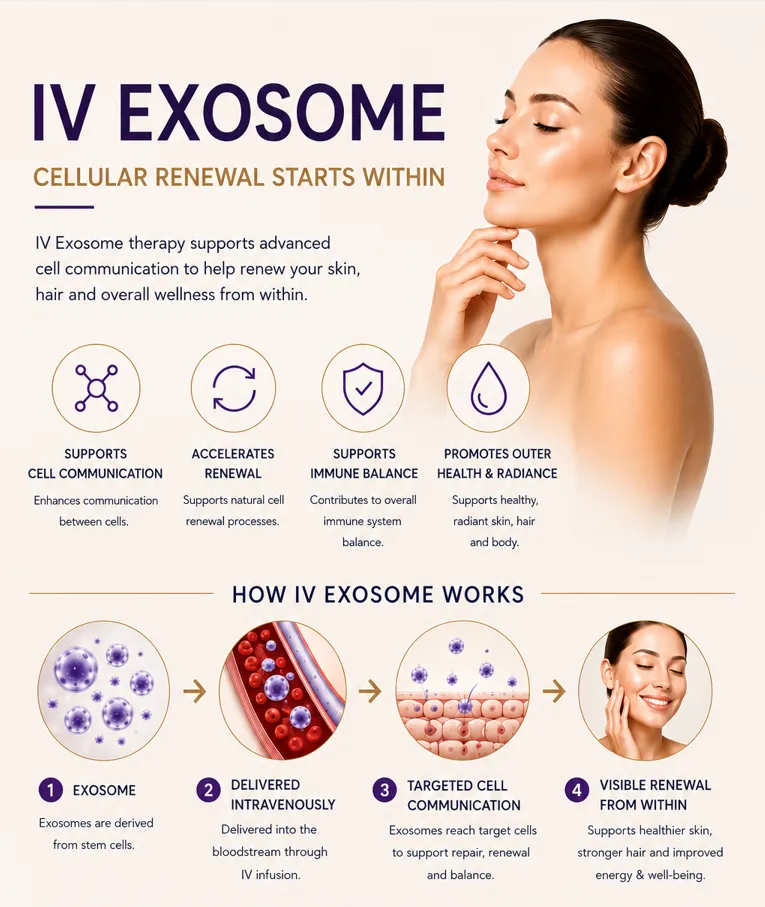
IV exosome therapy delivers exosomes – small cellular structures that enable communication between cells and support tissue repair – directly into the bloodstream through an intravenous infusion. Unlike skin-focused exosome treatments applied topically or through local injection, IV delivery aims for a systemic effect rather than targeting one specific area.
This is a relatively new and evolving field that requires individualized medical evaluation to determine suitability, dosing and frequency. Exaggerated claims – that it "cures" conditions or "stops ageing" – are not scientifically supported; a realistic framing is that it may offer potential support to tissue repair and general vitality processes, not a guaranteed outcome.
What Exactly Is IV Exosome Therapy?
Exosomes are nanometer-scale cellular structures secreted by cells, carrying growth factors, proteins, lipids and genetic material. Because their role is to transmit biological signals between cells, they're thought to play a part in tissue repair, inflammation regulation and cellular renewal processes.
In IV exosome therapy, these particles are delivered directly into the bloodstream through intravenous infusion, rather than being injected locally into the skin. The logic behind this approach is that exosomes can circulate throughout the body rather than remaining confined to a single treated area.
The exosomes used are typically produced in a laboratory setting from stem cell cultures and undergo strict quality control processes. Source, purity and sterile manufacturing are critical to the safety of IV administration – which product is used, from which supplier, and under what quality standards, are all questions worth asking openly during consultation.
Wondering If IV Exosome Therapy Is Right for You?
This treatment requires a consultation that reviews your overall health and goals. Send us a message on WhatsApp for preliminary information before your appointment.
Ask on WhatsAppHow Does IV Exosome Therapy Work?
1. Cell-to-Cell Signalling
Exosomes communicate with target cells through the growth factors and signalling molecules they carry. These signals may carry instructions related to repair, renewal and inflammation regulation processes.
2. Systemic Circulation
Exosomes delivered via IV enter the bloodstream and, in theory, can reach different areas of the body. This is the core distinction from local injection treatments that target one skin area – but it's also precisely what makes measuring exactly where, how much, and for how long the effect occurs more difficult.
3. Tissue Repair and Inflammation Regulation
Exosomes are thought to have potential to support cell proliferation, promote angiogenesis (new blood vessel formation) and help regulate inflammation. These mechanisms remain an active area of research, and no guarantee can be made that every patient will respond to the same degree.
Who May Be Considered, and Who May Not
Profiles Who May Be Considered
- Generally healthy patients seeking support for vitality and recovery
- Those wanting support for recovery after intense physical activity
- Patients familiar with regenerative treatment concepts and holding realistic expectations
- Patients able to commit to thorough medical screening and follow-up
Needs Careful Evaluation
- Active infection or uncontrolled chronic disease
- History of autoimmune disease
- Active cancer diagnosis or cancer history
- Pregnancy or breastfeeding
- Anyone expecting a "miracle" or guaranteed result
These lists offer general guidance, not a final decision. Actual suitability can only be determined through a detailed medical history, current bloodwork and physician evaluation.
IV Exosome vs Topical/Injected Exosome vs PRP
| Criteria | IV Exosome | Topical / Local Exosome | PRP |
|---|---|---|---|
| Delivery route | Intravenous infusion | Microneedling or injection into the skin | Local injection from your own blood |
| Scope of effect | Systemic (whole body) | Local (treated area) | Local (treated area) |
| Source | Laboratory-produced, derived from stem cell cultures | Laboratory-produced | Patient's own blood (autologous) |
| Target concern | General recovery and vitality support | Skin quality, hair, localized renewal | Skin and hair renewal |
| Session duration | 30–60 minutes (infusion) | 20–40 minutes | 30–45 minutes (including blood draw) |
| Preparation | Requires thorough bloodwork and medical history | Standard skin assessment | Standard assessment |
| Evidence level | Emerging, limited long-term data | Emerging | More established, widely used |
These treatments aren't competitors – they serve different purposes. If your primary concern is skin or hair, our topical exosome treatment guide or PRP treatment guide may be more directly relevant.
What Does the Treatment Process Involve?
1. Thorough Pre-Treatment Screening
Your medical history, current health status, medications and any chronic conditions are reviewed. Current bloodwork is typically requested at this stage; some patients may need additional testing.
2. Suitability Decision
Once all information is reviewed, a decision is made on whether the treatment is appropriate for you and, if so, what protocol is planned. Realistic expectations are discussed openly at this stage.
3. Sterile IV Administration
The procedure is carried out in a sterile medical setting under physician supervision, via a cannula placed in a vein, as a controlled infusion. Vital signs are monitored throughout.
4. Observation and Follow-Up
A brief observation period follows the procedure. Once checked for any adverse reaction, patients can return to normal daily activities. A follow-up appointment may be scheduled to assess response.
Safety, Risks and Why Caution Matters
IV procedures fall into a more serious medical category than skin treatments, since the substance is delivered directly into the bloodstream. The following points are particularly important:
- Product source and quality: The laboratory origin and quality control processes behind the exosomes used should be made clear to you.
- Sterile administration: The procedure should only be performed in an appropriate medical setting, using sterile technique, by experienced medical personnel.
- Allergic reaction risk: Though rare, an allergic or inflammatory reaction to the infusion is possible.
- Infection risk: As with any IV procedure, there is a theoretical local infection risk at the cannulation site.
- Limited long-term data: Because IV exosome therapy is a relatively new field, long-term safety and efficacy data is still accumulating.
Minimizing these risks depends on the treatment being planned only after thorough medical evaluation, using reputably sourced products, under the supervision of an experienced physician. Any clinic or provider promising a guaranteed outcome should be treated as a red flag.
Have Questions About Safety?
You're welcome to ask about our product sourcing and treatment protocol on WhatsApp.
Ask on WhatsAppRecovery Process and Result Expectations
| Time | What to Expect |
|---|---|
| Day of treatment | Mild tenderness at the cannulation site is possible; most patients continue normal activities |
| First few days | Some patients report a general sense of recovery; this is a subjective observation, not a guarantee |
| 2–4 weeks | Any change, if present, may begin to be noticed gradually |
| Longer term | The role of repeat sessions is discussed with your doctor based on your goals |
This isn't a treatment that can be visually measured the way a skin procedure can, so a "before-after photo" format isn't a meaningful way to evaluate it. Patients typically describe results in subjective terms – energy levels, general wellbeing, or recovery speed – and these vary from person to person and can't be guaranteed.
What Affects the Cost?
The cost of IV exosome therapy depends on the source and concentration of the product used, the number of sessions, the testing required during pre-treatment screening, and the personalized scope of your treatment protocol.
Istanbul pricing can be more accessible than in many countries, but for this treatment, price shouldn't be the sole deciding factor – particularly with IV procedures, product quality and physician experience are directly tied to safety.
IV Exosome Therapy for International Patients
Istanbul has become a common destination for international patients seeking regenerative medicine treatments. Efem Clinic is located in Levent, easily accessible from Etiler, Beşiktaş and central Istanbul.
For treatments like IV exosome therapy that require more comprehensive medical evaluation, sharing your medical history and any current test results before travelling helps with correct appointment planning.
Turkey and Istanbul pricing can be more accessible than in many countries, but final cost and suitability depend on consultation.

The IV Exosome Approach at Efem Clinic
Dr. Abdurrahman Efem is a medical aesthetic physician and ministry-appointed medical aesthetics trainer. He approaches emerging regenerative medicine applications with caution and scientific rigor; treatments like IV exosome therapy are only planned after thorough medical evaluation, within a framework of realistic expectations, and in line with the principles of the Efem Method.
Meet Dr. Efem Ask on WhatsAppRelated Guides
Exosome & Regenerative Treatments
Frequently Asked Questions
What is IV exosome therapy?
A regenerative medicine treatment in which exosome particles, which support cell-to-cell communication, are delivered into the body through an intravenous infusion.
What's the difference between IV exosome and exosome applied to the skin?
IV exosome aims for a systemic effect by entering the bloodstream, while topical or injected exosome targets a specific skin area. They serve different purposes.
Is IV exosome therapy safe?
Generally well tolerated under sterile conditions, with reputably sourced products, under experienced physician supervision, but like any IV procedure it carries some risk and requires thorough pre-screening.
Who is IV exosome therapy not suitable for?
Patients with active infection, uncontrolled chronic disease, a history of autoimmune disease, an active cancer diagnosis, or those who are pregnant or breastfeeding require careful evaluation; in some cases the treatment isn't recommended.
Is IV exosome therapy painful?
It feels similar to a standard IV cannulation; a brief pinch during insertion is possible, but the infusion itself is not typically uncomfortable.
How many sessions are needed?
The number of sessions is personalized based on your goals and physician evaluation. There is no standard package or universal number.
When will results be seen?
This treatment doesn't offer a visually measurable result; some patients report a subjective sense of recovery or wellbeing within a few weeks, but this can't be guaranteed and varies by person.
Does IV exosome therapy stop ageing?
No. Such a claim isn't scientifically supported. This treatment should be viewed as potential support for tissue repair and general vitality processes, not a treatment that stops or reverses ageing.
Where do the exosomes used come from?
They're produced in a laboratory setting from stem cell cultures. Source and quality control processes vary between clinics, so it's important to get clear information on this.
Can IV exosome therapy be combined with PRP?
In some patients it may be considered at different times, but this isn't a standard combination and should be individually planned by a physician.
How long does the procedure take?
The infusion itself typically takes 30 to 60 minutes; total time spent at the clinic, including screening and observation, may be longer.
Is there long-term safety data?
IV exosome therapy is a relatively new application, and long-term data is still accumulating. This is exactly why transparent communication and careful patient selection matter.
What should I prepare before the consultation?
Bringing any current bloodwork, a list of medications you're taking, and your chronic condition history speeds up the evaluation process.
Doctor’s Note
Regenerative medicine is advancing quickly, and IV exosome therapy is an exciting part of that. But that same excitement is precisely why it matters that patients can tell the difference between exaggerated claims and genuine scientific potential. I only offer this treatment after a thorough evaluation, to patients I genuinely believe are appropriate candidates, with clear expectation-setting – not as a guarantee, but as a carefully considered option.
Learn More About IV Exosome Therapy
Reach out on WhatsApp to find out whether this treatment is right for you, or book a consultation at Efem Clinic.
Get Information on WhatsApp Contact Efem ClinicDoctor-led treatment planning · Private villa clinic in Levent · International patient support
About Dr. Abdurrahman Efem
Dr. Abdurrahman Efem
Dr. Abdurrahman Efem is a medical aesthetic physician specializing in facial rejuvenation, non-surgical aesthetic treatments, and regenerative medicine. His approach focuses on enhancing natural beauty through personalized treatment plans designed around each patient's unique features and goals. Dr. Efem works with both local and international patients, emphasizing balanced, natural-looking results and long-term aesthetic wellbeing. This content has been prepared or medically reviewed by Dr. Abdurrahman Efem to ensure accuracy and relevance.