

Endolift For Face
ENDOLIFTX FOR THE FACE • TISSUE TIGHTENING • FACIAL CONTOURING
Endolift for the Face: Which Facial Concerns May Be Suitable?
Endolift for the face should not be considered a single, universal “facial rejuvenation” treatment. Reduced jawline definition, lower-face laxity, small pockets of localized fat and loss of subcutaneous tissue firmness can create similar visual concerns, but their anatomical causes are not necessarily the same.
Endolift uses a very fine optical laser fibre to deliver controlled energy within selected subcutaneous tissues. Whether treatment focuses primarily on localized fat, contour or tissue firmness should be determined according to the individual facial anatomy.
The key question is not simply “Can Endolift be used on the face?” but which tissue is responsible for the appearance you would like to change and whether Endolift is appropriate for that tissue.
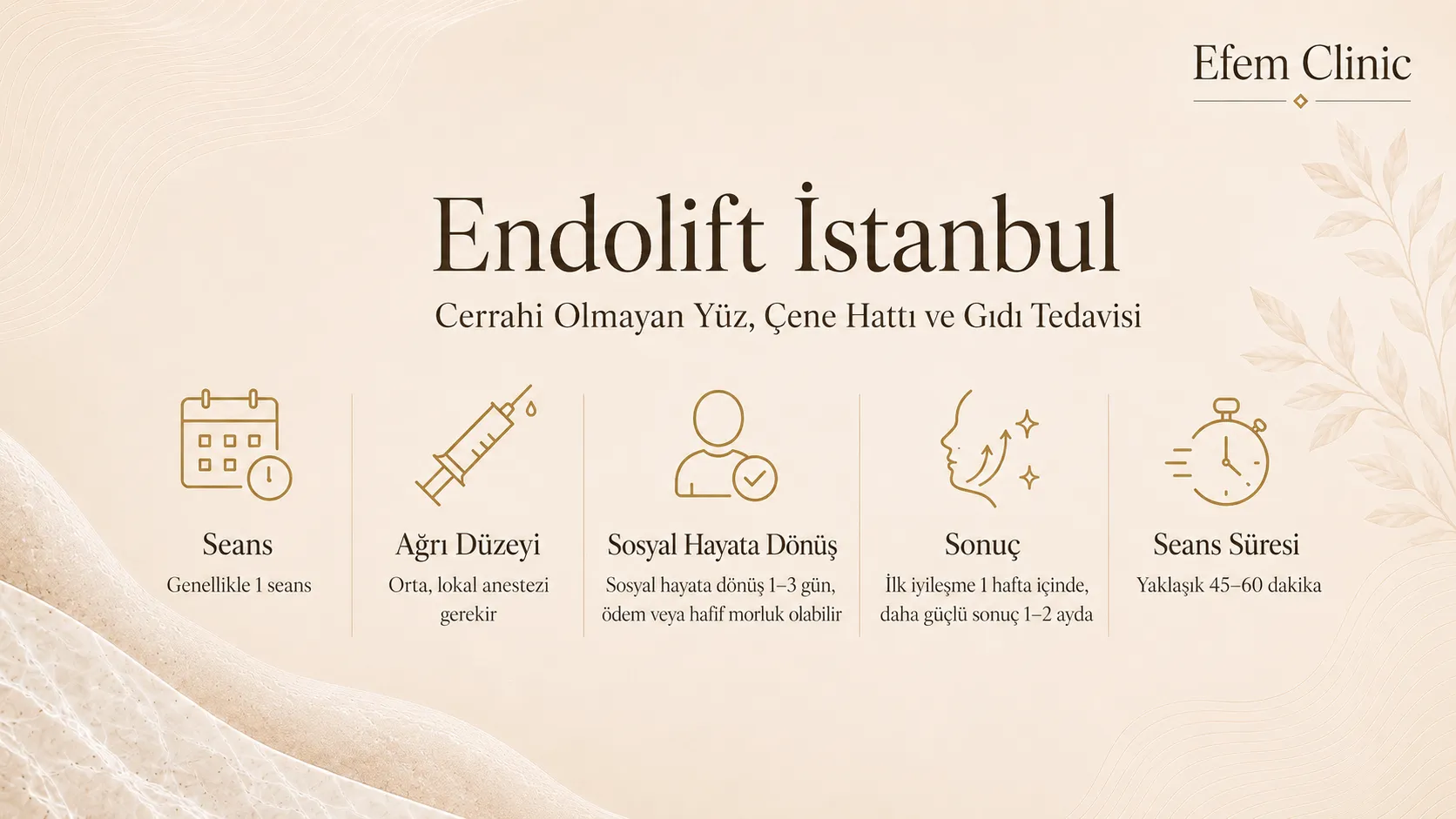
The tissue responsible for the visible concern is identified first.
Controlled energy is delivered within selected subcutaneous tissues.
Avoiding unnecessary volume reduction is part of treatment planning.
There is no single Endolift protocol for every face.
QUICK ANSWER
What Is Endolift Used for on the Face?
In selected patients, facial Endolift may be considered for subcutaneous tissue firmness, lower-face and jawline contouring, and small areas of localized fat.
Fat reduction, however, is not the correct objective for every face. When facial volume needs to be preserved, treatment may focus more on tissue firmness and remodelling rather than reducing localized fat.
Endolift alone may not be suitable where there is advanced facial sagging, significant excess skin, substantial structural volume loss or an expectation comparable with surgical lifting.
What Is Causing the Change in Facial Contour?
What appears in the mirror as “sagging,” “laxity” or loss of jawline definition is not one single anatomical problem. Before choosing a treatment, it is important to distinguish which tissue change is contributing to the appearance.
1. Localized Fat
Small pockets of fat around the submental or lower-face area may make the contour appear heavier. Endolift may be considered for this component in selected patients.
2. Tissue Laxity
Mild to moderate laxity of the skin and underlying tissues may contribute to reduced definition through the jawline and lower face.
3. Volume and Structural Support Loss
If mid-face volume, chin projection or deeper structural support is the primary issue, tightening tissue alone may not create the desired facial balance.
4. Skin Surface and Texture
Concerns such as enlarged pores, fine surface lines, pigmentation or scarring involve different tissue levels and may require a different treatment approach.
How Does Endolift Work on the Face?
During Endolift, a very fine optical laser fibre is used within the subcutaneous tissue plane selected by the doctor. The controlled thermal effect created by the laser energy may be incorporated into a treatment plan addressing tissue firmness, remodelling and, where appropriate, selected localized fat.
1. The Face Is Assessed
Fat distribution, tissue laxity, facial volume and structural support are considered together.
2. The Target Tissue Is Selected
The doctor determines whether the treatment objective relates primarily to fat, contour or tissue firmness.
3. Controlled Energy Is Delivered
The fine optical fibre delivers controlled laser energy within selected subcutaneous tissues.
4. Results Are Followed Over Time
Early treatment-related changes and gradual tissue remodelling are considered separately when assessing the result.
Which Facial Areas May Be Considered for Endolift?
A treatment area should not be selected simply by its anatomical name. In the same region, one patient may primarily have localized fat while another may have tissue laxity or structural support loss.
Jawline and Lower Face
Mild to moderate tissue laxity and selected localized fat contributing to reduced jawline definition may be assessed.
Under the Chin
Where small pockets of localized fat coexist with tissue laxity, Endolift may be one of the treatment options considered.
Lower Cheek
Facial volume plays an important role in this area. Patient selection and tissue targeting should therefore be especially careful to avoid unnecessary volume reduction.
Face-to-Neck Transition
Fat distribution and tissue laxity affecting the transition between the jawline and neck may be considered together.
PRESERVING FACIAL VOLUME
Why Is “More Fat Reduction” Not Always Better with Facial Endolift?
Facial fat is not simply unwanted volume. Specific fat compartments contribute to a balanced and naturally youthful facial appearance. The objective of facial Endolift should therefore not be to reduce as much fat as possible.
In slimmer faces, in people who already have age-related volume loss, or where lower-cheek volume contributes positively to facial proportions, unnecessary volume reduction may be undesirable.
In facial Endolift planning, knowing which tissue should be preserved can be just as important as deciding which tissue should be treated.
Who May Be Suitable for Facial Endolift?
Situations That May Be Considered
- Mild to moderate lower-face tissue laxity
- Early loss of jawline definition
- Selected small areas of localized submental fat
- Early reduction in tissue firmness
- Patients considering a non-surgical or minimally invasive option
- Patients with realistic expectations about the degree of change
Endolift May Not Be Enough
- Advanced facial or neck sagging
- Significant excess skin
- Expectations comparable with surgical facelift results
- Facial volume loss as the primary concern
- Contour concerns primarily related to skeletal or structural support
- Medical factors that make treatment unsuitable after clinical assessment
For a more detailed discussion of patient selection, see who is a good candidate for Endolift.
THE EFEM METHOD™
How Is the Decision About Facial Endolift Made?
With the Efem Method™, facial treatment planning does not begin by choosing a device or procedure name. The first objective is to understand the anatomical reason for the concern and then, when treatment is appropriate, select the relevant tissue level and treatment approach.
1. Understand the Need
Jawline change, submental fullness, laxity, volume loss and skin quality are considered separately.
2. Choose the Right Layer
The doctor assesses whether the concern relates to the skin surface, subcutaneous tissue, fat or deeper structural support.
3. Intervene Only as Much as Needed
More energy, more treatment areas or more procedures do not automatically mean a better result.
4. Preserve Natural Appearance
Treatment planning aims to preserve the patient’s facial identity and natural proportions rather than create unnecessary change.
Sometimes Endolift may be appropriate; in other cases another technology, a combination approach, postponing treatment or choosing no treatment may be more appropriate. This is why treatment selection should begin with anatomy rather than with a device.
What Is the Difference Between Endolift, Ultherapy Prime and Morpheus8 for the Face?
All three technologies may appear under the broad category of facial rejuvenation, but they do not approach the same tissue concern in the same way. Instead of asking which is universally better, it is more useful to ask which approach corresponds to the tissue responsible for the individual concern.
| Treatment | Approach | Potential Planning Focus |
|---|---|---|
| EndoliftX | Fine optical laser fibre used within subcutaneous tissue | Subcutaneous tissue firmness, facial contour and selected localized fat concerns |
| Ultherapy Prime | Focused ultrasound energy | Deeper tissue support and lifting-oriented planning |
| Morpheus8 | Radiofrequency microneedling | Skin texture, pores, scars and dermal-quality concerns |
Where more than one tissue concern is present, combination treatment may be considered. The availability of several technologies, however, does not mean that every technology should be used in the same patient.
Does Facial Endolift Replace a Facelift?
No. Endolift is not the same procedure as a surgical facelift and does not reproduce the tissue repositioning that surgery can provide in advanced facial sagging.
A patient with mild to moderate laxity who is considering a minimally invasive approach is not in the same treatment category as someone with significant excess skin and advanced sagging.
Explaining these limits from the beginning is an important part of realistic treatment planning rather than presenting an energy-based procedure as a substitute for surgery when the anatomy indicates otherwise.
What Is Recovery Like After Facial Endolift?
The post-treatment experience varies according to the treatment area and scope. Temporary swelling, tenderness, a feeling of tightness or bruising may occur, and the degree of these effects differs between individuals.
Swelling, tenderness, tightness or bruising should not be confused with the final result.
As early treatment effects settle, contour and tissue response can be assessed more meaningfully.
Because tissue remodelling may develop gradually, results should not be judged from one early photograph alone.
When Can Facial Endolift Results Be Seen?
Endolift results should not be thought of as a fixed change appearing at one precise moment. In the early period, swelling or treatment-related tightness can affect appearance, while tissue remodelling may continue to develop over time.
The degree of change depends on starting anatomy, the level of laxity, localized fat, skin and tissue quality, treatment scope and individual biological response.
Another patient’s outcome therefore cannot guarantee your own result. For further information, see the Endolift results guide.
What Affects the Cost of Facial Endolift?
A single price cannot be determined from the treatment name alone because the scope of facial Endolift varies according to individual anatomy and the treatment plan.
- The facial area being treated
- Whether one or several areas are included
- The degree of tissue laxity
- Whether localized fat is part of the treatment objective
- The overall treatment scope
- Whether another tissue concern requires a combination approach
- The individual medical assessment and treatment plan
INTERNATIONAL PATIENTS
Considering Facial Endolift in Istanbul?
International patients considering Endolift at Efem Clinic can contact the clinic before travelling. Clear photographs taken from the front, side and oblique angles may help with an initial discussion of the facial concern and whether an in-person assessment is appropriate.
Photographs do not replace a medical examination. Final suitability, treatment areas and treatment scope are confirmed individually after doctor assessment.
Appointment timing and any travel or stay considerations depend on the planned procedure and should be confirmed individually rather than assumed in advance. Treatment costs in Istanbul may differ from those in other countries, but the final cost depends on the individual treatment plan rather than location alone.
Efem Clinic is located in Levent, Istanbul and follows a private, doctor-led approach to treatment planning for both local and international patients.
Contact the International Patient Line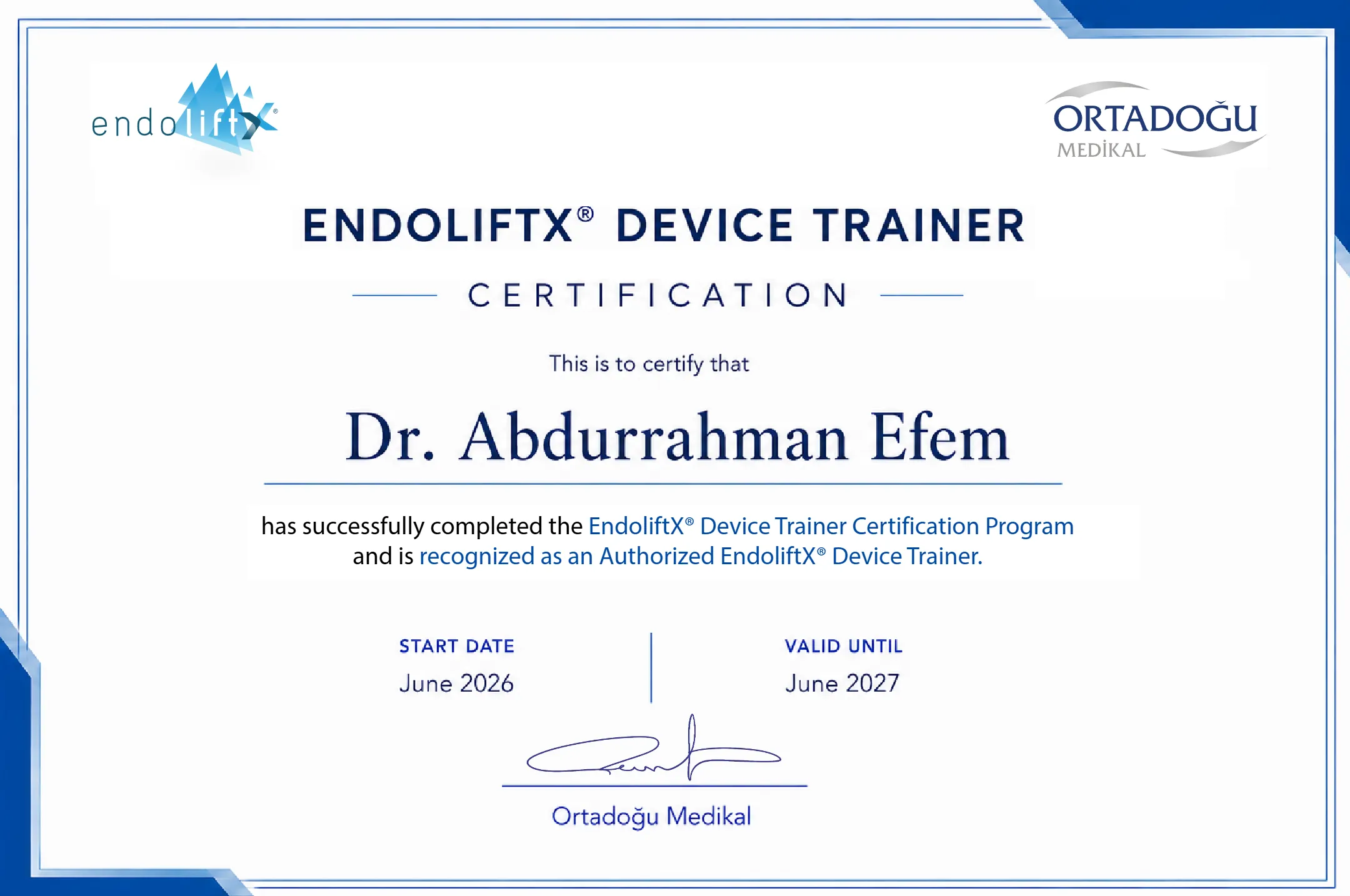
PHYSICIAN TRAINING & ENDOLIFTX
Dr. Abdurrahman Efem’s EndoliftX Trainer Certification
Dr. Abdurrahman Efem holds an EndoliftX trainer certificate. In fibre-based facial energy treatments, planning involves more than the technical use of a device. Patient selection, identification of the target tissue, preservation of facial volume and understanding the limits of treatment are also important parts of the process.
This is particularly relevant in facial Endolift, where the clinician must consider which fat contributes to unwanted fullness and which tissue should be preserved to maintain natural facial balance.

DR. ABDURRAHMAN EFEM
Why Does Doctor Assessment Matter for Facial Endolift?
Not every change in facial contour or firmness has the same anatomical cause. Rather than selecting treatment according to one visible area alone, fat distribution, tissue laxity, facial volume, chin support and overall facial proportions should be considered together.
The objective is not to create the greatest possible change, but to identify a measured treatment goal while preserving the natural identity of the face.
If Endolift is not the appropriate option, another technology, a different treatment approach, surgical assessment, postponing treatment or choosing no treatment may be more suitable.
RESULTS & PATIENT PRIVACY
How Should Facial Endolift Before-and-After Images Be Interpreted?
Lighting, camera angle, head position, facial expression, camera distance and timing can all significantly alter the appearance of facial contour in photographs. Standardized conditions are therefore important when comparing before-and-after images.
Another patient’s result does not predict or guarantee your own. Starting anatomy, fat distribution, degree of laxity and individual tissue response vary from person to person.
Efem Clinic places importance on patient privacy. Realistic expectations should be based on your own anatomy rather than attempting to reproduce another patient’s facial result.
Before & After Gallery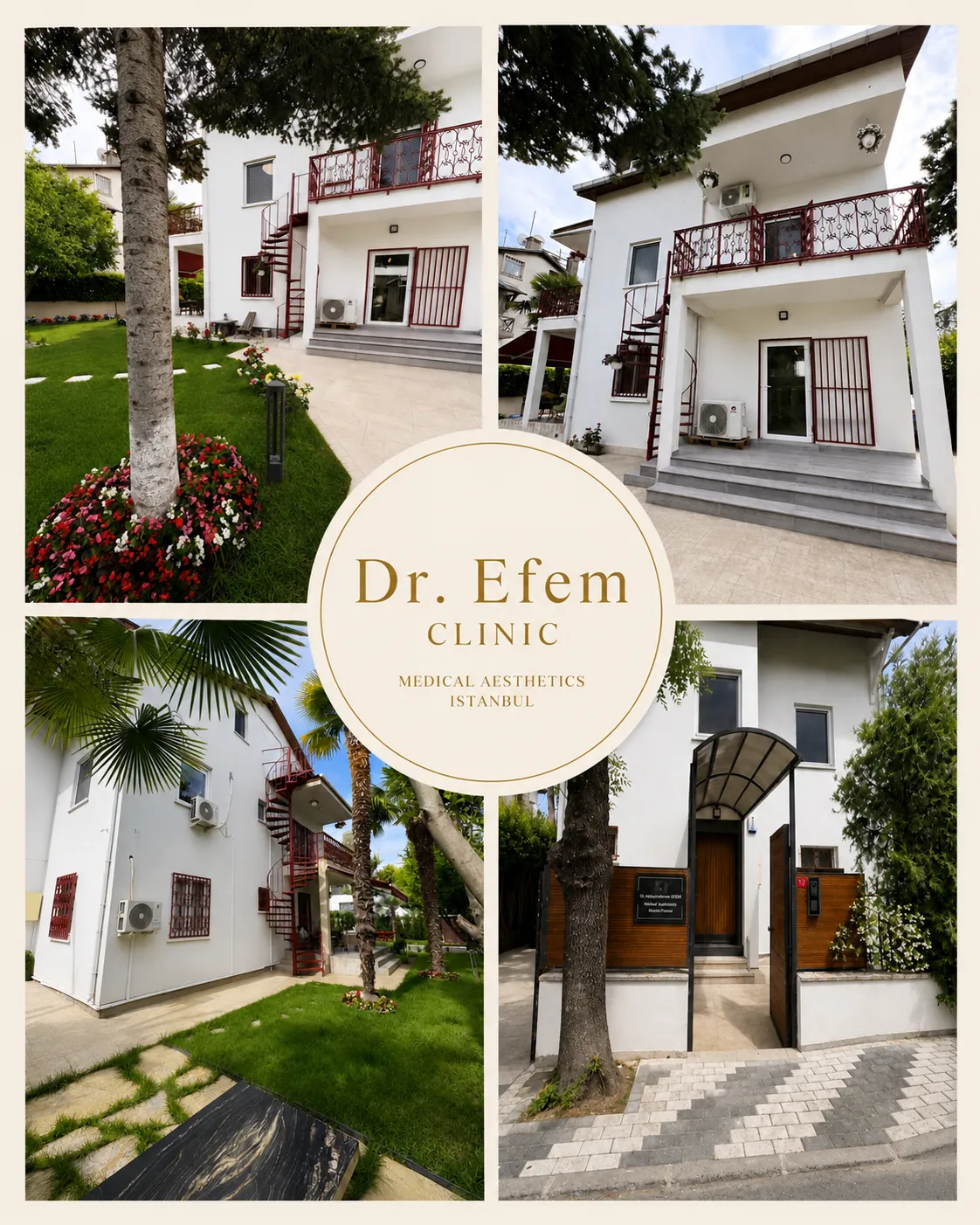
Facial Endolift Assessment in Levent, Istanbul
Efem Clinic is a doctor-led medical aesthetic clinic in a private villa setting in Levent, Istanbul. The clinic environment includes a garden and parking, with an emphasis on privacy and individualized treatment planning.
A facial Endolift assessment is not simply about identifying areas that can be treated. It is intended to determine which areas genuinely require treatment, which tissues should be preserved and whether Endolift is consistent with the patient’s anatomy and expectations.
Explore More About Endolift
If you are researching a specific aspect of Endolift, you can continue with the related guides below.
FREQUENTLY ASKED QUESTIONS
Questions About Endolift for the Face
Is Endolift performed on the entire face?
Not necessarily. Treatment areas are selected according to the anatomical cause of the concern and the individual treatment objective rather than applying one standard protocol across the whole face.
Does facial Endolift reduce fat?
Selected localized fat may form part of some treatment plans, but fat reduction is not the objective of every facial Endolift procedure. Where facial volume should be preserved, a different tissue target may be selected.
Can Endolift make the face look thinner?
This depends on starting anatomy and the tissue being treated. Fat distribution and facial proportions should be assessed beforehand to avoid unnecessary facial volume reduction.
Can facial Endolift improve jawline definition?
Endolift may be considered where mild to moderate tissue laxity or selected localized fat contributes to reduced jawline definition. Chin structure, neck anatomy and deeper support also influence the appearance of the jawline.
Is one facial Endolift session enough?
There is no fixed session number that applies to everyone. Treatment area, starting tissue condition, individual response and treatment goals influence follow-up planning.
Is Endolift an alternative to facelift surgery?
Endolift and facelift surgery are not equivalent interventions. Endolift may be considered as a minimally invasive option for selected patients with mild to moderate laxity, while significant excess skin or advanced sagging may require surgical assessment.
What is the difference between facial Endolift and Ultherapy Prime?
Endolift uses a fine optical laser fibre within selected subcutaneous tissues, while Ultherapy Prime delivers focused ultrasound energy from the skin surface. Treatment choice depends on the target tissue, degree of laxity, the role of localized fat and individual facial anatomy.
Are facial Endolift and Morpheus8 the same treatment?
No. Their treatment methods and tissue targets differ. Endolift may be considered for subcutaneous tissue and contour planning, while Morpheus8 can have a different role where skin texture and dermal-quality concerns are relevant.
Are facial Endolift results permanent?
Permanent results cannot be guaranteed. Natural ageing, weight changes, sun exposure, lifestyle and individual tissue characteristics continue to influence facial appearance over time.
EFEM NOTE
Knowing What to Preserve Is as Important as Knowing What to Treat
Within the Efem Method™, facial Endolift planning is not based on achieving maximum fat reduction or maximum tightening. The objective is to identify the anatomical reason for the concern, select the tissue that genuinely requires intervention and protect the natural volume balance of the face from unnecessary treatment.
WHAT DOES YOUR FACE ACTUALLY NEED?
Find Out Whether Endolift Is Appropriate for Your Face
If you are considering Endolift for the jawline, lower face, under-chin area or facial laxity, clear photographs from the front, side and oblique angles may help with an initial discussion. Photo assessment does not replace an examination; final suitability and treatment planning are determined through individual doctor assessment.
Treatment suitability and the degree of change that may be achieved vary according to facial anatomy, tissue quality, fat distribution, degree of laxity, treatment scope and individual biological response.
About Dr. Abdurrahman Efem
Dr. Abdurrahman Efem
Dr. Abdurrahman Efem is a medical aesthetic physician specializing in facial rejuvenation, non-surgical aesthetic treatments, and regenerative medicine. His approach focuses on enhancing natural beauty through personalized treatment plans designed around each patient's unique features and goals. Dr. Efem works with both local and international patients, emphasizing balanced, natural-looking results and long-term aesthetic wellbeing. This content has been prepared or medically reviewed by Dr. Abdurrahman Efem to ensure accuracy and relevance.