


Body Tightening vs Body Contouring: What Is the Difference?
BODY TREATMENTS • TIGHTENING • CONTOURING
Body Tightening vs Body Contouring: What Is the Difference?
Body tightening and body contouring are often discussed as though they mean the same thing. They do not. Tightening primarily addresses laxity and tissue firmness, while contouring is a broader concept that may involve localised fat, shape, proportions and, in some cases, skin quality.
The practical question is therefore not simply “Which body treatment is better?” It is whether the visible concern is mainly loose skin, localised volume, tissue quality or a combination of these factors. Treatment selection should follow that distinction.
QUICK ANSWER
Is Body Tightening the Same as Body Contouring?
No. Body tightening generally refers to improving the appearance of skin or tissue laxity. Body contouring is a broader term describing treatments intended to alter the shape or outline of a selected body area.
If loose skin is the dominant concern, tightening may be the more relevant objective. If localised fat is creating unwanted volume, contouring may require a different tissue target. If both are present, the treatment plan may need to consider both components without automatically assuming that multiple procedures are necessary.
Neither term describes a single treatment. The appropriate approach depends on what tissue is creating the contour concern, how significant it is and what degree of change is realistically possible.

Body Tightening and Body Contouring Target Different Problems
BODY TIGHTENING
When Laxity Is the Main Concern
Body tightening focuses primarily on skin and supporting tissue when an area has become less firm or does not follow the underlying contour as closely as before.
This may be relevant for selected degrees of laxity involving areas such as the abdomen, upper arms, thighs or above the knees. It does not mean physically removing substantial excess skin.
BODY CONTOURING
When Shape or Localised Volume Is the Main Concern
Body contouring describes a broader objective: changing the visible outline or proportions of a selected body area. Localised subcutaneous fat may be one important component.
It should not be confused with general weight loss. A local contouring procedure addresses a selected anatomical region rather than overall body weight.
Body Tightening vs Body Contouring at a Glance
| Question | Body Tightening | Body Contouring |
|---|---|---|
| Primary objective | Improve the appearance of selected skin or tissue laxity | Alter the shape or outline of a selected body area |
| Typical tissue question | Is reduced firmness the dominant concern? | Is localised volume or shape the dominant concern? |
| Localised fat | Not necessarily the primary target | May be an important target depending on the treatment |
| Loose skin | Often central to the treatment objective | May need separate consideration if volume reduction is planned |
| Weight loss | Not a weight-loss treatment | Local contouring is not a substitute for weight management |
| Substantial excess skin | Non-surgical tightening has important limitations | Changing local volume does not remove substantial redundant skin |
Why Does the Difference Matter?
The same body area can look soft, undefined or “loose” for different reasons. Treating the visual description as though it were a diagnosis can lead to the wrong treatment objective.
For example, reducing local volume in an area where skin laxity is already significant may not produce the type of tightening a patient expects. Conversely, focusing exclusively on skin firmness in a fat-dominant area may leave the main source of fullness largely unchanged.
The treatment question should therefore move from “Which machine should I choose?” to “Which tissue is responsible for the appearance I want to change?”
What If You Need Both Tightening and Contouring?
Mixed concerns are common. A person may have localised fat beneath skin that has also become less firm after ageing, pregnancy or weight change. In another person, laxity may be the dominant feature and local volume only a minor contributor.
Finding more than one tissue component does not automatically justify combining multiple technologies. The useful questions are which component contributes most to the visible concern, which changes are realistically achievable and whether treating an additional layer would provide a meaningful benefit.
In some situations a layered plan may be appropriate. In others, one well-selected treatment—or no non-surgical treatment at all—may be the more proportionate approach.
How Can Different Technologies Enter the Treatment Discussion?
Different technologies have different treatment characteristics and tissue targets. The examples below illustrate treatment-selection logic rather than providing an individual prescription.
| Treatment | When It May Enter the Discussion | Important Distinction |
|---|---|---|
| Ultherapy Body | When selected degrees of body skin or tissue laxity make tightening the primary objective | It should not be interpreted as a general weight-loss treatment or as removal of substantial excess skin. |
| Morpheus8 | When tissue quality and firmness are relevant treatment considerations | Suitability depends on the area, tissue characteristics and the intended treatment target. |
| Endolift | When a minimally invasive approach to selected laxity or contour concerns is being considered | The anatomical area, tissue layer and degree of the concern need to fit the intended treatment. |
| Onda Plus | When localised adipose tissue is relevant to the contour concern | Local contouring should remain distinct from overall weight management. |
The presence of several available technologies does not mean that every patient needs several technologies. The treatment mechanism should match the tissue problem rather than the treatment plan being built around a device list.
How Does This Difference Apply to Common Body Areas?
Abdomen
An abdominal concern may involve skin laxity, localised fat or deeper structural factors. A softer or projecting abdomen should not automatically be treated as a fat-only problem.
Upper Arms
Upper-arm shape may reflect loose skin, subcutaneous fullness or both. This distinction determines whether tightening, contouring or a different discussion is more relevant.
Thighs and Above the Knees
Inner-thigh fullness, skin laxity and local folds above the knees can have different dominant tissue components even within the same leg.
What Changes After Weight Loss?
After weight loss, a reduction in body volume can make previously less visible skin laxity more apparent. The remaining concern may therefore be very different from the one present before the weight change.
Some people may still have localised fat in selected areas, while others are primarily concerned about loose or redundant skin. The degree of excess skin is particularly important because non-surgical tightening has limits when substantial redundant tissue is present.
The fact that a body area changed after weight loss does not by itself determine whether tightening or contouring is appropriate. The remaining tissue needs to be reassessed.
When Are Non-Surgical Tightening or Contouring Treatments Not Enough?
Non-surgical treatment has practical limits. If substantial excess skin is the dominant issue, a tightening technology should not be presented as equivalent to physically removing that redundant skin.
Likewise, local body contouring does not replace general weight management, and superficial skin or fat treatments should not be expected to correct deeper structural problems that are contributing to the body shape.
Recognising that a particular treatment is unlikely to meet the patient's objective is part of treatment planning. A consultation does not need to result in a procedure.
THE EFEM METHOD™
Define the Tissue Before Choosing the Technology
Within The Efem Method™, body treatment planning begins by separating the visible concern into the tissues that may be contributing to it rather than starting with a device.
The assessment considers whether the main issue is skin laxity, localised subcutaneous fat, tissue quality, deeper structural support or a combination. The treatment objective can then be defined as tightening, contouring, a layered approach or, where appropriate, no non-surgical intervention.
This tissue-first approach also supports a principle of proportional treatment: adding another technology is useful only when it addresses a meaningful component that would otherwise remain untreated.
Explore The Efem Method™ →Does Body Tightening Cost the Same as Body Contouring?
There is no single price relationship between tightening and contouring because these terms can refer to different treatment plans. Cost depends on what tissue is being addressed and how the treatment is planned.
Factors may include the anatomical area, size and extent of the treatment zone, dominant tissue concern, selected technology and whether there is a genuine rationale for addressing more than one component.
A useful cost discussion therefore follows assessment. Selecting a treatment primarily because of its price before identifying the tissue problem can place the decision in the wrong order.
Planning Body Tightening or Contouring When Travelling to Istanbul
International patients may begin with a remote discussion about the body area that concerns them. Photographs, when appropriate, can help describe whether the visible issue appears to involve laxity, localised fullness or both.
However, photographs cannot reliably establish every tissue characteristic or identify all deeper contributors to body shape. They can support initial planning but should not be treated as a substitute for the medical assessment required for final treatment selection.
For this reason, travel plans should avoid depending on the assumption that a particular technology will necessarily be appropriate before assessment.

DR. ABDURRAHMAN EFEM
Treatment Planning Beyond Device Names
The difference between tightening and contouring becomes clinically useful only when it is connected to anatomy. A treatment can be technically available for a body area without necessarily being the appropriate choice for the tissue creating the concern.
Dr Abdurrahman Efem's role in physician education and professional knowledge sharing around advanced medical aesthetic technologies supports an approach in which anatomy, tissue layers and appropriate patient selection come before the device itself.
The objective is therefore not to fit the patient to a technology, but to decide whether a treatment mechanism matches the tissue, degree of change and realistic treatment goal.
Before-and-After Images and Individual Expectations
Patient privacy is important at Efem Clinic, and patient before-and-after photographs are not routinely used as a marketing tool.
Body photographs can also be misleading when used as a treatment-selection shortcut. Posture, lighting, camera position, muscle engagement and body angle can change the apparent degree of laxity or localised fullness.
Expected results should therefore be discussed in relation to the individual's anatomy, tissue characteristics and starting point rather than another person's photograph.
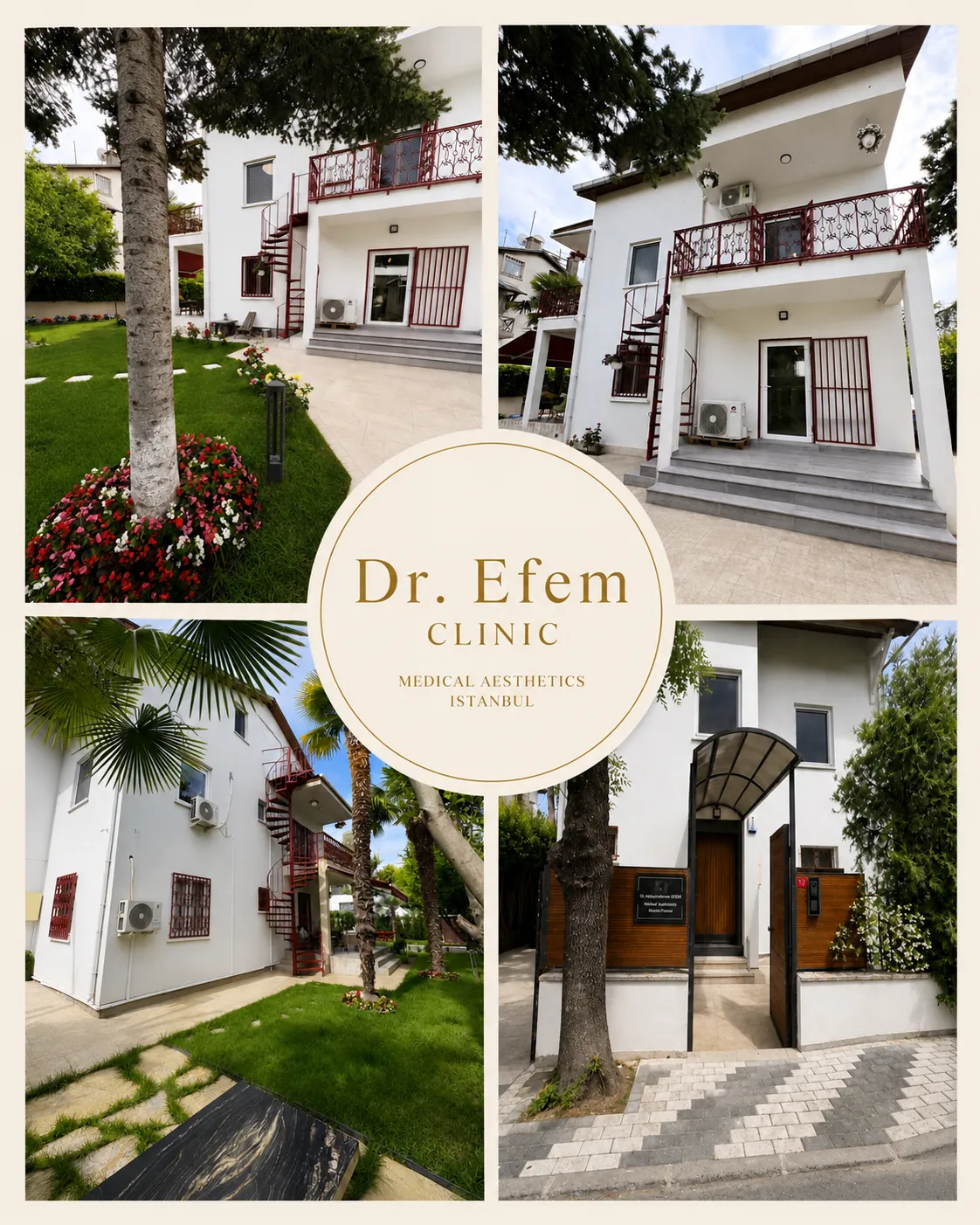
Physician-Led Body Treatment Planning in Istanbul
Efem Clinic provides physician-led planning for facial and body medical aesthetic treatments in a private villa clinic setting in Levent, Istanbul. Body concerns are assessed according to anatomy and tissue characteristics before a tightening, contouring or combined approach is considered.
You can learn more about the clinic and its treatment philosophy on the About Efem Clinic page.
Related Treatments and Guides
FREQUENTLY ASKED QUESTIONS
Body Tightening vs Body Contouring FAQs
What is the main difference between body tightening and body contouring?
Body tightening primarily addresses selected skin or tissue laxity. Body contouring is a broader concept focused on changing the shape or outline of an area and may involve localised fat. The appropriate objective depends on the tissue creating the visible concern.
Can body contouring tighten loose skin?
It depends on the treatment and tissue being targeted. Body contouring is a broad term and should not automatically be assumed to correct skin laxity. When loose skin is an important component, it needs to be assessed separately.
Does body tightening remove fat?
Body tightening should not automatically be interpreted as fat reduction. Different technologies have different tissue targets, so localised fat needs to be distinguished from skin laxity before treatment is selected.
Can I have loose skin and localised fat at the same time?
Yes. The same body area can contain localised fat while the overlying skin has reduced firmness. The assessment should establish which component is dominant and whether both need to be addressed.
Is body contouring a weight-loss treatment?
No. Local body contouring is intended to address selected anatomical areas and should not be presented as a substitute for general weight management or broader changes in body composition.
Which is better after weight loss: tightening or contouring?
The answer depends on what remains after weight loss. Some people primarily have skin laxity, others retain localised fat, and some have both. The degree of true excess skin is also important when considering the limits of non-surgical treatment.
Do I need more than one treatment if I have both laxity and fat?
Not necessarily. Identifying more than one tissue component does not automatically mean several technologies are required. A combined approach should have a clear rationale and address a meaningful problem that would otherwise remain untreated.
Can non-surgical body tightening remove a large amount of excess skin?
Non-surgical tightening should not be considered equivalent to surgical removal of substantial redundant skin. The degree of laxity and the realistic limits of treatment need to be assessed individually.
How do I know whether I need body tightening or body contouring?
The useful first step is to determine whether the visible concern is mainly related to skin laxity, localised fat, tissue quality, deeper structural factors or a combination. Treatment selection can then follow the tissue diagnosis rather than beginning with a device.
Not Sure Whether You Need Tightening or Contouring?
You do not need to choose the treatment category or device yourself. The useful starting point is to identify which tissue is creating the concern and what degree of change can realistically be achieved.
Treatment suitability and expected change depend on anatomy, tissue characteristics, the underlying cause of the contour concern and individual treatment goals. Online information does not replace a personal medical assessment.
About Dr. Abdurrahman Efem
Dr. Abdurrahman Efem
Dr. Abdurrahman Efem is a medical aesthetic physician specializing in facial rejuvenation, non-surgical aesthetic treatments, and regenerative medicine. His approach focuses on enhancing natural beauty through personalized treatment plans designed around each patient's unique features and goals. Dr. Efem works with both local and international patients, emphasizing balanced, natural-looking results and long-term aesthetic wellbeing. This content has been prepared or medically reviewed by Dr. Abdurrahman Efem to ensure accuracy and relevance.