


Temple Filler Istanbul | Natural Upper-Face Balance and Hollow Temple Correction
Doctor-Led Medical Aesthetics · Levent, Istanbul
Temple Filler Istanbul
Natural Upper-Face Balance, Hollow Temple Correction and Facial Frame Support
If your temples look hollow, your upper face appears more tired, or your face has started to look narrower and less supported from the sides, temple filler may be considered after a detailed facial assessment.
The goal is not to create a rounded, puffy or visibly filled upper face. Treatment is planned by assessing the temples, forehead, eye area, cheeks, facial proportions and natural expression together.
For an initial assessment, send clear front, side and angled photos in natural light. Final suitability and treatment planning require a medical consultation.
QUICK ANSWER
What Does Temple Filler Do?
Temple filler is an injectable medical aesthetic treatment used in selected patients to soften visible hollowing and support the upper facial frame.
When appropriately planned, it may improve the transition between the forehead, temples, outer eye area and cheeks. It can help the upper face appear softer, less skeletal and more balanced.
Temple filler is not simply about filling an empty area. Its purpose is to restore proportion and support while preserving the patient’s natural facial character.
What Is Temple Filler?
Temple filler is a non-surgical, injection-based medical aesthetic treatment used to address volume loss or hollowing in the temporal region.
The temple area contributes to the shape of the upper face and influences how smoothly the forehead, eyes and cheeks connect. When the temples lose volume, the face may appear narrower, more angular, tired or aged.
In selected patients, temple filler may help with:
- Visible temple hollowing
- Upper-face volume loss
- A tired or aged facial frame
- Loss of softness around the outer eye area
- A disrupted forehead-temple-cheek transition
- Mild upper-face asymmetry
- A narrow or skeletal upper-face appearance
- A desire for more harmonious facial proportions
When planned carefully, temple filler can restore subtle structural support and create a smoother facial transition.
When overused or poorly positioned, it may create puffiness, heaviness, asymmetry or an unnatural facial shape. For this reason, temple filler should be approached as a detailed anatomical treatment rather than a routine volume procedure.
Why Do Temples Become Hollow?
Temple hollowing may develop gradually or may be part of a person’s natural facial structure.
Age-Related Volume Loss
Changes in facial fat, skin, connective tissues and bone support may make the temples look progressively more hollow.
Genetic Facial Structure
Some people naturally have a narrower or more angular upper face with visible temple depression.
Weight Loss
Significant or rapid weight loss may reduce facial volume and make the temples appear more prominent.
Low Body Fat
People with naturally low body fat may have a more defined or skeletal facial frame.
Bone and Tissue Changes
Changes in skeletal support and the position of facial tissues can affect the forehead-temple-cheek relationship.
Previous Filler Treatments
Overfilling the cheeks or nearby areas may make untreated temple hollowing appear more obvious.
The correct question is not simply, “Should the temples be filled?”
The correct question is whether temple hollowing is affecting the patient’s overall facial frame, proportions and expression.
Who May Be Suitable for Temple Filler?
Potentially Suitable Patients
- Visible temple hollowing
- Upper-face volume loss
- A narrow or skeletal facial frame
- A tired-looking outer eye area
- Loss of softness between the forehead and cheeks
- Mild asymmetry
- A preference for subtle, natural improvement
- Realistic expectations
When It May Not Be the First Choice
- No meaningful temple volume loss
- An already overfilled upper or midface
- A tendency toward significant facial swelling
- Active skin infection or inflammation
- The main concern is skin laxity rather than volume loss
- A desire for an exaggerated or rounded upper face
- Certain medical conditions affecting suitability
- Unrealistic expectations
Temple filler is not necessary for every patient with a tired-looking face. Cheek support, under-eye assessment, skin-quality treatment, Ultherapy, Morpheus8 or doing less may be more appropriate.
Temple Filler vs Cheek Filler
Temple filler and cheek filler both influence facial balance, but they support different parts of the face.
Temple Filler
- Supports the upper facial frame
- Softens temple hollowing
- Improves side facial support
- Smooths the forehead-temple-cheek transition
- Helps balance upper-face proportions
Cheek Filler
- Supports the midface
- Improves cheek contour
- Supports the under-eye-cheek transition
- May indirectly soften nasolabial folds
- Influences midface and lower-face balance
Some patients need cheek support without temple filler. Others need temple support without cheek filler. Some require cautious treatment of both areas, while others need neither.
Which Treatment Is Right for Upper-Face Balance?
Temple filler is only one possible solution. The correct treatment depends on whether the main issue is volume loss, tissue laxity, skin quality, under-eye hollowing or a combination of concerns.
Temple Filler
May be considered when genuine temple hollowing affects the upper facial frame.
Main role: Upper-face volume and structural support.
Cheek Filler
May be more appropriate when tiredness is mainly caused by loss of midface support.
Explore cheek filler in IstanbulUnder-Eye Filler
May be considered in selected patients when tear-trough hollowing is the primary concern.
Read the under-eye filler guideUltherapy
May be more suitable when laxity and loss of deeper tissue support are more important than volume loss.
Read the Ultherapy Istanbul guideMorpheus8
May support skin texture, firmness, fine lines and mild laxity without replacing temple volume.
Read the Morpheus8 Istanbul guideNo Additional Filler
If the face is already balanced or looks overfilled, adding more volume may not be appropriate.
Sometimes the right plan is to do less.
Our Approach: A Softer Facial Frame, Not a Puffy Upper Face
One of the most common aesthetic mistakes in temple treatment is using more volume than the facial anatomy requires.
Excessive temple filler may create:
- A rounded or swollen upper face
- Heaviness around the temples
- An unnaturally wide facial frame
- A heavy cheek-temple transition
- Visible asymmetry
- Loss of natural facial definition
- An obviously treated appearance
Less is more.
The right amount, the right anatomical plane and the right patient are more important than adding more product.
How Is Temple Filler Planned?
01 · CONSULTATION
Upper-Face and Full-Face Assessment
The temples, forehead, outer eye area, cheeks, under-eye region, facial asymmetry, skin quality, expression and previous filler history are evaluated.
02 · IDENTIFYING THE MAIN CONCERN
Volume Loss, Laxity or Skin Quality?
If true temple hollowing is present, filler may be considered. If the main issue is cheek support, under-eye hollowing, skin laxity or texture, a different treatment may be more appropriate.
03 · PRODUCT AND AMOUNT
Anatomy-Based Selection
Product characteristics, amount and placement are selected according to temple depth, skin thickness, asymmetry, required support and safety considerations.
04 · FOLLOW-UP
Settling and Result Review
After early swelling settles, facial balance, symmetry, temple softness, expression and the need for any additional treatment are reassessed.
What Does Temple Filler Feel Like?
The temple is an anatomically sensitive area, so treatment may feel different from filler in other facial regions.
Patients may experience:
- Needle or cannula sensation
- Pressure
- A deep feeling of fullness
- Mild stinging
- Temporary tenderness
- A tight or unfamiliar sensation in the temple area
Sensitivity varies between patients. Comfort is important, but accurate anatomical placement and safety remain the priority.
Downtime and Recovery
Recovery after temple filler is usually manageable, but temporary effects can occur and should be considered when planning social or professional commitments.
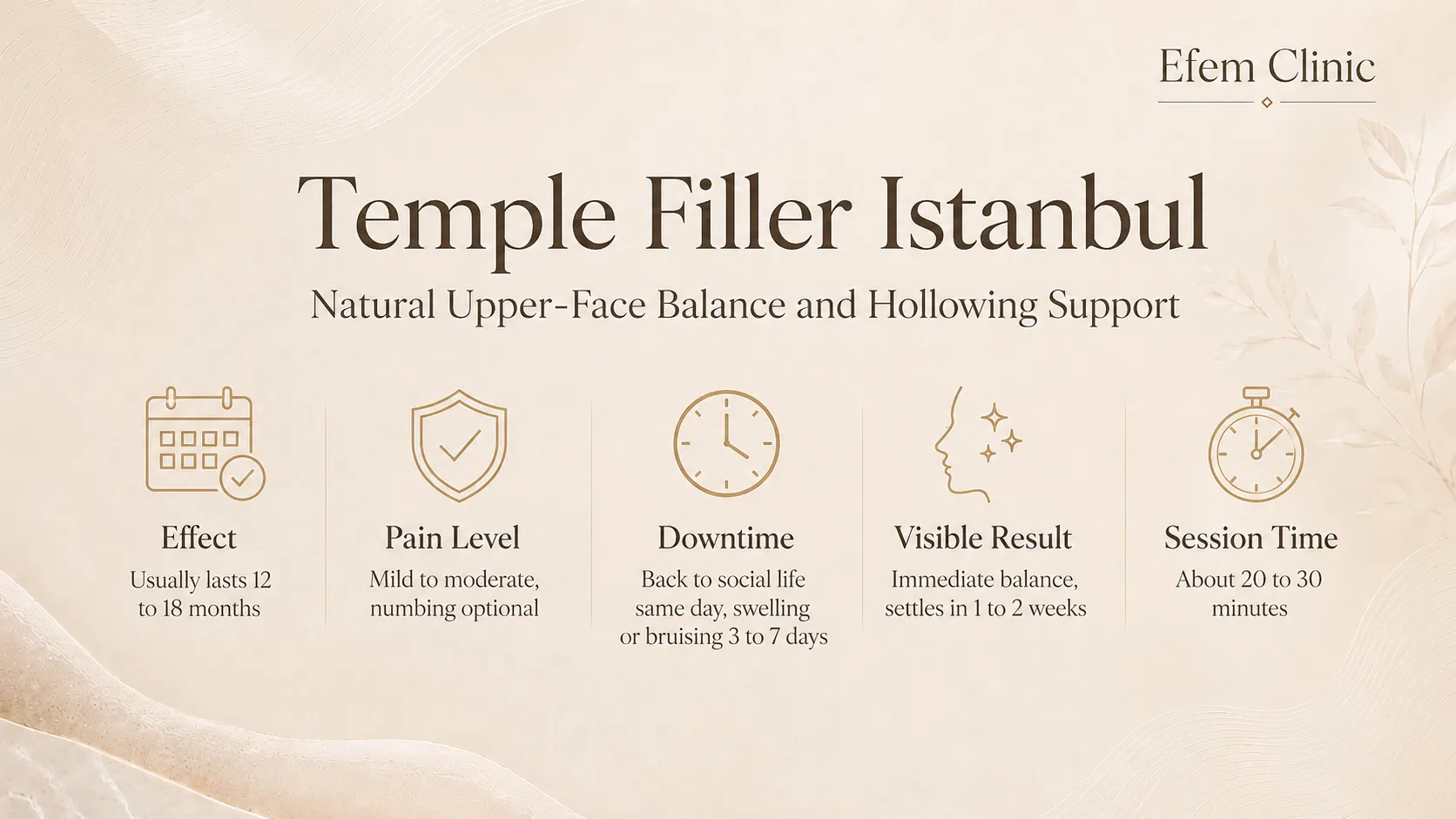
First 24–48 hours: Swelling, redness, tightness or tenderness may be present.
First few days: Bruising or temporary asymmetry caused by swelling may occur.
After 1–2 weeks: The filler generally appears more settled and integrated.
Follow-up: The result and need for any refinement can be assessed.
When Are Temple Filler Results Visible?
A change in temple hollowing may be visible shortly after treatment. However, the early appearance is not the final result because swelling can temporarily affect volume and symmetry.
Immediately: The hollow area may appear softer and more supported.
First few days: Swelling or bruising may temporarily influence the appearance.
After 1–2 weeks: The result usually appears more natural and settled.
Follow-up period: Symmetry and the need for additional treatment are reviewed.
How Long Does Temple Filler Last?
Temple filler longevity is not identical for every patient.
Factors that may influence duration include:
- The characteristics of the filler used
- The amount applied
- The depth and anatomical plane of treatment
- Individual tissue structure
- Metabolism
- Lifestyle factors
- Previous filler treatments
- Individual tissue response
The expected duration should be discussed during consultation rather than treated as a guaranteed fixed period.
Is Temple Filler Safe?
Temple filler is a medical aesthetic procedure that requires detailed knowledge of facial anatomy. Important blood vessels and anatomical structures are present in the temple region, so the procedure should not be treated casually.
Possible side effects and risks may include:
- Temporary swelling, redness or tenderness
- Bruising
- Temporary asymmetry
- Lumps or irregularity
- An overfilled appearance
- Infection
- An unsatisfactory aesthetic result
- Rare but important vascular complications
Your medical history, current medications, allergies and previous filler treatments should be shared during the consultation.
Appropriate patient selection, conservative planning, medical-grade products and an anatomy-based technique are central to risk reduction.
What If the Face Already Looks Overfilled?
If the upper or midface already appears excessively full, adding more filler is usually not the first step.
Possible signs of previous overfilling include:
- A puffy upper-face appearance
- Overly rounded temples
- A face that appears wider than before
- A heavy cheek-temple transition
- Artificial contour
- Loss of natural facial definition
- Asymmetry
Depending on the filler type and clinical assessment, options may include waiting, monitoring, correction planning, avoiding additional volume or dissolving suitable filler in selected cases.
The aim is not to hide excessive filler with more filler. The aim is to restore a more natural facial balance.
Temple Filler Cost in Istanbul
The cost of temple filler depends on the individual treatment plan rather than one standard amount for every patient.
Factors that may influence pricing include:
- The degree of temple hollowing
- Whether one or both sides require treatment
- Facial asymmetry
- The characteristics of the selected product
- The amount required
- The intended anatomical plane
- Previous filler treatments
- The need for correction or staged treatment
Using more filler does not automatically create a better result. A conservative plan may be preferable to adding unnecessary volume.
Request an Assessment and Price InformationInternational Patients Visiting Istanbul
Efem Clinic welcomes patients travelling from Europe, the United Kingdom, the Middle East and other international locations.
Before travelling, you may send recent front, side and angled photos through WhatsApp. This can help the clinic understand your concerns and organise your appointment, but it does not replace an in-person medical examination.
About Dr. Abdurrahman Efem

Dr. Abdurrahman Efem is a medical aesthetic physician known for natural-result focused, anatomy-based facial planning.
He is a ministry-appointed medical aesthetics trainer and provides professional education in advanced applications including Endolift, Ultherapy, Morpheus8, botulinum toxin and filler treatments.
His treatment philosophy includes:
- Preserving natural facial expression
- Balanced rather than exaggerated rejuvenation
- Detailed patient selection
- Medical safety and anatomical planning
- High-standard product selection
- Avoiding unnecessary or artificial-looking volume
Why Choose Efem Clinic for Temple Filler in Istanbul?

Before and After Expectations
Temple filler results vary according to facial anatomy, the degree of hollowing, tissue quality, product selection, treatment amount and individual response.
Before-and-after images should be compared under similar lighting, camera distance, facial expression and head position. Another patient’s result cannot predict or guarantee your individual outcome.
A natural result should soften the temple area and improve the facial frame without making the face look visibly filled.
View the Before and After GalleryRelated Treatments and Detailed Guides
Frequently Asked Questions
What is temple filler?
Temple filler is an injectable medical aesthetic treatment used in selected patients to soften temple hollowing and support upper-face balance.
Who is suitable for temple filler?
It may be suitable for patients with genuine temple hollowing, upper-face volume loss, a narrow facial frame or mild asymmetry, provided there is no medical contraindication.
Is temple filler suitable for everyone?
No. It may not be appropriate when there is no meaningful temple volume loss, the face already looks overfilled or the main concern is skin laxity rather than volume.
Can temple filler look natural?
A natural result may be achieved through conservative dosing, appropriate product selection and full-face planning. The aim is subtle support rather than visible fullness.
Does temple filler lift the face?
Temple filler does not replace lifting treatments. It may support the facial frame, but Ultherapy or another treatment may be more appropriate if laxity is the main concern.
Is temple filler the same as cheek filler?
No. Temple filler focuses on the upper facial frame, while cheek filler mainly supports the midface and cheek contour.
Can temple and cheek filler be combined?
They may be combined in selected patients when both upper-face and midface support are reduced. The treatment should be planned conservatively.
Is temple filler painful?
Patients may feel a needle or cannula sensation, pressure, stinging, deep fullness or temporary tenderness. Sensitivity differs between individuals.
Is there downtime after temple filler?
Temporary swelling, bruising, redness, tightness or tenderness may occur. Many patients resume daily activities shortly after treatment.
When will I see the result?
An initial change may be visible immediately, but the more settled result is usually assessed after early swelling has reduced.
How long does temple filler last?
Longevity depends on the product, treatment amount, anatomical plane, metabolism, lifestyle and individual tissue response.
Is temple filler safe?
It can be planned with a safety-focused approach when performed with appropriate patient selection, anatomical knowledge and suitable medical products. The temple is an anatomically important region.
Can temple filler affect the eye area?
In some patients, improving the upper facial frame may create a softer transition around the outer eye area. Under-eye concerns still require a separate assessment.
Can temple filler be combined with Ultherapy?
If volume loss and tissue laxity are both present, temple filler and Ultherapy may be included in a staged treatment plan.
Can temple filler be combined with Morpheus8?
Morpheus8 targets skin quality and firmness, while filler addresses volume and support. Treatment sequence should be personalised.
Will temple filler make my face look wider?
Excessive or poorly planned filler can make the upper face appear wider. Conservative dosing is important for maintaining natural proportions.
Can excess temple filler be dissolved?
Depending on the filler material and clinical assessment, dissolving or correction may be considered in selected cases.
What should I tell the doctor before treatment?
Share your medical history, current medications, allergies and previous filler or facial treatments during consultation.
Can I travel after temple filler?
Travel plans should be discussed with the clinic. Because swelling or bruising can occur, allowing time before important social events or flights may be helpful.
How is temple filler cost determined?
Cost depends on anatomy, the degree of hollowing, product selection, required amount, asymmetry and whether staged treatment or correction is needed.
Doctor’s Note
Temple filler is not simply about filling a hollow area. It is about understanding the facial frame.
Some patients have genuine temple hollowing that affects the whole face. Others need cheek support, under-eye assessment, skin treatment or no filler at all.
The goal is not fullness. The goal is harmony, proportion and a softer facial transition.
At Efem Clinic, our focus is refined, conservative and safety-conscious upper-face planning.
Dr. Abdurrahman Efem
PERSONALISED UPPER-FACE ASSESSMENT
Is Temple Filler Right for You?
The first step is not deciding to have filler. The first step is understanding whether your concern comes from temple hollowing, cheek support, under-eye anatomy, skin quality, tissue laxity or a combination of factors.
Send front, side and angled photos in natural light for an initial review. A final treatment decision is made after medical consultation.
About Dr. Abdurrahman Efem

Dr. Abdurrahman Efem
Dr. Abdurrahman Efem is a medical aesthetic physician specializing in facial rejuvenation, non-surgical aesthetic treatments, and regenerative medicine. His approach focuses on enhancing natural beauty through personalized treatment plans designed around each patient's unique features and goals. Dr. Efem works with both local and international patients, emphasizing balanced, natural-looking results and long-term aesthetic wellbeing. This content has been prepared or medically reviewed by Dr. Abdurrahman Efem to ensure accuracy and relevance.