

How Does Endolift Reduce Fat?
ENDOLIFTX • LOCALIZED FAT • CONTOUR PLANNING
How Does Endolift Reduce Fat? Localized Fat, Contouring and Volume Preservation
Endolift may be considered in selected patients when localized fat contributes to an unwanted contour. However, reducing fat is not the objective of every Endolift treatment. Particularly in the face, careful planning means distinguishing between volume that contributes to heaviness and volume that should be preserved for natural facial proportions.
Localized fullness beneath the chin, heaviness around the jawline or a limited fat deposit in a body area is not the same as overall excess body weight. Endolift should not be viewed as a weight-loss treatment or as a method for large-volume fat removal.
The important question is not simply “Can Endolift reduce fat?” but “Is fat actually the tissue that should be reduced in this area?”
QUICK ANSWER
How Does Endolift Target Localized Fat?
Endolift uses a very fine optical laser fibre to deliver laser energy into selected subdermal tissues, creating a controlled thermal effect in the intended treatment area. When localized fat contributes meaningfully to a contour concern, selected fatty tissue may form part of the treatment strategy.
This does not mean that fat should be reduced during every Endolift treatment. For some patients, the main objective may instead be tissue firmness and collagen remodelling while preserving existing volume.
The goal is not to remove as much fat as possible. It is to identify whether localized fat is actually contributing to the concern and to treat only what is appropriate for the individual anatomy.
Is Localized Fat the Same as Excess Body Weight?
No. Localized fat refers to a limited fat deposit in a particular anatomical area that contributes to its contour. Excess body weight is a broader issue involving overall body composition.
A person may have a relatively stable body weight but still have localized fullness beneath the chin or in another specific area. Conversely, when the concern involves a large volume of generalized fat, the role of Endolift is different.
Endolift is not a weight-loss treatment. It should not be presented as a method for reducing overall body weight or removing large volumes of fat.
How Is Localized Fat Included in an Endolift Treatment Plan?
Planning begins by identifying what is creating the visible contour concern. If localized fat is an important part of the problem, selected fatty tissue may be included in the Endolift treatment target.
01
Identify the Contour Concern
The doctor assesses whether visible fullness is related mainly to localized fat, tissue laxity, anatomical structure or a combination of factors.
02
Identify Volume to Preserve
Particularly in the face, not all fat is unwanted. Volume that contributes to natural proportions and facial support may need to be preserved.
03
Select the Target Tissue
The very fine optical laser fibre is guided through selected subdermal tissues according to the individual treatment plan.
04
Reassess the Overall Contour
The objective is not maximum volume reduction but a proportionate contour that remains compatible with the patient’s anatomy.
Does Fullness Always Mean There Is Too Much Fat?
No. Similar-looking contour concerns can have different anatomical causes. This is particularly important around the lower face, jawline and submental area.
| Visible Concern | Possible Cause | What It May Mean for Endolift |
|---|---|---|
| Limited fullness beneath the chin | Localized fat | Selected fat may be included in the treatment target in an appropriate patient. |
| Less defined jawline | Localized fat, laxity, anatomy or a combination | The dominant cause should be identified before deciding whether fat reduction has a role. |
| Lower-face heaviness | Fat distribution and/or tissue laxity | Planning should distinguish volume that contributes to heaviness from volume that supports facial proportions. |
| Hollow or tired appearance | Volume loss or structural support change | Further fat reduction may be inappropriate and may accentuate the concern. |
| Significant excess skin | Advanced tissue laxity | Reducing fat may not address the main problem; surgical assessment may be more relevant. |
FACIAL VOLUME PRESERVATION
Is Less Facial Fat Always Better?
No. Facial fat is not simply unwanted volume. Different facial fat compartments contribute to natural proportions, transitions between facial areas and overall facial support.
For this reason, facial Endolift planning should not begin with the question “How much fat can be reduced?” It should begin by asking which volume is genuinely contributing to the unwanted contour and which volume should remain.
In a naturally thin face or a face with existing volume loss, unnecessary fat reduction may contribute to a more hollow or tired appearance. Lower-face contouring therefore needs to be considered in the context of the whole face rather than as an isolated fat-reduction exercise.
A natural-looking result may depend as much on preserving the right volume as on reducing unwanted volume.
Can Fat Reduction and Collagen Remodelling Be Part of the Same Endolift Plan?
In selected patients, an Endolift plan may involve more than one tissue objective. When localized fat contributes to the contour concern, selected fatty tissue may be addressed while the controlled thermal effect also forms part of a strategy to support tissue firmness and collagen remodelling.
This does not mean that every patient requires both objectives. In one patient, localized fat may be an important component of the concern. In another, preserving volume while focusing on tissue firmness may be more appropriate.
The role of localized fat should therefore be considered as one part of the overall anatomical treatment plan rather than as an automatic Endolift target.
Read About Endolift and Collagen StimulationWho May Be Considered for Endolift When Localized Fat Is a Concern?
May Be Considered
- Selected patients with limited localized fat affecting contour
- Patients in whom localized fat and mild to moderate tissue laxity coexist
- Selected patients with limited submental or lower-face fullness
- Patients whose anatomical assessment shows a meaningful match between the tissue concern and Endolift
May Need a Different Approach
- Patients primarily seeking weight loss or large-volume fat reduction
- Faces with significant pre-existing volume loss or hollowing
- Cases in which significant excess skin or advanced laxity is the main concern
- Situations in which the visible contour issue is not primarily caused by fat
When May Endolift Not Be the Right Approach for Fat Reduction?
The fact that Endolift can have a role in selected areas of localized fat does not mean it is suitable for every fat-related concern. Recognising these limitations is part of appropriate patient selection.
- When the primary goal is overall weight loss
- When large-volume fat reduction is required
- When the face already has significant volume loss
- When the contour concern is primarily related to skeletal or deeper structural anatomy
- When significant excess skin or advanced laxity is present
- When expectations exceed what a minimally invasive treatment can realistically address
In some patients, deliberately leaving facial fat untreated may be an important part of the treatment decision.
THE EFEM METHOD™
The Goal Is Not to Remove Fat — It Is to Plan the Right Contour
Within the Efem Method™, planning goes beyond asking whether fat is present. The anatomical source of the visible concern, the tissue that should be targeted and the volume that should be preserved are considered together.
1. Understand the Need
Clarify the contour concern and the change the patient hopes to achieve.
2. Choose the Right Layer
Determine whether the concern relates primarily to localized fat, tissue laxity, volume loss or deeper anatomical structure.
3. Intervene Only as Much as Needed
The objective is not maximum fat reduction, but a proportionate intervention directed at the tissue that actually contributes to the concern.
4. Preserve Natural Appearance
Particularly in the face, volume that supports natural proportions should not be reduced unnecessarily.
Sometimes the appropriate Endolift plan includes selected fat treatment. Sometimes it means preserving volume, choosing another technology or deciding that no treatment is needed.
When Can Contour Changes Be Evaluated After Endolift?
The appearance immediately after treatment should not be considered the final result. Temporary swelling, tenderness or tightness may affect the early appearance, while tissue remodelling develops more gradually.
The degree of visible contour change may vary according to baseline anatomy, the amount and distribution of localized fat, tissue laxity, treatment area, treatment scope and individual biological response.
For this reason, treatment results are better considered over the appropriate follow-up period rather than judged only from the immediate post-treatment appearance.
Read the Endolift Results GuideDoes Endolift Replace Liposuction or Surgery?
Endolift and surgical fat removal are not equivalent procedures. Endolift may be considered as a minimally invasive option for selected localized contour concerns, but surgical approaches have a different role when large-volume fat reduction or removal of significant excess skin is required.
Similarly, advanced tissue laxity cannot necessarily be corrected by reducing fat. When excess skin or substantial tissue descent is the dominant concern, surgical assessment or another approach may be more appropriate.
The objective is not to position Endolift as a substitute for surgery, but to determine which approach corresponds to the actual anatomical problem.
INTERNATIONAL PATIENTS
Considering Endolift for Localized Fat in Istanbul?
International patients can share photographs and explain the area that concerns them before travelling to Istanbul. Photographs may help begin the discussion about whether localized fat, tissue laxity or another anatomical factor appears to contribute to the contour.
Photographs alone cannot confirm treatment suitability. Final planning requires individual medical assessment, particularly when the decision involves whether facial volume should be reduced or preserved.
Appointment timing, treatment scope and practical travel considerations are discussed individually once the proposed treatment plan is clearer. Treatment costs can also vary according to the area and scope rather than location alone.
Contact the International Patient Line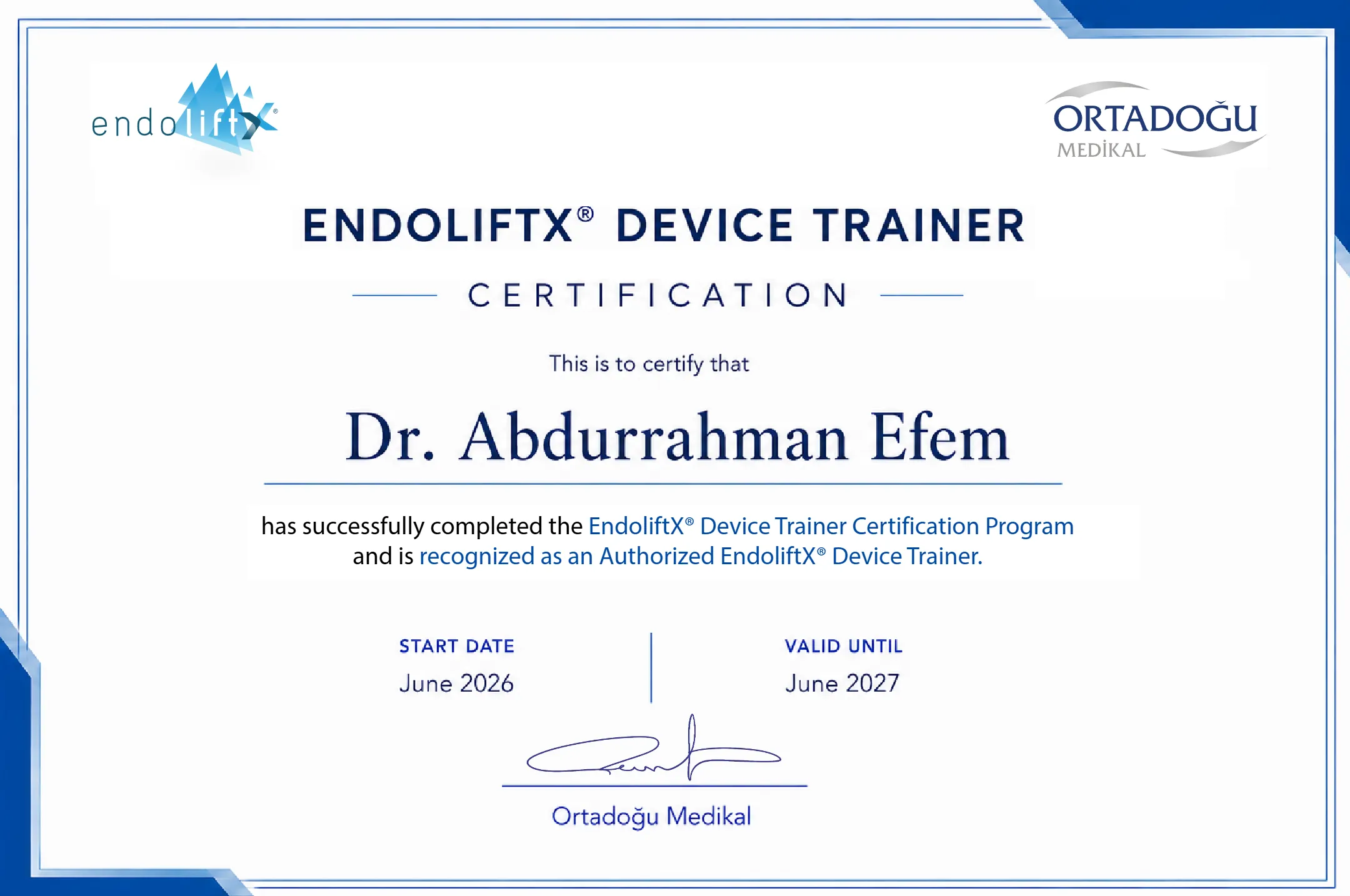
ENDOLIFTX TRAINER AUTHORITY
Dr. Abdurrahman Efem’s EndoliftX Trainer Certification
Dr. Abdurrahman Efem holds an EndoliftX trainer certificate. Planning Endolift for contour concerns involves more than knowing how laser energy interacts with tissue. It also requires deciding whether fat is genuinely part of the problem, which volume should be preserved and where the limits of the treatment lie.
This distinction is particularly important in facial treatment, where reducing unnecessary volume may work against the goal of maintaining natural proportions.
DR. ABDURRAHMAN EFEM
Why Does Anatomy Matter When Deciding Whether to Reduce Fat?
The presence of fat does not automatically mean that reducing it will improve the contour. Its position and distribution, the degree of tissue laxity, facial or body proportions and the patient’s treatment goals all need to be considered together.
In facial treatment, preserving natural volume may be as important as reducing selected localized fullness. The goal is not simply a thinner appearance, but a contour that remains balanced with the individual anatomy.
Following medical assessment, Endolift, another technology, surgical assessment or no treatment may be considered more appropriate.
RESULTS & PATIENT PRIVACY
Why Do Endolift Contouring Results Differ Between Patients?
The amount and distribution of localized fat, tissue quality, degree of laxity and baseline anatomy vary between individuals. Another patient’s contour change therefore cannot predict or guarantee an individual result.
Lighting, camera angle, position, facial expression and timing can also change the apparent difference in before-and-after photographs. Standardised photography and clinical assessment provide more useful context than isolated images.
Efem Clinic places importance on patient privacy and on establishing realistic expectations from the patient’s own anatomy rather than another person’s result.
View the Before & After Gallery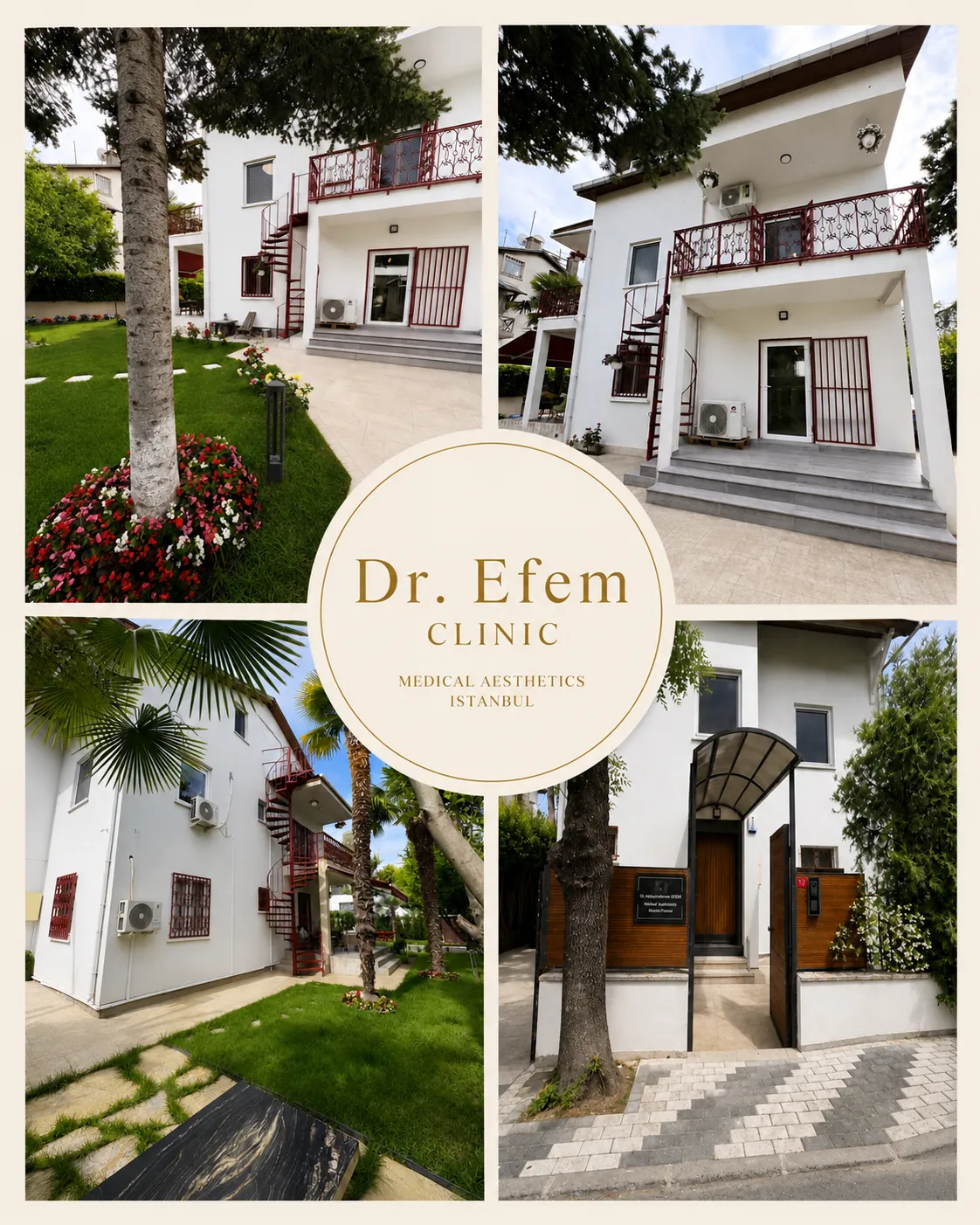
Localized Fat and Endolift Assessment at Efem Clinic
Efem Clinic is a doctor-led medical aesthetic clinic in a private villa setting in Levent, Istanbul. The clinic offers a garden and parking area while placing emphasis on privacy, individual assessment and personalised treatment planning.
The purpose of an Endolift assessment is not simply to establish whether fat is present. It is to understand whether that fat meaningfully contributes to the contour concern and whether reducing it would remain compatible with the patient’s natural proportions.
Continue Your Endolift Research
To understand how localized fat fits into the broader Endolift decision, you can continue with the treatment, candidacy, collagen and results guides.
FREQUENTLY ASKED QUESTIONS
Questions About Endolift and Localized Fat
Does Endolift reduce fat?
Selected localized fat may be included in an Endolift treatment plan when it contributes to an unwanted contour. Fat reduction is not the purpose of every Endolift treatment.
Can Endolift help with weight loss?
No. Endolift is not a weight-loss treatment. Its role in relation to fat concerns is limited to selected localized areas where fat contributes to contour.
Does Endolift remove all facial fat?
That should not be the objective. Facial fat can contribute to natural proportions and support. Planning should distinguish unwanted localized fullness from volume that should be preserved.
Can Endolift be considered for a double chin?
Selected localized submental fullness may be considered in appropriate patients. However, a double-chin appearance can also be influenced by tissue laxity and individual anatomy, so fat should not automatically be assumed to be the only cause.
Can Endolift address localized fat and skin laxity together?
In selected patients, both concerns may form part of the same treatment plan. The exact objective depends on which tissues are contributing to the visible concern and which tissues should be preserved.
Does Endolift replace liposuction?
No. Endolift and liposuction are different approaches. When large-volume fat reduction is required, surgical methods have a different role. Treatment choice depends on the amount and location of fat, tissue laxity and the intended outcome.
Does removing more fat produce a better Endolift result?
No. Particularly in the face, unnecessary volume reduction may negatively affect natural proportions. The aim is to address the relevant tissue while preserving volume that supports facial balance.
EFEM NOTE
The Presence of Fat Does Not Automatically Mean It Should Be Reduced
Within the Efem Method™, fat is assessed not only by quantity but also by its location, its contribution to the visible contour, the condition of surrounding tissues and the volume that should be preserved. Particularly in facial treatment, the objective is not to create the thinnest possible appearance, but to maintain a balanced contour compatible with the patient’s natural anatomy.
ENDOLIFT ASSESSMENT IN ISTANBUL
Find Out Whether Localized Fat Is Actually Causing Your Contour Concern
If you are considering Endolift, you can share the area that concerns you and the change you hope to achieve with Efem Clinic. The contribution of localized fat, the volume that should be preserved, tissue laxity and the suitability of Endolift are assessed individually.
Treatment suitability and the degree of visible change vary according to anatomy, fat distribution, tissue quality, treatment area, treatment scope and individual biological response.
About Dr. Abdurrahman Efem
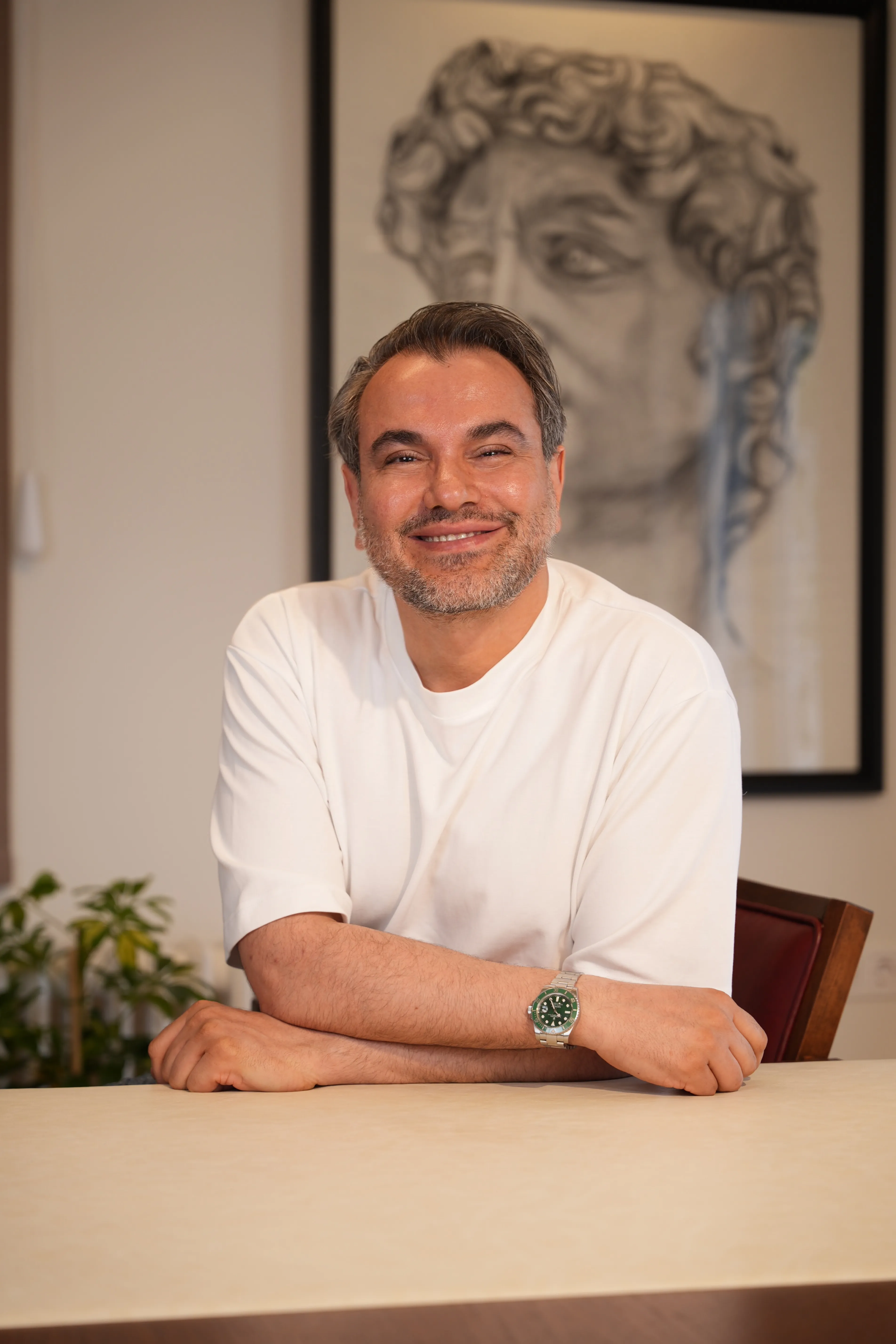
Dr. Abdurrahman Efem
Dr. Abdurrahman Efem is a medical aesthetic physician specializing in facial rejuvenation, non-surgical aesthetic treatments, and regenerative medicine. His approach focuses on enhancing natural beauty through personalized treatment plans designed around each patient's unique features and goals. Dr. Efem works with both local and international patients, emphasizing balanced, natural-looking results and long-term aesthetic wellbeing. This content has been prepared or medically reviewed by Dr. Abdurrahman Efem to ensure accuracy and relevance.