

Endolift Treatment Areas
ENDOLIFTX • TREATMENT AREAS • ANATOMY-BASED PLANNING
Endolift Treatment Areas: Face, Jawline, Double Chin, Neck and Body
Endolift may be considered for selected areas of the face, neck and body, but an area being technically treatable does not automatically mean it is suitable for every patient. The decision depends on what is causing the concern: localized fat, tissue laxity, loss of structural support, skin quality or a combination of these factors.
Commonly assessed areas include the jawline, double chin, lower face and neck, as well as selected body areas such as the arms, abdomen, thighs and back. Different regions require different treatment objectives because their anatomy, tissue thickness, fat distribution and degree of laxity are not the same.
The most useful question is not simply “Can Endolift be used here?” but “Is Endolift the right treatment for the tissue problem in this area?”
QUICK ANSWER
Which Areas Can Be Assessed for Endolift?
Endolift may be considered in selected patients for the jawline, double chin, lower face, neck and selected facial areas, as well as certain body regions including the upper arms, abdomen, thighs and back.
The treatment uses a very fine optical laser fibre within selected subdermal tissues. Depending on the anatomy and treatment objective, planning may focus on selected localized fat, tissue firmness, collagen remodelling or contour support.
Not every concern within these areas is an Endolift concern. Significant excess skin, large-volume fat, structural volume loss or a problem arising from a different tissue layer may require another treatment or surgical assessment.
Endolift Treatment Areas at a Glance
The treatment objective changes from one anatomical region to another. The following overview describes why different areas may enter an Endolift assessment rather than implying that every patient with these concerns is suitable.
FACE
Lower Face & Cheeks
May be assessed when mild to moderate tissue laxity, early jowling or selected lower-face heaviness contributes to contour change. Facial volume preservation is particularly important.
CONTOUR
Jawline
May be considered when localized fat or mild to moderate laxity contributes to reduced jawline definition. Bone structure and chin projection also affect the visible contour.
SUBMENTAL AREA
Double Chin
A small localized pocket of fat beneath the chin, particularly when accompanied by mild tissue laxity, may be considered. Larger fat volumes require a different discussion.
FACE–NECK TRANSITION
Neck
Selected patients with early or moderate laxity may be assessed for treatment, but neck anatomy, fat distribution and other structural factors need to be considered.
BODY
Upper Arms
May be assessed when limited tissue laxity and selected localized fullness affect upper-arm contour. Significant excess skin is a different problem.
BODY
Abdomen
Selected abdominal concerns may be considered when localized contour changes or limited laxity are present. Endolift is not a weight-loss or large-volume fat-removal procedure.
BODY
Thighs
Selected thigh concerns may be assessed for limited laxity and contour changes. Inner-thigh tissue requires particularly realistic expectations because anatomy and skin mobility affect treatment response.
BODY
Back
Selected localized fullness and tissue laxity may enter treatment planning when they affect back contour. The size and nature of the area determine whether Endolift has a meaningful role.
Endolift for the Face: Why Treatment Areas Cannot Be Planned in Isolation
Facial Endolift is often discussed in terms of individual zones, but facial ageing and contour change rarely respect the borders of one small area. The cheeks, lower face, jawline, chin and neck influence one another visually.
For example, a softer jawline may be influenced by localized fat, early jowl formation, tissue laxity, chin projection or deeper structural support. Treating the jawline simply because it appears less defined does not establish which tissue should be targeted.
The cheeks require additional caution. Many cheek concerns are related to volume loss rather than excess volume. Removing unnecessary facial fat can work against the objective of maintaining natural facial proportions.
Facial planning should therefore begin with the anatomy of the whole lower face rather than with a list of isolated treatment zones.
LOWER-FACE CONTOUR
Jawline and Double Chin: Two Common Endolift Assessment Areas
The jawline and submental area are among the regions most commonly associated with Endolift because localized fat and mild to moderate tissue laxity can sometimes contribute to the same contour concern.
A small localized fat pocket beneath the chin may soften the transition between the chin and neck. Early laxity can also blur the mandibular border. In selected patients, these tissues may be considered within an Endolift plan.
However, a poorly defined jawline is not always a fat or laxity problem. Chin projection, mandibular anatomy and deeper support can influence the same appearance. Similarly, a double-chin appearance may involve more than submental fat alone.
This is why the jawline and double chin should be assessed as anatomical problems rather than treated automatically as fat-reduction areas.
Can Endolift Be Used for the Neck?
The neck may be considered in selected patients with early to moderate tissue laxity or when the transition between the lower face and neck has become less defined.
Neck appearance can be influenced by several factors, including skin quality, tissue laxity, localized fat and underlying anatomy. These do not all respond to the same treatment.
When significant excess skin or more advanced tissue descent is present, the degree of change expected from a minimally invasive treatment should not be equated with surgical neck lifting.
Which Body Areas May Be Assessed for Endolift?
Endolift is not limited to the face. Selected body areas may also be considered when the concern involves limited tissue laxity, selected localized fat or a combination of contour and firmness concerns.
Upper Arms
Upper-arm treatment may be discussed when early or moderate laxity and selected localized fullness affect contour.
Thighs
Thigh anatomy varies considerably by region. Limited laxity may be assessed, while significant excess skin following major weight loss may require a different treatment discussion.
Abdomen
Selected abdominal laxity and localized contour concerns may be evaluated. Endolift should not be confused with weight loss, large-volume liposuction or surgical removal of excess abdominal skin.
Back
Selected areas of back laxity or localized fullness may enter Endolift planning when the treatment objective is compatible with the tissue problem.
The Same Area Can Contain Different Treatment Problems
Choosing Endolift according to body part alone can be misleading. Two patients may point to exactly the same area but require completely different treatment discussions.
| Primary Tissue Concern | What It May Look Like | Treatment Discussion |
|---|---|---|
| Localized fat | Limited fullness affecting contour | Selected localized fat may be considered within an Endolift plan when appropriate. |
| Tissue laxity | Softening, looseness or reduced definition | Endolift may have a role in selected mild to moderate concerns, depending on anatomy. |
| Volume loss | Hollowing, flattening or loss of support | Fat reduction may be inappropriate; volume or structural support may need a different approach. |
| Skin surface / texture | Texture, pores, scars or superficial skin-quality concerns | A skin-focused technology may be more relevant than Endolift alone. |
| Significant excess skin | Advanced sagging or substantial loose skin | A surgical assessment may be more appropriate than expecting minimally invasive treatment to reproduce surgical change. |
VOLUME PRESERVATION
Why Does Facial Endolift Require More Than an “Area List”?
Facial fat is not automatically unwanted. Different fat compartments contribute to facial support, soft transitions and natural proportions. This is particularly important in naturally thin faces or patients who already have age-related volume loss.
A treatment area may therefore contain both tissue that contributes to heaviness and tissue that should be preserved. Reducing volume indiscriminately can produce a result that looks hollow rather than more balanced.
For facial Endolift, the target should be defined by anatomy and tissue need—not simply by the fact that an area can technically be treated.
How Is Suitability Determined for a Specific Endolift Area?
There is no universal Endolift area protocol that applies equally to every patient. Assessment may include:
- The exact location and nature of the concern
- The amount and distribution of localized fat
- The degree of tissue laxity
- Skin and subdermal tissue quality
- Facial or body proportions
- Whether natural volume should be preserved
- Previous procedures in the area
- Whether the expected change is realistic for a minimally invasive treatment
- General medical suitability for the proposed procedure
THE EFEM METHOD™
Choose the Tissue Before Choosing the Treatment Area
The Efem Method™ approaches treatment areas through the underlying anatomical need. A patient does not need Endolift simply because the jawline, neck, arm or abdomen appears on a list of possible treatment regions.
1. Understand the Need
Define what the patient sees and what change they actually want.
2. Choose the Right Layer
Determine whether the concern is related to fat, laxity, deeper support, volume loss or skin quality.
3. Intervene Only as Much as Needed
Avoid treating a larger area or more tissue simply because it is technically possible.
4. Preserve Natural Appearance
Plan contour changes in the context of the patient’s overall facial or body proportions.
Sometimes Endolift is appropriate for the area being assessed. Sometimes another technology, surgical evaluation or no treatment is the more appropriate conclusion.
Do Recovery and Results Differ by Treatment Area?
Yes. The face, neck and body do not have identical tissue characteristics. Area size, tissue thickness, mobility and the extent of treatment can influence both the early recovery experience and how results are assessed.
Temporary swelling, tenderness, tightness, sensitivity or bruising may occur after Endolift. The extent and visibility of these effects vary between patients and treatment areas.
The final treatment result should not be judged immediately after the procedure. Early swelling can affect contour, while tissue response and collagen remodelling develop more gradually.
The degree of improvement depends on the starting anatomy, treatment area, tissue quality, localized fat, laxity and individual biological response.
Explore Endolift ResultsWhen Is an Area Beyond the Realistic Scope of Endolift?
Endolift is a minimally invasive treatment and should not be expected to reproduce the tissue removal or repositioning possible with surgery.
Significant excess facial or neck skin, advanced tissue descent, substantial post-weight-loss skin redundancy or large-volume fat may require a different approach. The fact that Endolift can technically be discussed for a body region does not mean that it is the appropriate treatment for every degree of concern in that region.
Defining where Endolift is unlikely to provide enough change is as important as identifying the areas where it may be useful.
INTERNATIONAL PATIENTS
Which Endolift Area Should You Ask About Before Travelling to Istanbul?
International patients may send clear photographs of the area they are concerned about before travelling. For facial assessment, front, profile and 45-degree photographs can help begin the discussion. Body concerns should be photographed clearly enough to show the relevant contour and tissue laxity.
Photographs may support preliminary discussion but cannot confirm treatment suitability. The same visible concern can be caused by different tissues, and final planning requires individual medical assessment.
Treatment scope, appointment timing and practical travel considerations are discussed individually once the proposed plan is clearer. The number and size of treatment areas can also influence the overall treatment plan and cost.
Contact the International Patient Line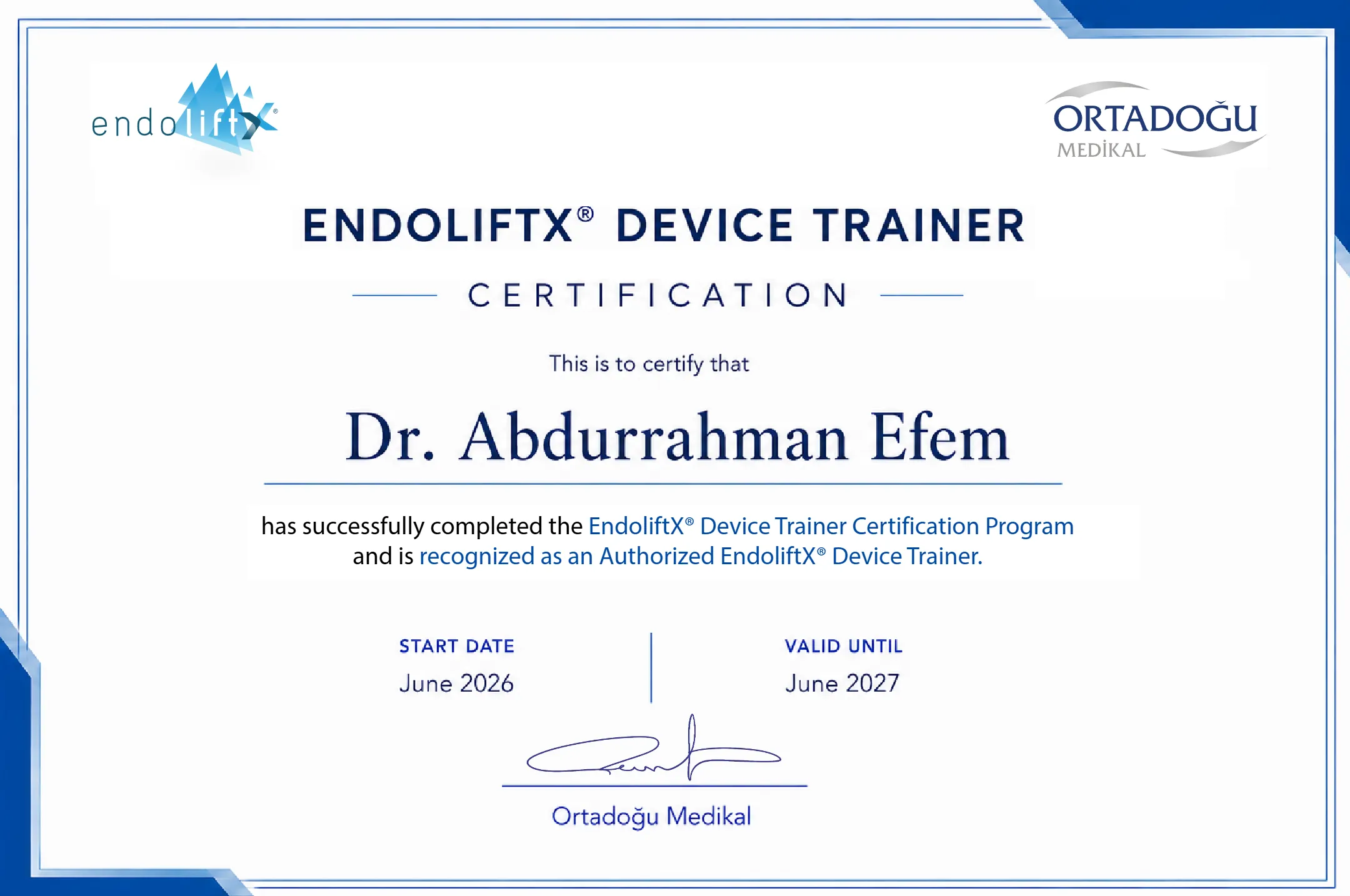
ENDOLIFTX TRAINER AUTHORITY
Dr. Abdurrahman Efem’s EndoliftX Trainer Certification
Dr. Abdurrahman Efem holds an EndoliftX trainer certificate. Area selection for Endolift is not simply a question of where the laser fibre can be used. Treatment planning requires understanding which tissue is creating the concern and whether Endolift corresponds to that tissue.
This becomes especially important when moving between facial and body areas because tissue thickness, fat distribution, laxity and treatment objectives can differ substantially.

DR. ABDURRAHMAN EFEM
The Treatment Area Is Only the Starting Point
Two patients requesting Endolift for the same area may have different anatomical problems. One may have localized fat, another may have laxity, while another may primarily have structural volume loss or significant excess skin.
For this reason, treatment planning is based on anatomy, tissue quality, realistic goals and the relationship between the treatment area and surrounding regions.
Following assessment, Endolift, another technology, surgical evaluation or no treatment may be considered more appropriate.
RESULTS & PATIENT PRIVACY
Why Should Results Be Compared Area by Area?
The jawline, neck, arms, abdomen and thighs have different anatomy. Results from one area should therefore not be used to predict what another area—or another patient—will achieve.
Baseline anatomy, fat distribution, skin quality, laxity, photography angle, posture, lighting and follow-up timing can all influence how before-and-after differences appear.
Efem Clinic places importance on patient privacy and on establishing expectations from the individual patient’s anatomy rather than promising the result seen in another person.
View the Before & After Gallery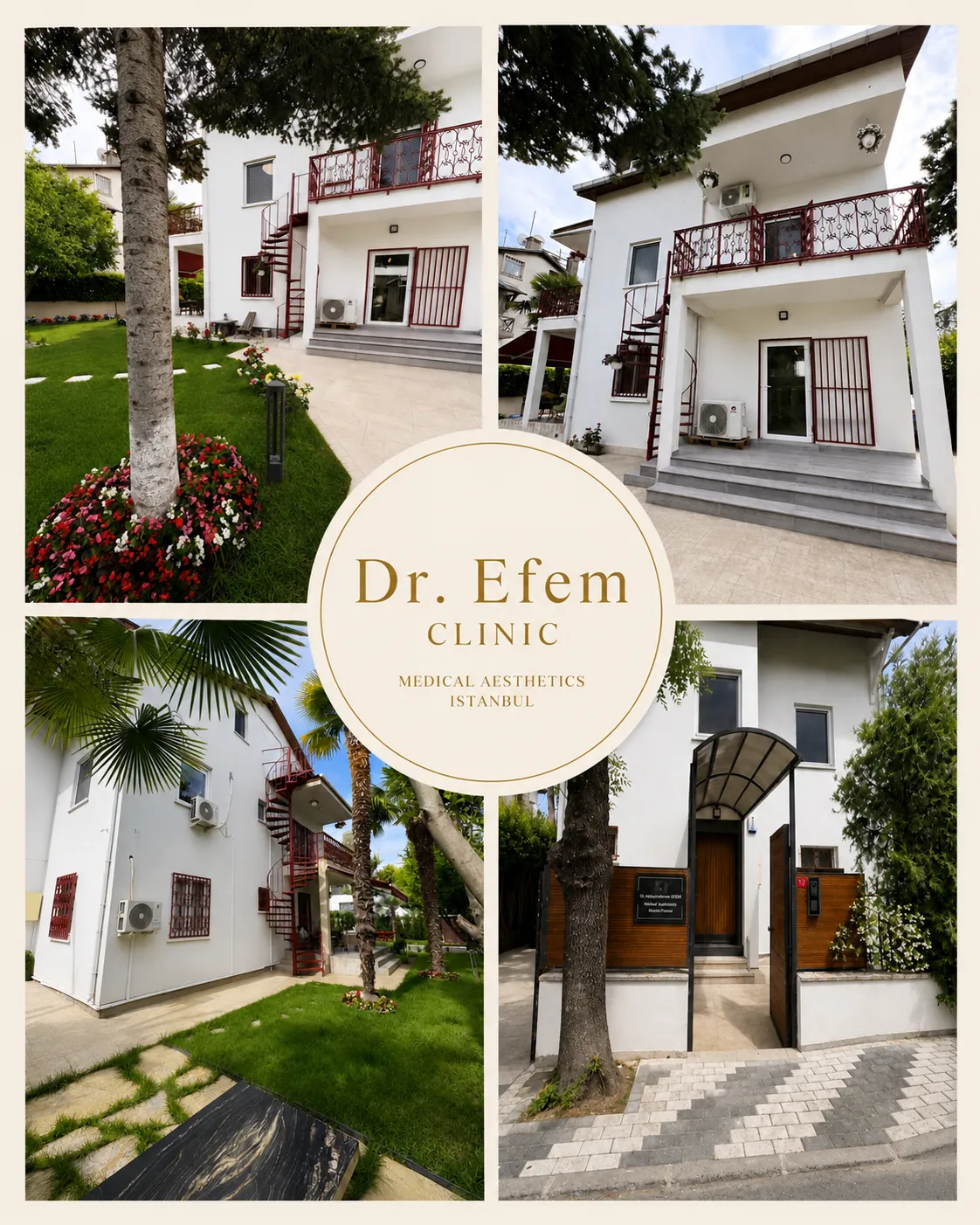
Endolift Treatment Planning at Efem Clinic in Istanbul
Efem Clinic is a doctor-led medical aesthetic clinic in a private villa setting in Levent, Istanbul. The clinic includes garden and parking areas and places emphasis on privacy, individual assessment and personalised treatment planning.
Endolift area selection is based on the underlying tissue concern rather than simply applying the same treatment concept to every region of the face or body.
Continue Your Endolift Research
After identifying the area that concerns you, the next step is to understand whether the underlying tissue problem and your expectations make Endolift a meaningful option.
FREQUENTLY ASKED QUESTIONS
Questions About Endolift Treatment Areas
What are the most common Endolift treatment areas?
Commonly assessed areas include the lower face, jawline, double chin and neck. Selected body regions such as the upper arms, abdomen, thighs and back may also be considered depending on anatomy and treatment goals.
Can Endolift be used on the whole face?
Facial treatment should be planned according to specific tissue needs rather than automatically treating every facial area. Some regions may require volume preservation, while others may not be suitable for Endolift at all.
Can Endolift be used for the jawline?
It may be considered when localized fat or mild to moderate tissue laxity contributes to reduced jawline definition. Structural anatomy should also be assessed because not every poorly defined jawline is caused by fat or laxity.
Can Endolift treat a double chin?
A small localized pocket of submental fat may be considered in selected patients, particularly when mild tissue laxity is also present. Larger fat volumes or other anatomical causes may require a different approach.
Can Endolift be used on the neck?
Selected patients with early to moderate neck laxity may be assessed for Endolift. Significant excess skin or advanced tissue descent may require a different treatment discussion.
Which body areas can be treated with Endolift?
Selected upper-arm, abdominal, thigh and back concerns may be assessed when localized fat or limited tissue laxity is compatible with the treatment. Suitability varies considerably by area and degree of concern.
Can several Endolift areas be treated?
The treatment scope is determined individually. Whether more than one region should be included depends on anatomy, treatment objectives, area size and the overall medical plan rather than simply on the number of areas requested.
Does being a possible Endolift treatment area mean I am suitable?
No. A treatment area describes where Endolift may be considered, not who should receive it. Individual suitability depends on the underlying tissue problem, anatomy, medical assessment and realistic expectations.
EFEM NOTE
A Treatable Area Is Not Automatically an Area That Needs Treatment
Within the Efem Method™, the treatment decision starts with the tissue problem rather than a list of areas. The jawline, double chin, neck, arms or abdomen may all be discussed in Endolift planning, but treatment is meaningful only when the underlying anatomy, treatment objective and realistic expected change are aligned.
ENDOLIFT AREA ASSESSMENT IN ISTANBUL
Ask Whether Endolift Fits the Area That Concerns You
If you are considering Endolift for the face, jawline, double chin, neck or a body area, you can share the region that concerns you with Efem Clinic. The underlying tissue problem, degree of laxity, localized fat, volume preservation and realistic treatment limits are assessed individually.
Treatment suitability and expected change vary according to the treatment area, anatomy, tissue quality, localized fat, degree of laxity, treatment scope and individual biological response.
About Dr. Abdurrahman Efem
Dr. Abdurrahman Efem
Dr. Abdurrahman Efem is a medical aesthetic physician specializing in facial rejuvenation, non-surgical aesthetic treatments, and regenerative medicine. His approach focuses on enhancing natural beauty through personalized treatment plans designed around each patient's unique features and goals. Dr. Efem works with both local and international patients, emphasizing balanced, natural-looking results and long-term aesthetic wellbeing. This content has been prepared or medically reviewed by Dr. Abdurrahman Efem to ensure accuracy and relevance.