


Endolift for the Post-Pregnancy Body: Distinguishing Skin Laxity, Localised Fat and Structural Changes
Endolift for the Post-Pregnancy Body: Distinguishing Skin Laxity, Localised Fat and Structural Changes
Pregnancy and childbirth can affect the appearance of the body through changes in different tissues. Skin and subcutaneous tissue laxity, limited localised fat, weight changes and differences in tissue quality may influence body contour, while significant excess skin or structural changes involving the abdominal wall and muscles require a different assessment.
EndoliftX is a minimally invasive medical aesthetic treatment that uses a very fine laser fibre to deliver controlled energy to selected subdermal tissues. When considered for post-pregnancy body concerns, the objective is not to correct every change caused by pregnancy with one procedure. In suitable patients, the focus is on selected areas of mild-to-moderate tissue laxity and appropriate subcutaneous tissue concerns.
At Efem Clinic, post-pregnancy planning is not approached simply as “body tightening.” The tissues responsible for the change in each area, weight stability, skin quality, localised fat distribution, excess skin and whether the appearance may involve deeper structures are assessed separately.
Can Endolift Help with Post-Pregnancy Body Laxity?
If the appearance of a particular area after pregnancy is related to mild-to-moderate skin and subcutaneous tissue laxity, Endolift may be considered in appropriately selected patients to support tissue firmness and contour.
However, not every post-pregnancy change is caused by tissue laxity. Significant excess skin, larger-volume fat, general weight changes or structural concerns involving the abdominal wall and muscles may require different approaches. Endolift is not a single treatment for every post-pregnancy body change.
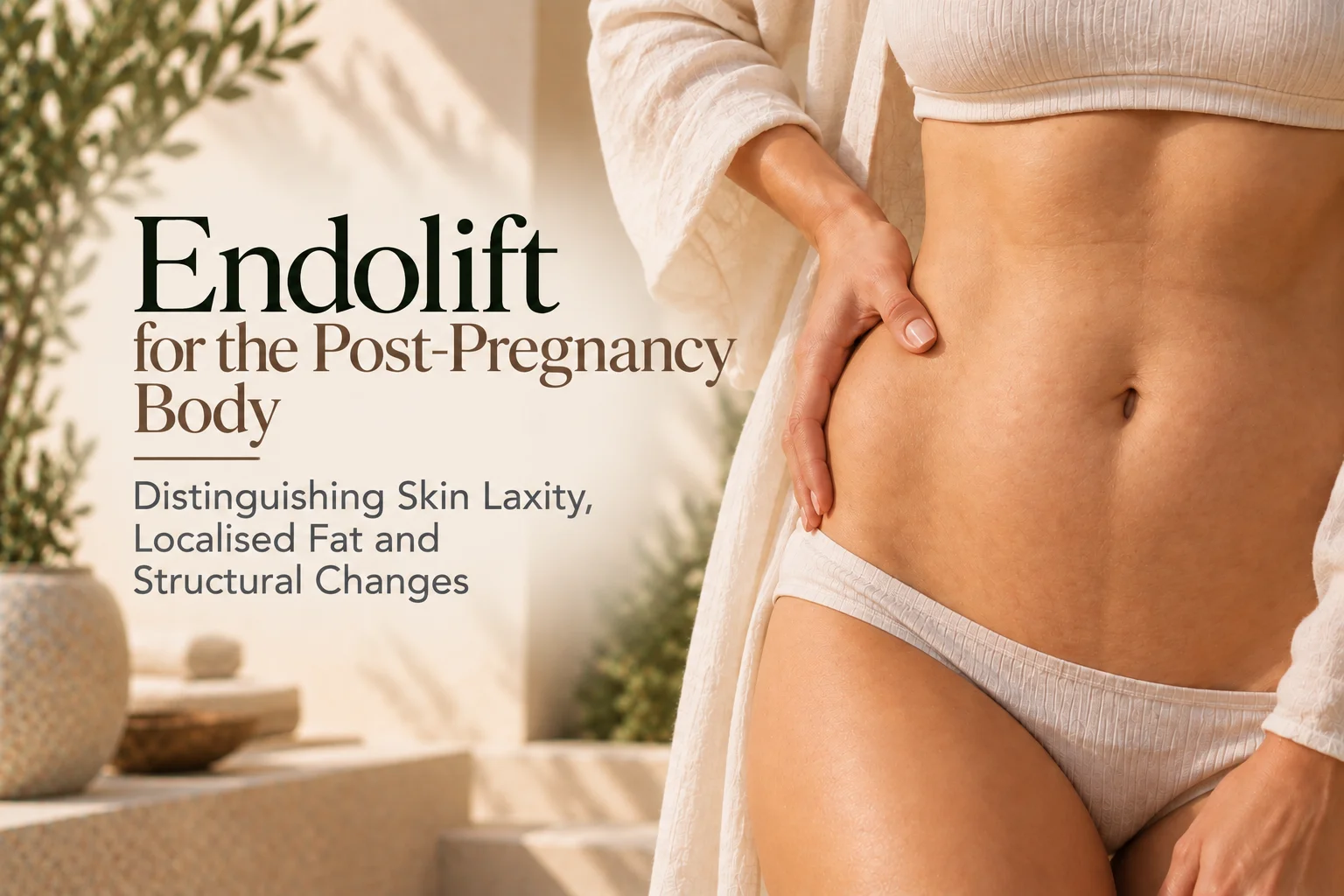
What Can Change Body Contour After Pregnancy?
Similar-looking contour changes after pregnancy and childbirth may arise from different tissues. Before deciding which area to treat, it is important to understand why the appearance of that area has changed.
Skin and Tissue Laxity
Skin and subcutaneous tissues stretched during pregnancy may not completely return to their previous firmness after childbirth. The degree of laxity varies between individuals.
Localised Fat Distribution
Changes in weight and body composition may make limited areas of subcutaneous fat more noticeable in certain parts of the body.
Excess Skin
Significant excess skin may exceed the degree of change that can realistically be achieved with a minimally invasive tightening approach. A different treatment pathway may be required.
Abdominal Wall and Structural Changes
Some post-pregnancy abdominal changes are not primarily related to the skin or subcutaneous tissues. Deeper structural factors require separate assessment and are not addressed in the same way as tissue laxity.
How Does Endolift Work for the Post-Pregnancy Body?
During Endolift, a very fine laser fibre is directed into selected subdermal tissues. For post-pregnancy body planning, the treatment area, degree of laxity, characteristics of the subcutaneous tissues and individual anatomy are considered together.
In suitable patients, the objective is to support tissue firmness and collagen remodelling within selected tissues. Limited localised subcutaneous tissue areas may form part of the plan in certain patients, but Endolift is not intended for weight loss or large-volume fat reduction.
Supporting tissue firmness and collagen remodelling within selected subdermal tissues in suitable patients.
Assessing only the areas with a genuine treatment need rather than approaching the entire post-pregnancy body as a single treatment area.
Focusing on anatomically appropriate selected subcutaneous tissues rather than attempting large-volume fat reduction.
The objective is not to recreate the pre-pregnancy body exactly, but to support measured contour improvement that remains consistent with the patient’s anatomy.
Who May Be Considered for Post-Pregnancy Endolift?
Situations Where It May Be Considered
- Mild-to-moderate skin and subcutaneous tissue laxity in selected areas
- Limited tissue laxity following pregnancy and weight changes
- Selected localised subcutaneous tissue areas affecting body contour
- Relatively stable body weight and contour
- A preference for measured improvement with a minimally invasive approach
- Patients anatomically suitable for Endolift
Another Approach May Be More Appropriate
- Significant or hanging excess skin
- Larger-volume fat
- General weight loss being the primary need
- Suspected structural concern involving the abdominal wall or muscles
- Advanced tissue laxity
- Expectations comparable to surgical body contouring
Identifying Which Tissue Actually Needs Treatment After Pregnancy
The Efem Method™ focuses on understanding which area and which tissue may genuinely benefit from treatment rather than automatically turning a broad aesthetic goal into multiple procedures.
This is particularly important in post-pregnancy body assessment. Not every physical change requires treatment, and different areas in the same patient may have very different needs.
1. Understand the Need
Skin laxity, subcutaneous tissue, localised fat, excess skin and structural changes are distinguished from one another.
2. Choose the Right Layer
Endolift is directed towards selected subdermal tissues. If the primary cause lies in a deeper structure, a different assessment is required.
3. Intervene Only as Much as Needed
Post-pregnancy planning does not mean treating as many areas as possible. The focus is on areas where there is a genuine and anatomically appropriate treatment need.
4. Preserve Natural Appearance
The objective is not to reshape the body according to a single ideal, but to plan measured improvement that respects the patient’s existing anatomy and natural proportions.
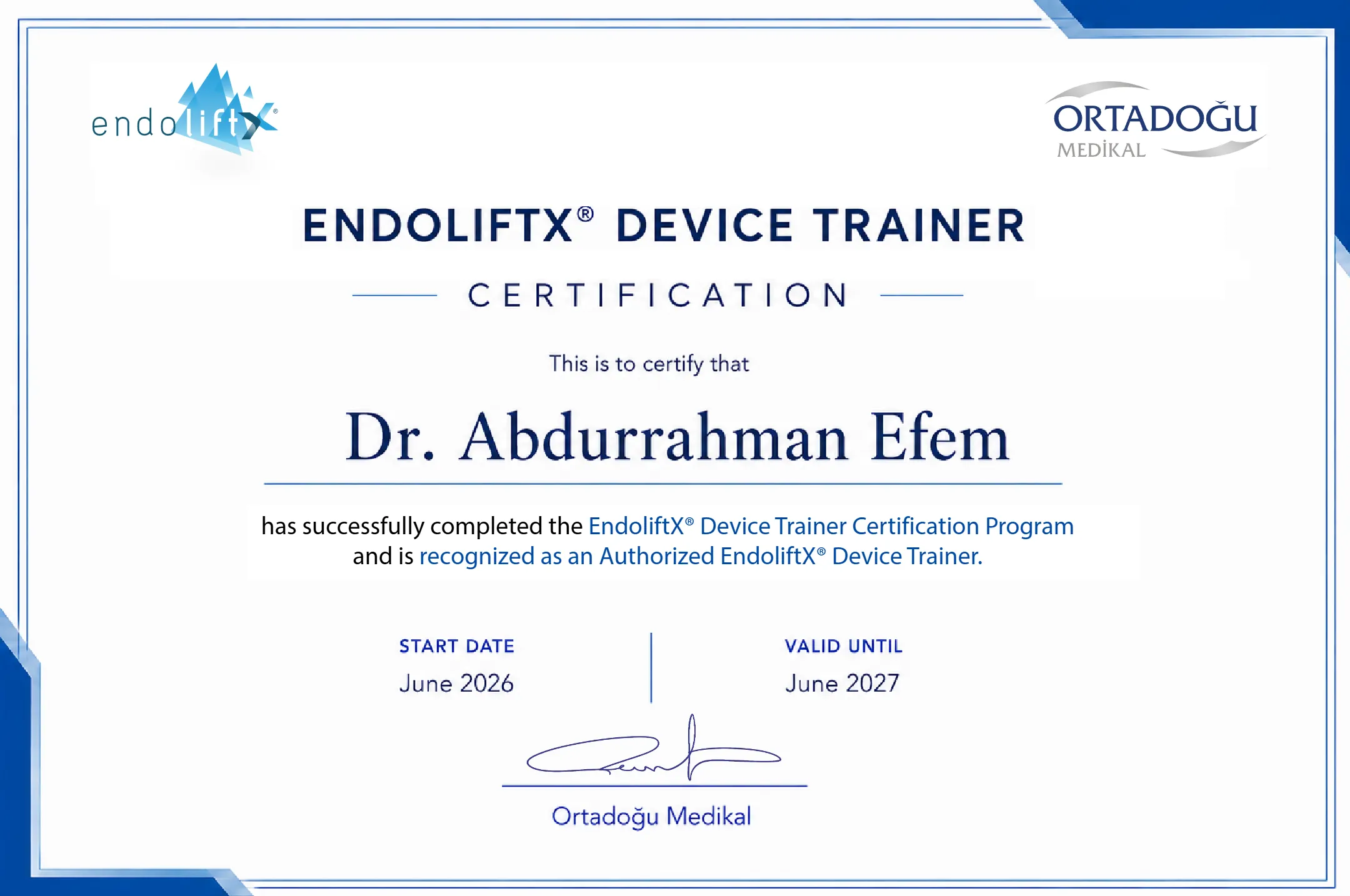
Dr. Abdurrahman Efem’s EndoliftX Trainer Certification
Dr. Abdurrahman Efem holds an EndoliftX trainer certificate. With fibre-based treatments, appropriate patient selection, identification of the target tissue and planning according to anatomical need are important parts of the treatment process.
In post-pregnancy body assessment, the degree of skin and subcutaneous tissue laxity, localised fat distribution, tissue quality and the realistic limitations of a minimally invasive procedure are considered together.
The Role of Endolift Depends on the Cause of the Post-Pregnancy Change
“Post-pregnancy body tightening” is not a single medical or aesthetic problem. The potential role of Endolift depends on identifying which tissue is primarily responsible for the appearance.
| Primary Concern | Potential Role of Endolift | Assessment |
|---|---|---|
| Mild-to-Moderate Tissue Laxity | May be considered to support tissue firmness and local contour. | May be relevant in appropriately selected patients. |
| Limited Localised Subcutaneous Tissue | Selected tissue areas may be considered according to individual anatomy. | Not intended for weight loss or large-volume fat reduction. |
| Significant Excess Skin | The degree of change achievable with minimally invasive tightening may be limited. | Surgical assessment may be more realistic. |
| Abdominal Wall / Muscle-Related Change | Subdermal Endolift treatment does not correct the underlying structural cause. | Problem-specific assessment is required. |
Treatment, Sensation, Recovery and Results
Treatment
The target area and tissues are identified according to anatomy, tissue laxity and the characteristics of the subcutaneous tissues. The fine laser fibre is used in selected subdermal tissues in a controlled manner.
Sensation
Pressure, warmth, pulling or brief stinging sensations may occur. Comfort levels vary according to individual sensitivity and treatment scope.
Recovery
Temporary swelling, tenderness, bruising or tightness may occur. Recovery varies according to the treatment area, scope and individual tissue response.
Results
Results are assessed progressively. The degree of visible change depends on baseline anatomy, the area treated, tissue characteristics and individual response.
How Are Post-Pregnancy Endolift Results Assessed?
An Endolift result should not be considered complete immediately after treatment. Early swelling and temporary tissue changes may influence the contour of the treated area.
As healing progresses, tissue firmness and contour can be assessed more meaningfully. Collagen remodelling may continue over time, so the development of visible change can vary between patients.
Success does not mean recreating the exact appearance of the body before pregnancy. In suitable patients, more balanced tissue firmness, a more refined local contour and preservation of natural body proportions are more realistic goals.
How Many Sessions Are Needed? Can Multiple Areas Be Planned Together?
There is no fixed number of Endolift sessions that applies to everyone. Planning depends on the target area, degree of tissue laxity, treatment scope and individual tissue response.
Having post-pregnancy changes in several areas does not mean that all of those areas must be treated with the same procedure or at the same time. The need and suitability of each area should be assessed individually.
The principle behind combination or multi-area planning is not that more procedures produce a better result. Different methods should only be considered when genuinely different tissue concerns require them.
How Is the Cost of Post-Pregnancy Endolift Determined?
A single standard price cannot accurately represent every post-pregnancy Endolift plan. The areas that genuinely require treatment and the scope of the procedure can vary considerably between patients.
- The body area or areas being assessed
- The size of the treatment area
- The degree of tissue laxity
- The characteristics of the skin and subcutaneous tissues
- Localised fat distribution
- Whether one or multiple areas are being planned
- The scope of treatment
- Whether a different or complementary approach is required
- Physician assessment and individual anatomy
For this reason, identifying which area has changed, why it has changed and whether Endolift genuinely addresses that concern is more meaningful than starting with price alone.
Planning Post-Pregnancy Endolift in Istanbul
Efem Clinic is located in Levent, Istanbul and welcomes international patients seeking doctor-led medical aesthetic planning in a private clinic environment.
Photographs shared before travel may help with a preliminary discussion of tissue laxity, localised subcutaneous tissue and the areas of concern, but photographs cannot confirm treatment suitability or distinguish every possible structural cause. Final candidacy and treatment planning require individual physician assessment.
Appointment timing, travel arrangements and the appropriate length of stay should be verified individually before travel. Final treatment cost also depends on the personalised treatment plan rather than a fixed package.
Privacy and individual planning remain central to the process for both local and international patients.
How Should Post-Pregnancy Endolift Before-and-After Photos Be Interpreted?
Patient privacy is important at Efem Clinic. For this reason, we do not prefer to use patient before-and-after photographs as a routine marketing tool.
Body appearance in photographs can be significantly influenced by posture, muscle contraction or relaxation, camera angle, lighting, clothing position and the timing of the photograph.
In addition, every patient has different post-pregnancy skin quality, tissue laxity, fat distribution, body anatomy and healing response. Realistic expectations are therefore better based on the patient’s own tissues and the realistic limits of treatment rather than another patient’s photograph.
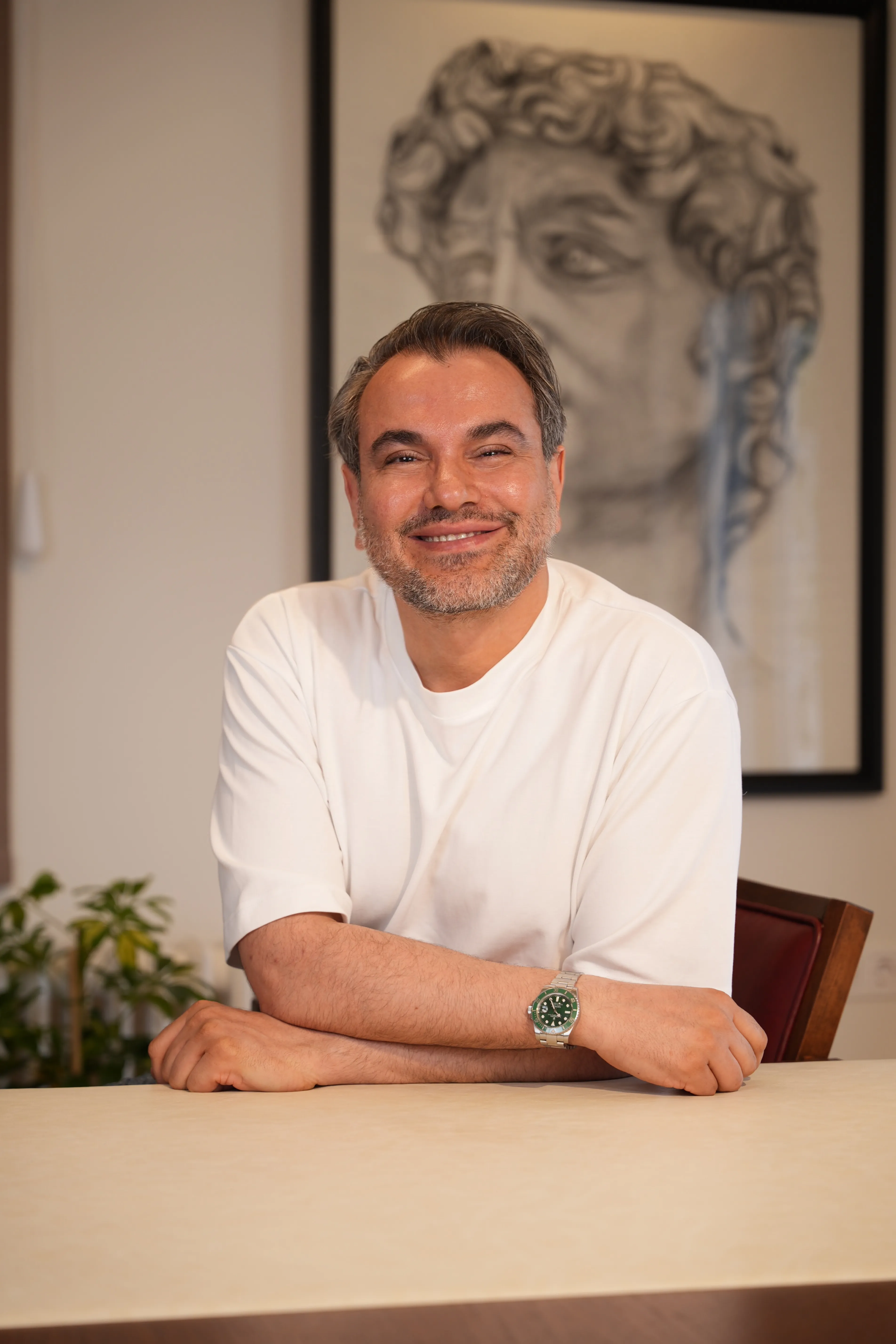
Physician Assessment for Post-Pregnancy Endolift Planning
In Dr. Abdurrahman Efem’s approach, post-pregnancy body concerns are not treated as a single procedure or standard treatment package. The skin, subcutaneous tissues, localised fat, excess skin and anatomical characteristics of each area are assessed individually.
This means that two patients with apparently similar post-pregnancy body changes may receive different recommendations. Endolift may be considered for one patient, while another may require a different approach, surgical assessment, postponing treatment or no procedure at all.
The objective is not to intervene in every physical change after pregnancy and childbirth, but to identify the areas that genuinely concern the patient and may anatomically benefit from measured treatment.
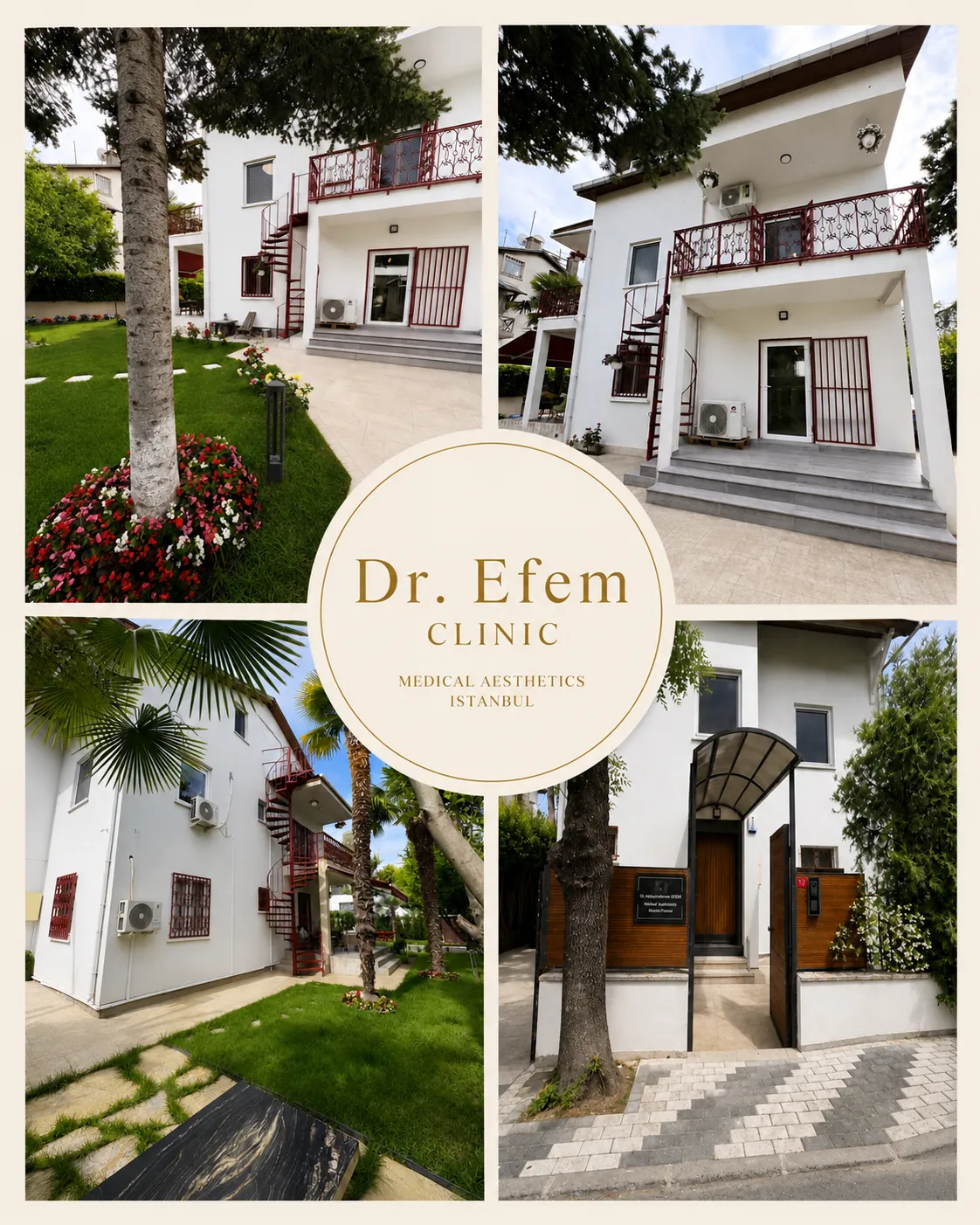
Post-Pregnancy Endolift Assessment at Efem Clinic
Efem Clinic is a doctor-led medical aesthetic clinic located in a private villa setting in Levent, Istanbul. Individual assessment, privacy and measured treatment planning that avoids unnecessary intervention are central to the clinic’s approach.
The purpose of post-pregnancy body assessment is not to direct the patient towards a standard “body tightening package.” The tissues responsible for changes in each area are assessed to determine whether Endolift genuinely corresponds to the patient’s concern.
Related Guides About Post-Pregnancy Body Concerns and Endolift
Common Questions About Endolift for the Post-Pregnancy Body
Can Endolift help with loose skin after pregnancy?
In appropriately selected patients with mild-to-moderate skin and subcutaneous tissue laxity, Endolift may be considered to support tissue firmness. Suitability depends on the area and individual anatomy.
Does Endolift help with post-pregnancy weight loss?
No. Endolift is not a weight-loss treatment. General weight reduction and large-volume fat reduction are different concerns.
Can Endolift be considered for the abdomen after pregnancy?
It may be considered for limited skin and subcutaneous tissue laxity in suitable patients. However, if the abdominal appearance is related to significant excess skin or deeper structural changes, another approach may be required.
Can Endolift completely restore the body to its pre-pregnancy appearance?
No. The objective is not to guarantee the exact appearance that existed before pregnancy. Results depend on individual anatomy, tissue characteristics, the area treated and personal response.
Can multiple areas be treated with Endolift?
Multiple areas may be assessed, but each area should be evaluated separately to determine whether treatment is genuinely needed and whether Endolift is appropriate for that specific tissue concern.
Is one Endolift session enough after pregnancy?
There is no fixed session number that applies to everyone. Planning depends on the area, tissue characteristics, treatment scope and individual response.
What is recovery like after post-pregnancy Endolift?
Temporary swelling, tenderness, bruising or tightness may occur. Recovery varies according to the treatment area, scope and individual tissue response.
Is Endolift enough when there is significant excess skin?
When significant excess skin or advanced tissue laxity is present, the degree of change achievable with a minimally invasive method may be limited. Surgical assessment may be more realistic in these situations.
The Right Post-Pregnancy Treatment Plan Starts with Understanding Which Area and Which Tissue Actually Needs Treatment
Before choosing Endolift, it is important to distinguish whether post-pregnancy body changes are related to skin and subcutaneous tissue laxity, localised fat, excess skin or deeper structural factors. Photographs may help with a preliminary discussion, but final suitability and personalised treatment planning require physician assessment.
Treatment suitability, recovery and visible results vary between individuals. Another patient’s result does not guarantee an individual outcome.
About Dr. Abdurrahman Efem
Dr. Abdurrahman Efem
Dr. Abdurrahman Efem is a medical aesthetic physician specializing in facial rejuvenation, non-surgical aesthetic treatments, and regenerative medicine. His approach focuses on enhancing natural beauty through personalized treatment plans designed around each patient's unique features and goals. Dr. Efem works with both local and international patients, emphasizing balanced, natural-looking results and long-term aesthetic wellbeing. This content has been prepared or medically reviewed by Dr. Abdurrahman Efem to ensure accuracy and relevance.