

Endolift for the Jawline: Non-Surgical Definition
Endolift for Jawline: Supporting a More Defined, Natural-Looking Contour
A softer or less defined jawline does not have the same cause in every patient. Selected localised fat, mild-to-moderate tissue laxity, chin structure and volume support can each influence the contour of the lower face in different ways.
EndoliftX is a minimally invasive medical aesthetic treatment using a fine laser fibre that may be considered in suitable patients when selected subdermal tissues and tissue laxity are contributing to reduced jawline definition.
At Efem Clinic, the aim is not to create the sharpest possible jawline in every patient. The priority is to understand the actual cause of the contour concern and support a balanced result while preserving natural facial volume and individual facial character.
What Can Endolift Do for the Jawline?
Endolift may be considered in suitable patients when selected localised fat and mild-to-moderate tissue laxity contribute to a softer jawline, with the aim of supporting a more defined lower-face contour.
However, Endolift does not add volume or reconstruct a structurally under-projected chin. In patients with advanced sagging or significant excess skin, it should not be expected to reproduce the degree of change achievable with surgical lifting. Treatment selection should therefore begin by identifying why the jawline appears less defined.
What Can Cause a Less Defined Jawline?
The same concern — “my jawline is not defined enough” — can arise from different tissue and anatomical factors. Understanding this distinction is essential before deciding whether Endolift is actually relevant.
Localised Fat
Selected small fat deposits around the jawline or beneath the chin may obscure the mandibular border and create a softer contour.
Tissue Laxity
Mild or moderate laxity may reduce the continuous, defined appearance of the jawline.
Structural or Volume Support
If chin projection, mandibular structure or volume support is limited, the concern is not simply excess fat or laxity.
Skin Quality
If the main concern is pores, scarring or surface texture, a different treatment target may be more relevant.
How Does Endolift Work for the Jawline?
During Endolift, a very fine laser fibre is directed into selected subdermal tissues. Energy delivery is planned according to the patient’s anatomy, fat distribution, tissue quality and the area being targeted.
The objective is not to use the same amount of energy in every patient or to reduce as much fat as possible. Jawline planning requires identifying which tissue is softening the contour and which natural volume should be preserved.
Supporting a clearer transition along the jawline and lower face.
Including small fat deposits in the treatment plan when they are genuinely contributing to reduced definition.
Supporting tissue response and collagen remodelling through controlled laser energy.
Planning the relationship between the jawline, under-chin area and lower face according to individual anatomy.
Who May Be Considered for Endolift for the Jawline?
Situations Where It May Be Considered
- Softening along the jawline
- Mild heaviness in the lower face
- Selected localised fat deposits
- Early jowl appearance
- Mild-to-moderate tissue laxity
- Reduced definition between the chin and under-chin area
- A preference for a natural and measured change
Another Approach May Be More Appropriate
- Advanced lower-face sagging
- Significant excess skin
- Marked structural or volume support deficiency
- Skin surface or scarring as the primary concern
- Expectation of large-volume fat reduction
- Expectation of a surgical facelift-level change
Jawline Planning Starts with Understanding the Problem, Not Choosing a Device
The Efem Method™ focuses on understanding the anatomical or tissue-related reason behind a concern before moving directly to the treatment a patient initially requests.
This distinction is particularly important for the jawline. A similar loss of definition may be caused by localised fat in one person, tissue laxity in another, or limited structural support in someone else.
1. Understand the Need
Identify which anatomical or tissue-related issue is creating the appearance the patient would like to change.
2. Choose the Right Layer
Distinguish between localised fat, tissue laxity, deeper structural support and volume-related concerns.
3. Intervene Only as Much as Needed
The aim is not to perform more treatment, but to create the most measured plan that may provide meaningful benefit.
4. Preserve Natural Appearance
The goal is not to change facial identity, but to support a more balanced jawline while respecting the patient’s own proportions.
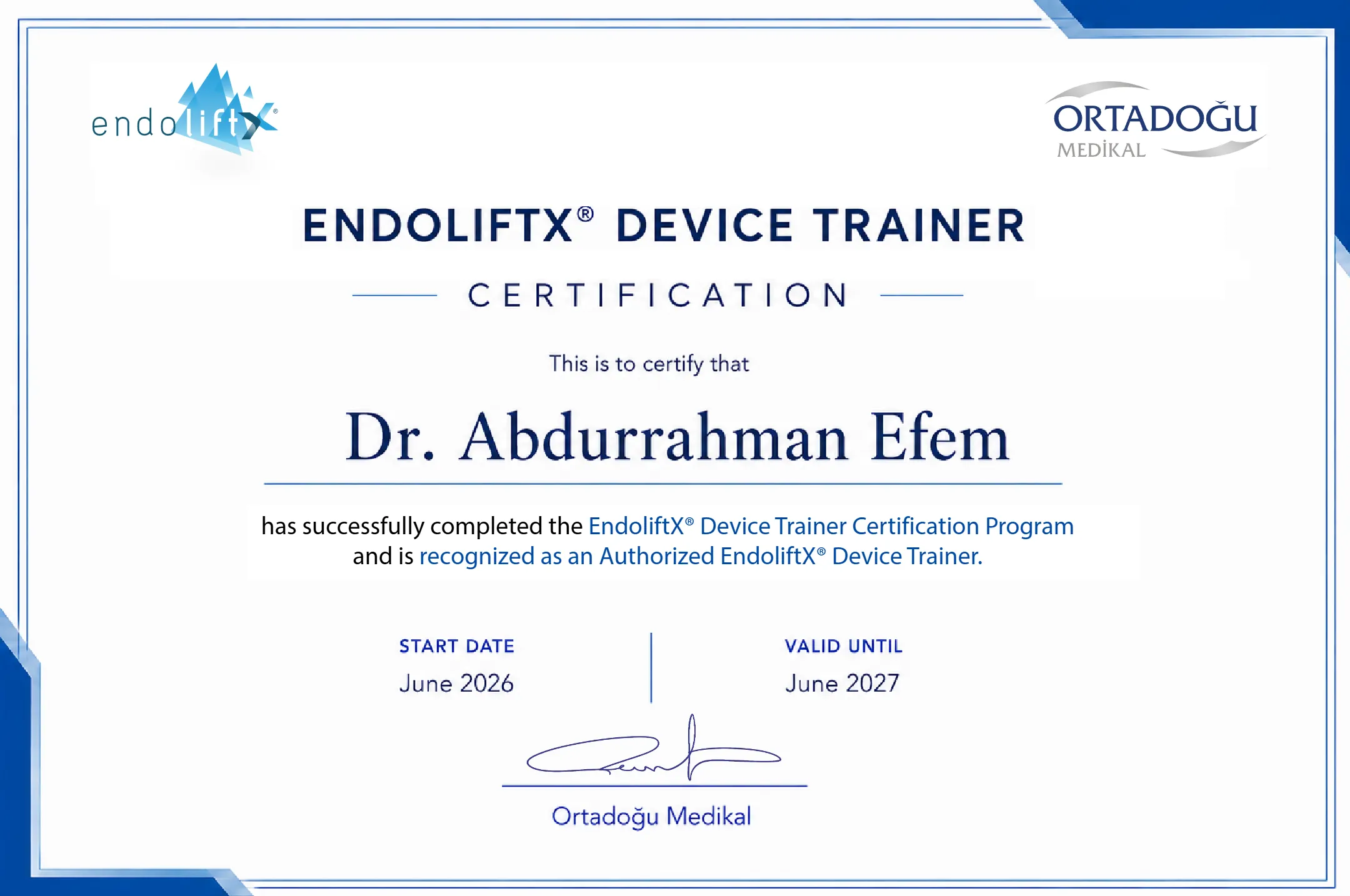
Dr. Abdurrahman Efem’s EndoliftX Trainer Certification
Dr. Abdurrahman Efem holds an EndoliftX trainer certificate. With fibre-based treatments, performing the procedure is only one part of the process; patient selection, anatomical assessment, identification of the target tissue and recognising when treatment may not be appropriate are also important.
For jawline planning, this supports a problem- and tissue-led decision process rather than a device-first approach.
What Is the Difference Between Endolift, Ultherapy Prime and Morpheus8 for the Jawline?
These technologies are not equivalent treatments targeting the same problem at the same tissue layer. The more relevant approach depends on which factor is primarily contributing to the jawline concern.
| Technology | Main Focus | When It May Be Considered |
|---|---|---|
| EndoliftX | Jawline contour, selected localised fat and tissue tightness | When localised fat or mild-to-moderate laxity contributes to reduced definition |
| Ultherapy Prime | Deeper tissue support and lifting planning | When deeper structural laxity is a more relevant concern |
| Morpheus8 | Skin quality, texture and RF microneedling targets | When skin surface and tissue quality are more prominent concerns |
The aim is not to choose the “strongest” device, but to identify which tissue actually requires treatment.
Treatment, Sensation, Recovery and Results
Treatment
Target areas along the jawline are planned according to anatomy, and the fine laser fibre is used in selected tissues in a controlled manner.
Sensation
Pressure, warmth, pulling or brief stinging sensations may occur. Comfort levels vary between individuals and treatment areas.
Recovery
Temporary swelling, tenderness, bruising or tightness may occur. Social recovery varies according to the individual and treatment scope.
Results
Jawline contour and tissue response are assessed progressively. The final appearance depends on individual healing and tissue response.
When Are Endolift Jawline Results Assessed?
An Endolift result should not be considered complete on the day of treatment. Early swelling, tenderness and tissue changes can temporarily influence the appearance of the jawline.
As healing progresses, the contour can be assessed more meaningfully. Collagen remodelling and individual tissue response may also continue to develop over time, so the degree and timing of visible change vary between patients.
Baseline anatomy, degree of laxity, localised fat distribution, skin quality and treatment scope are among the factors that can influence the visible outcome.
How Many Sessions Are Needed? Can Endolift Be Combined with Other Treatments?
There is no single jawline Endolift protocol that applies to everyone. Treatment scope is assessed according to jawline laxity, localised fat, skin quality, facial anatomy and the type of change being considered.
Endolift may be meaningful on its own for some patients. In others, a different approach may be more appropriate when deeper tissue support, skin quality or structural volume is the main concern.
The purpose of combination treatment is not to perform as many procedures as possible. It is to determine whether two genuinely different anatomical concerns require different treatment approaches.
How Is the Cost of Endolift for the Jawline Determined?
A single standard price for jawline Endolift cannot accurately represent every patient. Treatment scope may vary according to individual anatomy and which areas genuinely require treatment.
- The size and scope of the treatment area
- Localised fat distribution around the jawline and under the chin
- Degree of tissue laxity
- Whether one or multiple areas are being planned
- Overall treatment scope
- Whether another approach is also clinically relevant
- Physician assessment and individual anatomy
For this reason, understanding the actual cause of reduced jawline definition is more meaningful than starting with price alone.
Planning Endolift for the Jawline in Istanbul
Efem Clinic is located in Levent, Istanbul and welcomes international patients seeking doctor-led medical aesthetic planning in a private clinic environment.
Photographs shared before travel may help with a preliminary discussion, but they cannot confirm treatment suitability. Final candidacy and the treatment plan require an individual physician assessment.
Appointment timing, travel arrangements and the appropriate length of stay should be verified individually before travel. Final treatment cost also depends on the personalised treatment plan rather than a fixed package.
Privacy and individual planning remain central to the process for both local and international patients.
How Should Jawline Before-and-After Photos Be Interpreted?
Patient privacy is important at Efem Clinic. For this reason, we do not prefer to use patient before-and-after photographs as a routine marketing tool.
In addition, no two patients have identical chin structure, fat distribution, skin quality, tissue laxity or biological response. Lighting, camera angle, head position, facial expression and the timing of photographs can also significantly influence how the jawline appears.
A realistic expectation is therefore better based on the patient’s own anatomy and physician assessment than on another person’s photographs.

Physician Assessment for Jawline Endolift Planning
In Dr. Abdurrahman Efem’s approach, Endolift is not assessed simply as a “jawline procedure”. The balance of the lower face, under-chin area, fat distribution, skin and tissue quality, chin structure, volume that should be preserved and deeper support are considered together.
This means that two people presenting with a similar jawline concern may receive different recommendations. Endolift may be relevant for one patient, while another may be better suited to a different technology, an approach providing structural support, surgical assessment or observation without treatment.
The aim is not to perform more treatment, but to create a plan that responds to the patient’s actual needs while preserving a natural appearance.
Endolift Jawline Assessment at Efem Clinic
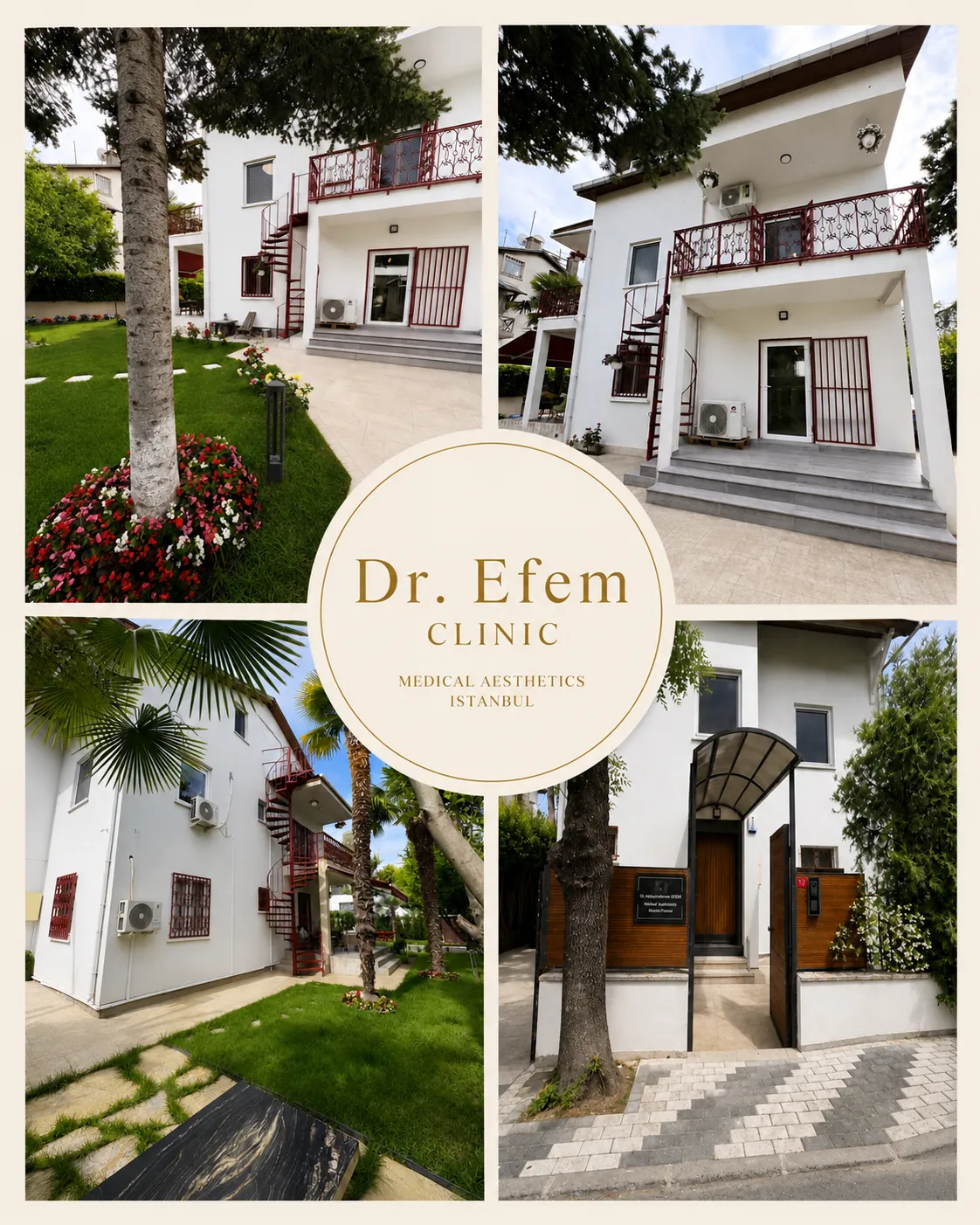
Efem Clinic is a doctor-led medical aesthetic clinic located in a private villa setting in Levent, Istanbul. Individual assessment, privacy and measured treatment planning that respects natural appearance are central to the clinic’s approach.
The purpose of a jawline assessment is not to direct every patient towards a particular procedure. It is to understand the anatomical reason for reduced definition and identify an appropriate treatment only when treatment is genuinely indicated.
Related Guides About the Jawline and Endolift
Common Questions About Endolift for the Jawline
Can Endolift make the jawline more defined?
If selected localised fat or mild-to-moderate tissue laxity is contributing to a softer lower-face contour, Endolift may be considered to support greater jawline definition in suitable patients.
Does Endolift for the jawline make the face slimmer?
The aim is not to make the whole face slimmer. Selected localised fat may be included in the treatment plan when it is affecting contour, while natural facial volume should be preserved.
Does Endolift replace jawline filler?
Not necessarily. Endolift does not add volume. If reduced jawline definition is mainly related to structural or volume support, a different approach may be more relevant.
Can the jawline and double chin be assessed in the same plan?
Yes. The jawline and under-chin area are anatomically related. However, this does not mean that both areas necessarily require treatment; the scope should be based on individual anatomy.
Is Endolift for the jawline suitable for a thin face?
Thin faces or faces with existing volume loss require particularly careful assessment. Unnecessary fat reduction may compromise natural facial volume, so the target tissue should be selected cautiously.
What is recovery like after jawline Endolift?
Temporary swelling, tenderness, bruising or tightness may occur. Recovery and return to social activities vary according to the individual and the scope of treatment.
Is one Endolift session enough for the jawline?
There is no fixed session number that applies to everyone. Treatment and follow-up planning depend on baseline anatomy, treatment scope and individual tissue response.
Is Endolift enough for advanced jawline sagging?
When there is significant excess skin or advanced sagging, the degree of change achievable with a minimally invasive treatment may be limited. Surgical assessment may be more realistic in such cases.
The Right Jawline Treatment Starts with Understanding the Cause
Before choosing Endolift, it is important to understand whether reduced jawline definition is related to localised fat, tissue laxity, structural support or a combination of factors. Photographs may help with a preliminary assessment, but final suitability and personalised treatment planning require physician evaluation.
Treatment suitability, recovery and visible results vary between individuals. Another patient’s result does not guarantee an individual outcome.
About Dr. Abdurrahman Efem
Dr. Abdurrahman Efem
Dr. Abdurrahman Efem is a medical aesthetic physician specializing in facial rejuvenation, non-surgical aesthetic treatments, and regenerative medicine. His approach focuses on enhancing natural beauty through personalized treatment plans designed around each patient's unique features and goals. Dr. Efem works with both local and international patients, emphasizing balanced, natural-looking results and long-term aesthetic wellbeing. This content has been prepared or medically reviewed by Dr. Abdurrahman Efem to ensure accuracy and relevance.